


Ask a dozen pool owners in Dubai whether saltwater or chlorine is better and you will get a dozen confident, contradictory answers. The reason is that most of the debate is built on a misunderstanding: a saltwater pool is not a chemical-free pool. It is a chlorine pool with a clever way of making its own chlorine. Once you understand that, the real questions become practical ones — cost, maintenance, feel, and how each system copes with Dubai’s heat — and the answer gets much clearer.
This guide gives you the full picture: how each system works, what the water actually feels like, what each one asks of you week to week, how Dubai’s climate changes the maths, and the honest drawbacks nobody puts in the brochure. By the end you will know which one suits your household — or whether your existing pool should be converted.
A saltwater pool is a chlorine pool that doses itself
Let us clear up the biggest myth first. A saltwater pool is sanitised by chlorine — the same sanitiser as a “chlorine pool”. The difference is where the chlorine comes from. In a traditional pool, you (or your maintenance technician) add it manually as tablets, granules or liquid. In a saltwater pool, a device called a salt chlorinator makes chlorine from dissolved salt, automatically, every day the pump runs.
This matters because most of the claims made for saltwater — gentler on skin, no harsh smell, no handling chemicals — are really claims about steady, low-level chlorination versus the peaks and troughs of manual dosing. A well-managed traditional chlorine pool with careful dosing can feel very pleasant; a neglected saltwater pool with a scaled-up cell can feel awful. The system sets the pattern, but maintenance decides the result.
So the honest comparison is not “chemicals versus natural”. It is: do you want a system that doses itself steadily (salt), or one where you control every dose by hand (traditional chlorine)? Everything else — cost, feel, maintenance — flows from that choice.
How a salt chlorinator actually works
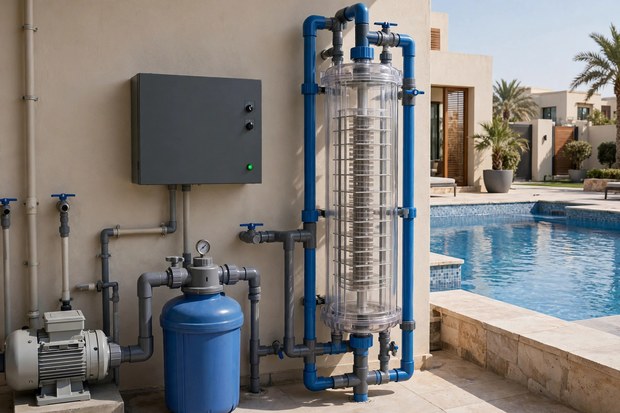
The pool water contains a low concentration of dissolved salt — around 3,000 to 4,000 parts per million, roughly a tenth of seawater, barely enough to taste. As the pump circulates water through the chlorinator’s cell, a low-voltage electric current splits the salt (sodium chloride) to produce chlorine gas, which dissolves instantly and sanitises the water. The process then reverses: once the chlorine has done its job, it converts back to salt, and the cycle repeats.
The control unit lets you dial the chlorine output up or down — higher in August when the heat and bather load are at their peak, lower in January when the pool barely needs sanitising. Most units also have a “boost” or “super-chlorinate” mode for after parties, dust storms or heavy use. It is not magic; it is electrolysis, and it has been keeping pools clean for decades.
What the chlorinator does not do is manage pH, alkalinity or calcium hardness. Those still need testing and adjusting, in saltwater and chlorine pools alike. Anyone who tells you a saltwater pool “looks after itself” is selling you something — usually a chlorinator.
What the water feels like: skin, eyes, hair and swimwear
This is where saltwater usually wins the popular vote. Because the chlorinator produces a steady, low residual instead of the spikes that follow a manual shock dose, most swimmers find saltwater gentler: less eye sting, less of that sharp “pool smell” (which, ironically, is strongest when chlorine is losing the fight against contaminants), and water that feels softer and silkier on the skin.
The difference is most noticeable for people who swim daily — children especially. Hair stays softer, swimwear fades more slowly, and the post-swim itchiness some people get from heavily chlorinated water is rarer. None of this is because saltwater is chemical-free; it is because the chlorine level stays in a narrower, lower band.
That said, a traditional chlorine pool that is tested and dosed properly — not shocked to oblivion once a fortnight — can feel perfectly pleasant. The unpleasant chlorine pool of memory is usually a badly managed one. If your main complaint about your current pool is the feel of the water, the first question is whether it is being dosed well, not which system it uses.
Day-to-day maintenance: what each system actually asks of you
Here the two systems diverge most in daily life. A saltwater pool asks less of you day to day: the chlorinator doses automatically, so there is no handling tablets, no measuring granules, no storing hazardous chemicals at home. You still test the water — pH tends to drift upward in saltwater pools and needs regular acid correction — and you still brush, skim and clean the filter. But the daily chemical chore disappears.
A traditional chlorine pool asks for hands-on attention several times a week: testing, then dosing with tablets, granules or liquid to suit. In Dubai’s summer, chlorine burns off fast under UV, so the routine intensifies from June to September. Many owners hand this to a pool maintenance technician, which solves the effort question but adds the service cost to the comparison.
What saltwater adds to maintenance is the cell. The salt cell needs periodic inspection and cleaning (more on that below), and the control unit’s settings need seasonal adjustment. It is a different kind of work — less frequent, more technical — rather than no work at all.
The salt cell: cleaning, scaling and replacement
The salt cell is the heart of the system — and a consumable. Inside it, coated metal plates carry the current that makes the chlorine. Over time, two things happen: calcium scale builds up on the plates (fast in Dubai’s hard water), and the coating gradually wears off. A scaled cell makes less chlorine; a worn-out cell makes none.
Cleaning is straightforward: the cell is removed and soaked in a mild acid solution to dissolve the scale, typically every few months in Dubai conditions — more often if your water is very hard or the pH runs high. It is a fifteen-minute job once you know how, and any maintenance technician does it routinely. Neglect it, and the system quietly stops sanitising while the control unit insists everything is fine.
Replacement is the big-ticket maintenance item. A cell typically lasts three to seven years depending on use, water chemistry and how hard it is driven (running at 100% all summer wears it faster). When output drops even after cleaning, the cell is done. Factor this into the long-term cost comparison — it is the one expense chlorine pools simply do not have.
Dubai’s heat, sun and evaporation change the rules
Dubai’s climate tilts several parts of this comparison. First, UV burns off chlorine fast. A traditional chlorine pool needs more frequent dosing in summer — sometimes every other day — while a saltwater pool just needs its output turned up, which the controller does at the press of a button. For owners who travel in summer, that automatic adjustment is worth a lot.
Second, evaporation is relentless. As water evaporates, the salt stays behind, so salinity creeps upward; when you top up with fresh water, it dilutes back down. The net effect is usually stable, but after very hot spells it is worth checking the salt level — too low and the cell cannot make enough chlorine; too high and you risk corrosion and taste issues.
Third, hard water. Dubai’s tap water is high in calcium, which means scale — on cells, on tiles, on heaters. Saltwater pools do not cause the hardness, but the chlorinator cell gives scale somewhere conspicuous to form. Keeping pH in range is the main defence, and it matters more here than in soft-water countries. An automatic pH doser, often paired with the chlorinator, earns its keep in Dubai.
Corrosion: the honest drawback of salt
This is the drawback the brochures minimise, so let us be direct: salt water is more corrosive than fresh water. It can attack certain metals — cheap ladders, handrails, light fittings and heater elements not rated for salt — and it can damage soft natural stone coping over time. If your pool has a lot of exposed metal or delicate stone, saltwater needs careful material choices.
The good news is that this is a solved problem. Salt-compatible ladders and fittings (316-grade stainless steel or better), sealed stone, and heaters with salt-rated exchangers handle it fine. For a new build, you simply specify the right materials from the start. For a conversion, the pre-conversion inspection should flag anything that needs upgrading — which is exactly what our site visit covers.
What salt does not do is destroy concrete shells, quality tiles or properly specified equipment. The horror stories almost always trace back to unsuitable materials, not to salt itself. But do go in with open eyes: if your pool is full of bare mild steel and soft limestone, conversion means upgrading those, and that belongs in the quote.
Running costs over time, in general terms
No honest guide can give you exact figures — pool size, bather load, electricity tariffs and chemical prices all move the numbers — but the shape of the comparison is consistent. Saltwater asks for more upfront: the chlorinator, control unit, installation and ideally automatic pH dosing. Traditional chlorine asks for the least at the start — a basic dosing setup is inexpensive.
Year to year, saltwater usually costs less in consumables: a bag of pool salt now and then versus a steady stream of tablets, granules or liquid chlorine, plus fewer emergency shock doses. Electricity is similar for both (the chlorinator uses little power; the pump dominates). The periodic cell replacement — every few years — is saltwater’s big recurring cost, and it roughly offsets some of the chemical savings.
Over a five-to-ten-year horizon, the two systems often end up closer than the upfront figures suggest. Saltwater tends to win on convenience and water feel; traditional chlorine tends to win on simplicity and lowest starting cost. The deciding factors are usually lifestyle, not arithmetic — which is why the sections above matter more than any price table.
Which suits families with children?
Families with children who swim daily are the classic saltwater success story — and for good reason. The softer feel, the absence of harsh chemical handling at home (no buckets of chlorine tablets where curious hands can reach), and the steady water quality all suit busy family life. Children notice the difference in eye comfort immediately.
Two caveats. First, “no chemicals at home” is slightly overstated: you will still keep pH corrector (acid) around, and it needs the same safe storage as any pool chemical. Second, children do not exempt you from maintenance — the cell still needs its schedule, and the water still needs testing. Saltwater makes the routine easier, not optional.
If your children have sensitive skin or eczema that flares in pools, saltwater is often worth trying — many parents report improvement, though the evidence is anecdotal and the steadier chlorine level is the likely mechanism. As always, rinse off after swimming whatever system you use.
Converting an existing chlorine pool to saltwater
Most villa pools in Dubai can be converted without draining the pool or changing the shell. The work is straightforward: install the chlorinator cell in the pipework after the filter, mount the control unit, add pool-grade salt to reach the target concentration, balance the water, and commission the system. A typical conversion takes a day, plus the water-balancing that follows.
Before that, the pool needs a compatibility check: metals, heater, stone coping and the condition of the finishes. Anything unsuitable gets flagged and quoted — better now than after a season of corrosion. The water chemistry also needs attention, because Dubai’s hard water and the existing stabiliser levels affect how the new system is set up.
Converting back is simpler — stop the cell and return to manual dosing — so a saltwater conversion is not a one-way door. For a new pool build, the decision is even easier: tell your builder before finishes are ordered, and salt-compatible materials are specified from the start at little extra cost.
So which one should you choose?
Choose saltwater if: your family swims often and values soft, gentle water; you want the daily dosing to look after itself; you travel in summer and want the system to cope without you; or you are building new and can specify compatible materials from the start. The higher upfront cost buys convenience and comfort.
Choose traditional chlorine if: you want the lowest starting investment; you prefer full hands-on control of every dose; your pool has a lot of existing metal or delicate stone you do not want to upgrade; or you have a reliable maintenance routine (or technician) already and the water feels fine. Simplicity has its own value.
Either way, the system is only half the story. Water that is tested regularly, pH kept in range, and a filter that is cleaned on schedule will feel good and stay safe under either regime. If you would like an honest recommendation for your specific pool — including whether conversion is worth it — a site visit settles it in one appointment.
Frequently asked questions
Is a saltwater pool really chlorine-free?
No — and any guide that says otherwise is misleading you. A saltwater pool is sanitised by chlorine; the salt chlorinator simply manufactures it from dissolved salt instead of you adding it by hand. Anyone selling “chemical-free” saltwater is selling a myth.
Is saltwater genuinely better for skin and eyes?
Most swimmers find it gentler, because the chlorine level stays steadier and lower on average, without the spikes that follow manual shock dosing. Children and daily swimmers notice the difference most. But a well-managed traditional chlorine pool can also feel perfectly pleasant — bad dosing, not the system, causes most irritation.
Will saltwater damage my pool equipment?
It can damage unsuitable materials — cheap metals, heaters not rated for salt, and soft natural stone. With salt-compatible fittings (316-grade stainless or better), sealed stone and a salt-rated heater, it is a solved problem. A pre-conversion inspection should flag anything that needs upgrading.
Do saltwater pools still need maintenance?
Absolutely. The daily chlorine dosing is automatic, but you still test the water, correct pH (which drifts up in saltwater pools), brush, skim and clean the filter — and the salt cell needs periodic inspection and acid-cleaning. It is less daily work, not no work.
Can I convert my chlorine pool to saltwater?
Usually, yes — most Dubai villa pools convert without draining, in about a day: cell and controller installed, salt added, water balanced. The pool needs a compatibility check first (metals, heater, stone, finishes). Converting back is simple, so it is not a one-way decision.
How long does a salt cell last in Dubai?
Typically three to seven years, depending on use, water chemistry and how hard it is driven. Dubai’s hard water means regular descaling; running the unit at 100% all summer wears it faster. When output drops even after cleaning, the cell needs replacing — budget for it as the system’s main recurring cost.
Does a saltwater pool taste salty?
Barely. Pool salinity (3,000–4,000 ppm) is about a tenth of seawater — most people cannot taste it, or notice only a faint softness. If your pool tastes noticeably salty, the salt level is too high and needs correcting.
Which is cheaper to run in Dubai?
Over five to ten years they often end up close. Saltwater costs more upfront (chlorinator, controller, ideally pH dosing) but less in daily chemicals; the periodic cell replacement offsets some savings. Traditional chlorine starts cheapest but needs steady chemical purchases and more hands-on time. Lifestyle usually decides it, not arithmetic.
Can I leave my saltwater pool unattended in summer?
More confidently than a chlorine pool — the chlorinator keeps dosing while you are away, and you can turn output up before you go. But “unattended” still means covered, pump on a timer, and someone checking the water and the skimmer baskets. Automation helps; abandonment does not.
What should I ask a contractor before converting?
Ask: is my heater, stone coping and metalwork salt-compatible (and what needs upgrading)? What size chlorinator are you specifying, and is it sized with headroom for August? Is automatic pH dosing included? What is the cell’s expected life and replacement cost? And what does the quote exclude? The answers reveal whether you are getting a system or just a box.
Related reading: our chlorine guide explains what chlorine actually does in pool water, our pool maintenance guide covers the routine that keeps either system healthy, and our pool chiller guide covers cooling Dubai pool water through summer.