


Dubai is hard on swimming pools in ways that are easy to underestimate until something goes wrong. Relentless sun, high summer heat, fast evaporation, hard water, dust blown in from the desert and year-round chemical treatment all wear on tiles, grout, plaster and equipment at the same time. A pool that looked perfect when you moved in can develop loose waterline tiles, a rough floor, a pump that sounds different or water that stays hazy and each of those symptoms is the pool telling you something specific, if you know how to read it.
This guide is for villa owners who want honest, practical answers about swimming pool repair in Dubai: what is actually wrong, what you can safely check yourself, what needs a technician, and when a repair is enough versus when renovation is the honest answer. It covers the problems owners really ask about, tiles popping off, grout failing, rough or stained plaster, coping and deck cracks, noisy pumps, cloudy water, heater and chiller faults, and slow leaks, with the kind of detail that helps you talk to a repair team as an informed owner rather than a worried one. Nothing here replaces a proper on-site diagnosis, because pools hide their real faults well, but it will help you spot trouble early, avoid the quick fixes that fail twice, and understand what a good repair should look like when it is done properly.
Read the early signs before they become a bigger job
Most pool repairs start small and announce themselves quietly. A tile that sounds hollow when tapped, a thin line of grout flaking at the waterline, a filter pressure reading that has crept above its clean reading, a pump note that has changed slightly, a water level dropping a little faster than evaporation alone would explain, each of these is cheap to deal with when it is caught early and expensive when it is ignored. The habit that saves owners the most trouble is simply paying attention on a regular visit to the plant room and a slow walk around the pool edge: look at the waterline, press a tile or two gently, glance at the pressure gauge, listen to the pump for a few seconds, and check the water level against the skimmer mouth. None of that takes long, and it is how small jobs stay small.
Two checks in particular are worth doing properly. The first is the water level. Dubai’s heat evaporates a noticeable amount of water, so a falling level on its own does not prove a leak, but a level falling faster than evaporation explains, or falling steadily while the weather is unchanged, deserves attention. A simple bucket test helps separate the two: a bucket of pool water stood on a top step, with the level marked inside the bucket and the pool level marked outside it, and both left for a day. Evaporation lowers both by roughly the same amount, while a leak lowers the pool further than the bucket. The second check is the filter pressure gauge. A reading noticeably above the clean-filter reading usually means the filter is loaded with debris and needs cleaning or backwashing, and a pool that stays cloudy after the filter is cleaned is telling you the problem lies elsewhere, in the water balance, in circulation, or in equipment that is no longer moving water properly. Both checks cost nothing, and both give a technician a far better starting point than “the pool looks wrong.”
Tiles popping off and grout failing
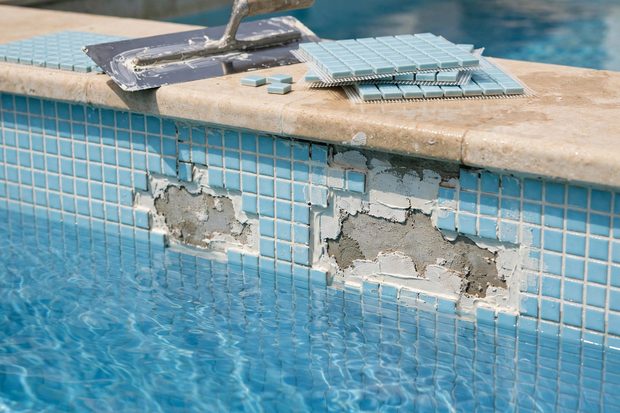
Tile delamination, tiles coming loose from the wall or floor, is one of the most common swimming pool repairs in Dubai, and it is also one of the most misunderstood. It rarely has a single cause. Heat expansion and contraction work the bond daily, pool water and dissolved salts attack adhesive and grout from behind, and in older pools the adhesive originally used was sometimes never designed for permanent submersion at all. The early signs are subtle: fine cracks forming around the tile line, grout thinning or flaking in small areas, a tile that shifts slightly when pressed, or a hollow sound when a tile is tapped. Water slipping behind a tile or a damp patch nearby means the bond has already failed in that spot, and once water is behind the surface, the affected area tends to spread if it is left alone.
The repair itself depends on how far the damage has gone. A few loose tiles, caught early, can typically be removed, the old adhesive cleaned away completely, and the tiles reset with a pool-grade adhesive and waterproof grout, often without draining the pool, since tile work at the waterline and on the walls can commonly be done underwater by a technician equipped for it. That matters, because draining and refilling a pool is disruptive and, on an older shell, not something to do casually. What a good repair team will not do is glue a new tile over a failed base or re-grout a joint that is still damp and dirty underneath; the new tile will simply come off again, usually within months, and the second repair costs more than the first one done properly. When tiles are failing across wide areas of wall or floor rather than in one patch, the honest conversation changes: widespread delamination usually points to a systemic adhesive or waterproofing failure, and at that point patching tile after tile becomes false economy. A full assessment of the shell, the waterproofing and the surface together is the right next step, and that assessment is what separates a repair from a renovation decision.
One habit protects tiles more than any other: steady water balance. Aggressive or neglected chemistry eats grout, seals and plaster alike, and sudden swings in water chemistry weaken bonds faster than steady use ever will. Regular swimming pool maintenance in Dubai that keeps the water balanced, combined with a prompt repair the first time a tile loosens, is what keeps a small tile job from becoming a wall job.
Rough, pitted plaster and stains that will not clean off
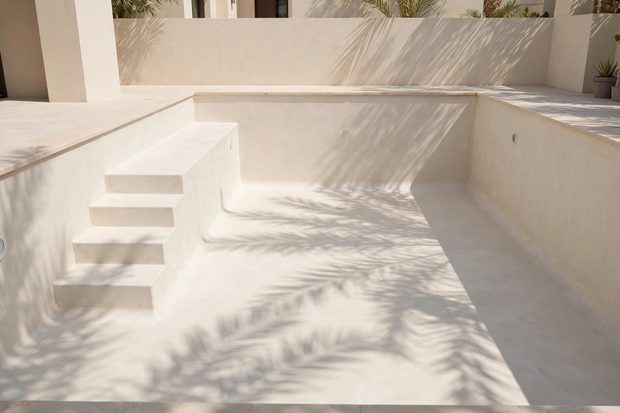
A pool interior should feel smooth underfoot. When the floor or steps turn rough, gritty or pitted, or when swimmers complain of scraped feet, the finish itself has degraded and that roughness is more than uncomfortable. A pitted surface harbours algae in its pores, makes the pool harder to keep balanced, and snags cleaning equipment. The usual causes in Dubai are chemical weathering over time, calcium scale from the region’s hard water building up on the surface, and algae that has rooted into porous grout or worn plaster rather than sitting on top of it. Regular swimming pool cleaning in Dubai keeps a healthy pool clean, but it cannot restore a worn-out finish, and that distinction matters: if the surface is rough or the staining is deep, cleaning harder will not fix it.
Stains deserve the same careful reading. Some stains respond to proper treatment, organic staining from leaves and debris, for example, or light scale at the waterline, while others are effectively part of the surface now. A stain that survives balanced water, thorough brushing and professional cleaning is usually telling you the finish beneath it has changed: metal deposits, mineral scale or algae embedded in worn plaster or grout. In those cases the honest options narrow to resurfacing, where the old finish is stripped back, any shell repairs and waterproofing membrane are dealt with first, and a new plaster or pebble finish is applied over a sound base. Be wary of any offer to plaster over a damaged base without addressing what lies beneath it: new plaster laid over an unrepaired shell crack will typically crack along the same line before long, and a fresh surface over failed waterproofing is a fresh surface waiting to fail. The sequence matters, structure first, membrane second, finish last and a repair team that insists on that order is a team protecting your money, not padding the job.
Coping stones and deck cracks
The coping the cap stones around the pool edge and the surrounding deck take a punishment of their own. In Dubai’s heat, deck surfaces get extremely hot, and stone, mortar and grout expand and contract daily. The most common reason deck and coping repairs fail is that they were done with indoor methods for outdoor conditions: ordinary mortar without room for thermal movement, spot-fixing instead of full-bed mortar, or rigid grout where flexible joints were needed. The result is familiar to many villa owners: coping stones that crack, shift or become loose, deck tiles that pop up, and joints that open and let water underneath, where it quietly destroys the bond from below.
Small, isolated coping damage, a single cracked stone, a short section of failed joint, can typically be repaired or replaced in sections without tearing everything out, provided the base beneath is sound and the replacement allows for movement. But coping that is crumbling, shifting across long runs, or turning into a toe-stubbing obstacle course is a different matter: it is a safety issue before it is a cosmetic one, and full replacement of the affected run, done with proper falls for drainage, full mortar coverage and flexible expansion joints, is usually the right call. The same judgement applies to deck cracks generally. A hairline crack in one slab may be monitorable; cracks that widen, recur after a previous repair, or run alongside a dropping water level point to movement or water damage underneath, and those need investigation before they need cosmetics. If your pool’s coping or deck is cracking and the water level is also falling, mention both symptoms together when you call the combination tells a technician far more than either symptom alone.
The pump: noise, lost power, and failure to prime
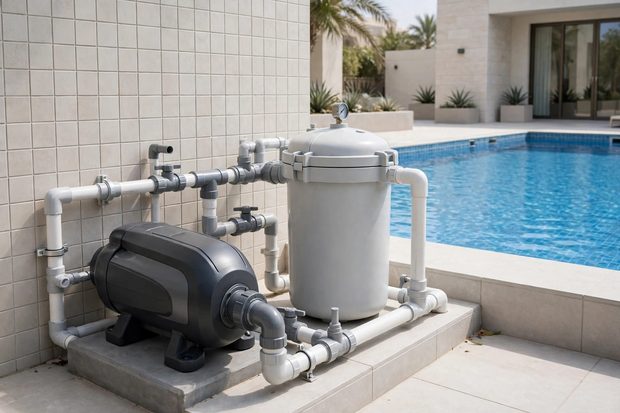
If the pump is the heart of the pool, then a change in its sound is the closest thing a pool has to a heartbeat worth listening to. A healthy pump produces a consistent, low hum. When that sound changes, the type of change points to the type of problem. A loud grinding, crunching or rumbling noise most commonly means failing motor bearings, often corroded after water has reached them through a worn shaft seal and the right response is to switch the pump off, because running a grinding motor on tends to destroy it. A motor that hums but will not start is typically an electrical starting fault, such as a failed start capacitor, while a high-pitched squeal again points to bearings. Weak flow from the return jets, or an automatic cleaner moving sluggishly, points to lost suction and pressure, which can be as simple as a clogged skimmer or pump basket or as serious as a worn impeller or a pump that can no longer hold its prime.
Priming deserves a word of its own, because it confuses many owners. Priming is the pump clearing air from its chamber and filling with water so it can create suction, and a healthy pump should achieve it quickly. A pump that takes a long time to prime, or will not prime at all, is usually struggling with an air leak, commonly a worn lid seal or with a blockage or worn impeller that can no longer generate enough force. A puddle forming directly under the pump, between the motor and the pump housing, is almost always a failed shaft seal, and it is urgent: leaking water corrodes the bearings and can short the motor. The safety rule for all of this is absolute and simple. Before touching any pump component, switch the power off at the breaker. Never attempt electrical work on a pump yourself, and if the pump hums without starting, leaks, or will not turn on at all, switch it off at the breaker and call a technician. A clean basket and a lubricated, well-sealed lid are the owner’s job; capacitors, bearings, seals and motors are the technician’s.
Cloudy water that will not clear
Cloudy or hazy water is the single most common pool complaint, and it is also the one most often misdiagnosed, because cloudiness is a symptom with several very different causes. The usual suspects are a loaded filter, unbalanced water, and early-stage algae, and the order in which you check them matters. Start with the filter: a pressure reading noticeably above the clean reading means the filter is full of captured debris and needs cleaning or backwashing, and no amount of chemical treatment will clear water that is not being filtered properly. Next, test and balance the water, addressing pH and alkalinity before sanitiser levels, because unbalanced water can stay cloudy regardless of what else you do. Then brush the pool surfaces, run the pump continuously until the water clears, and clean or backwash the filter again afterwards, since it will have captured everything the treatment loosened.
The point at which to stop troubleshooting and call a professional is equally clear: if you have cleaned the filter, balanced the water, brushed the surfaces and run the pump, and the water is still cloudy after a day or two, something structural is wrong, circulation that is not reaching part of the pool, a filter with torn cartridges or broken internals that is passing particles back, or an algae bloom rooted in a rough, porous surface that no surface treatment will shift. Persistent cloudiness after proper basic treatment is not a chemistry puzzle to keep guessing at; it is a diagnostic job, and continuing to add chemicals blindly usually makes the water harder to fix, not easier. A technician will check circulation and filtration as a system, pump output, filter condition, skimmer function and return flow, rather than treating the cloudiness as a single chemical number.
Heaters and chillers that stop doing their job
A pool heater or chiller that runs without changing the water temperature is frustrating precisely because everything appears to be working. The checks that owners can safely make are straightforward, and they resolve a surprising number of callouts. First, the settings: a unit set to the wrong mode, or a thermostat set incorrectly, will happily run all day and achieve nothing, and a sensor fault can report a temperature that has little to do with the water. Second, water flow: heaters and chillers depend on steady flow through the unit, and a dirty filter, debris-filled pump or skimmer baskets, or a bypass valve in the wrong position will starve the unit and trip its safety devices. Low flow is the most common cause of a heater or chiller that switches itself off or shows a fault, and it is also the easiest to check, clean baskets, clean or backwash the filter, and confirm valves are set to send water through the unit rather than around it.
Beyond those checks, the work belongs to a technician. Refrigerant faults, reversing-valve failures on heat pumps, flow-switch and pressure-switch faults, blocked evaporator coils and repeated safety lockouts all need proper diagnosis with the right instruments, and guessing at them risks turning a service visit into a replacement. The same applies to airflow: a chiller or heat pump needs clear air around it to move heat, and a unit boxed in by stored items or planting will underperform no matter how well the rest of the system runs. If your unit shows an error code, note the code and the conditions, what mode it was in, whether the filter had just been cleaned, whether the flow felt weak and pass that to the technician. Good fault information shortens the visit and prevents the most expensive outcome in equipment repair, which is replacing a part that was never the problem.
Leaks: the slow damage owners miss
A pool that loses water faster than evaporation explains has a leak somewhere, and the places it hides are remarkably consistent: the shell, a pipe joint, the skimmer throat, a light fitting, or a seal that has finally given up. The skimmer throat deserves special mention because it is the leak most owners miss — a slow, quiet loss at the joint where the skimmer meets the shell, often mistaken for evaporation for months while it undermines the surrounding structure. Light fittings, return jets and every penetration through the shell are similar weak points, and shell cracks, though less common, are the most serious of all. The bucket test described earlier in this guide is the simplest way to confirm a leak exists; finding where it is takes proper diagnosis, typically a pressure test on the plumbing lines, a dye test around fittings and cracks, and a close underwater look at lights, drains and joints.
How the leak is fixed depends entirely on where it is, and this is where quick fixes most often fail. A loose tile and a cracked shell are completely different problems, and treating them the same way is how repairs come back. Tile and grout leaks are surface fixes; a skimmer throat crack is sealed or the skimmer replaced with the joint re-bonded to the shell; a plumbing leak is repaired at the failed joint or section; and a structural crack is bonded from within — commonly by epoxy injection — before any finish goes over it. Whatever the fix, a good repair is tested before the job is called done: a repaired plumbing line is pressurised and held, and a structural repair gets a watched refill with the level marked. If a contractor ever proposes resurfacing over an unrepaired crack, treat that as a red flag, because the new surface will crack along the same line. For the full picture on finding leaks, see our guides on how to find and fix a swimming pool leak and swimming pool leak repair — and if your water level is falling and you cannot explain it, raise it early, because an undetected leak damages far more than the water bill.
What you can safely check yourself — and what needs a technician
Drawing this line clearly keeps owners safe and keeps small problems from becoming dangerous ones. Safe for an owner: skimming and brushing, cleaning skimmer and pump baskets, reading the filter pressure gauge and backwashing or rinsing the filter as its design requires, testing the water and keeping it balanced, watching the water level, listening to the pump, and looking — really looking — at tiles, grout, coping and the plant room on a regular basis. These are the checks that catch problems early, and a technician will thank you for the information they produce.
Everything else belongs to a technician, and the boundary is not about skill but about risk and tools. Electrical work of any kind, including anything inside the pump motor or its controls, is never an owner job. Sealed equipment — shaft seals, bearings, capacitors, refrigerant circuits — needs proper parts and proper diagnosis. Structural cracks, waterproofing failures and anything that requires working underwater or draining the pool need a team that can assess the shell, not just the symptom. And any fault that persists after the basic checks — cloudiness after filter and balance, a pump that will not prime, a heater or chiller that keeps faulting — has stopped being a maintenance task and become a diagnostic one. The most expensive sentence in pool ownership is “I will just try one more thing,” repeated for a month while a seal leak corrodes a motor or a skimmer leak undermines a shell. Calling early is not giving up; it is how a small repair stays a small repair.
When a repair is enough — and when renovation is the honest answer
This is the question owners ask most often, and the honest answer is that it depends on pattern, not on any single fault. A repair fixes a specific fault: a leak at one fitting, a patch of loose tiles, a failing pump seal, a cracked coping stone. A renovation renews the pool as a whole — its surface, tiles, waterproofing and equipment together. The difference shows in the pattern of trouble. One fault, clearly diagnosed and properly fixed, is a repair. The same fault returning after a previous repair, several different faults appearing together, or faults that keep multiplying across the pool, point the other way.
There are clear signs that renovation is the better long-term choice. Widespread tile failure rather than one loose patch, plaster that is rough and stained across the whole interior rather than in one area, structural cracks — especially ones that widen or recur after repair — persistent leaks that survive proper diagnosis and repair, and several ageing systems failing at once, such as a worn surface plus an inefficient pump plus a filter that no longer holds pressure. In those cases, continuing to patch treats symptoms while the underlying system ages underneath, and the cumulative cost and disruption of repeated repairs commonly overtakes the single, properly sequenced renovation. A renovation done properly follows the order that matters: drain the pool, check the shell for structural cracks and repair them, reapply waterproofing where needed, and only then lay the new tiles, plaster or pebble finish, with equipment renewed alongside. For the full picture, see our guide on swimming pool renovation in Dubai, and for what shapes any quotation, our pool cost factors guide. If you are unsure which side of the line your pool falls on, a proper site visit that assesses the shell, the surface, the waterproofing and the equipment together — rather than pricing one symptom — is how you find out, and it is the visit worth having before you commit either way.
How a good repair visit should run
Knowing what a good visit looks like helps you judge the team you hire, and it protects you from the two most common disappointments in pool repair: the fault that returns, and the bill that grows. A good visit starts with diagnosis before treatment. The technician should locate the cause — not just the symptom — and show you the plan before work starts: what is wrong, where it is, what will be done, and how the repair will be tested afterwards. That testing step is the proof, not a formality. A repaired plumbing line is pressurised and held, a structural repair gets a watched refill with the level marked, and a tile repair is checked once the grout has cured, not waved through on the day.
After the repair, the best protection is gloriously boring: steady water balance, because aggressive or neglected chemistry eats grout, seals and plaster alike, and a regular maintenance visit that catches the next loose tile while it is still a small job. A pool that is repaired and then neglected will simply present its next fault sooner, while a pool that is repaired and then maintained properly will often run for years without another visit beyond routine care. If your pool was built by Hello Landscaping & Pools LLC, or if you would like the same team to look after it after a repair, our swimming pool construction and maintenance teams work from the same understanding of how Dubai pools age — and that continuity, from diagnosis through repair to routine care, is what keeps a small repair small.
Related reading: our guide to finding a swimming pool leak and our leak repair guide cover water loss in depth, while our renovation guide explains when a bigger project is the right call.
Frequently asked questions
Why are my pool tiles falling off?
Tiles usually come loose for several reasons working together rather than one single cause. Heat expansion and contraction work the bond daily, pool water and dissolved salts attack adhesive and grout from behind, and in older pools the adhesive originally used was sometimes never designed for permanent submersion. Early signs include fine cracks around the tile line, grout thinning or flaking, a tile that shifts when pressed, or a hollow sound when tapped. Caught early, a few loose tiles can typically be reset with pool-grade adhesive and waterproof grout, often without draining the pool. When tiles fail across wide areas, the problem is usually systemic — a failed adhesive or waterproofing layer — and patching tile after tile becomes false economy, which is when a full assessment of the shell and surface is the right next step.
Can loose tiles be fixed without draining the pool?
Commonly, yes, for localised damage. Tile work at the waterline and on the walls can typically be done underwater by a technician equipped for it, which keeps the work quicker and avoids the disruption of emptying and refilling the pool. That applies to a patch of loose tiles and to re-grouting failed joints, provided the base beneath is sound and properly cleaned first. Deeper damage changes the answer: if the failure runs deep into the surface, or if the shell or waterproofing beneath needs work, partial or full draining becomes necessary. A good repair team will confirm which case applies after inspection rather than promising an underwater fix before seeing the damage.
My pump is making a grinding noise — what should I do?
Switch it off at the breaker and call a technician. A loud grinding, crunching or rumbling noise most commonly means failing motor bearings, often corroded after water has reached them through a worn shaft seal, and running a grinding motor on tends to destroy it. A motor that hums without starting typically points to an electrical starting fault, while a high-pitched squeal also points to bearings. Do not attempt electrical or motor work yourself. Before you call, note what you observed — the type of noise, whether the pump primes, whether water is leaking underneath it, and whether the baskets and filter are clean — because that information helps the technician diagnose the fault quickly and accurately.
Why is my pool water cloudy even after cleaning the filter?
Cloudiness has several causes, and the filter is only the first one to check. If you have cleaned or backwashed the filter and the water is still hazy, the next checks are water balance — pH and alkalinity before sanitiser — and thorough brushing of the surfaces, followed by running the pump continuously until the water clears and cleaning the filter again afterwards. If the water is still cloudy after a day or two of that routine, something structural is wrong: circulation that is not reaching part of the pool, a filter with damaged internals passing particles back, or algae rooted in a rough, porous surface. At that point it is a diagnostic job, not a chemistry puzzle, and adding more chemicals blindly usually makes the water harder to fix.
My heater or chiller runs but the water temperature is not changing — what is wrong?
Start with the checks you can safely make: the thermostat and mode settings, which are wrong more often than owners expect, and water flow, which heaters and chillers depend on entirely. A dirty filter, debris-filled pump or skimmer baskets, or a bypass valve set to send water around the unit rather than through it will starve the unit and trip its safety devices, so clean the baskets and filter and confirm the valves are set correctly. Also check that air can move freely around the unit. If the unit still faults, shows an error code, or works in one mode but not the other, the fault is likely in the refrigerant circuit, a valve, a flow or pressure switch, or a sensor — all of which need a technician with proper diagnostic instruments. Note any error code and the conditions when it appeared, and pass that to the technician.
How do I know if my pool is leaking or just evaporating?
Use the bucket test. Stand a bucket of pool water on a top step, mark the water level inside the bucket and the pool level outside it, and leave both for a day. Evaporation lowers both by roughly the same amount, while a leak lowers the pool further than the bucket. If the pool has dropped more, you have a leak, and the usual hiding places are the skimmer throat, light fittings, return jets, pipe joints and shell cracks. Finding the exact source takes proper diagnosis — typically a pressure test on the plumbing lines, a dye test around fittings and cracks, and a close underwater inspection. Raise a confirmed leak early, because an undetected leak quietly damages the surrounding structure while it is mistaken for evaporation.
What can I safely check myself before calling a technician?
Skimming and brushing, cleaning skimmer and pump baskets, reading the filter pressure gauge and backwashing or rinsing the filter as its design requires, testing the water and keeping it balanced, watching the water level, listening to the pump, and visually checking tiles, grout, coping and the plant room. These checks catch problems early and give a technician a far better starting point. Everything else belongs to a technician: any electrical work, sealed equipment such as shaft seals, bearings, capacitors and refrigerant circuits, structural cracks, waterproofing failures, anything requiring underwater work or draining the pool, and any fault that persists after the basic checks. The boundary is about risk and tools, not about skill, and respecting it is what keeps a small repair small.
When is a repair enough and when does my pool need renovation?
Look at the pattern, not any single fault. One clearly diagnosed fault — a leak at one fitting, a patch of loose tiles, a failing pump seal, a cracked coping stone — is a repair. The same fault returning after a previous repair, several different faults appearing together, widespread tile failure, plaster that is rough and stained across the whole interior, structural cracks that widen or recur, persistent leaks, or several ageing systems failing at once all point toward renovation. A renovation done properly follows a strict order: drain the pool, repair the shell, reapply waterproofing where needed, and only then lay the new finish, with equipment renewed alongside. If you are unsure which side of the line your pool falls on, a site visit that assesses the shell, surface, waterproofing and equipment together is how you find out before committing either way.
Why do stains keep coming back after cleaning?
Because the stain is no longer only on the surface. Stains that survive balanced water, thorough brushing and professional cleaning are usually embedded in a worn finish — metal deposits, mineral scale from hard water, or algae rooted in porous grout or degraded plaster. Cleaning removes what sits on top; it cannot restore a surface that has itself changed. In those cases the lasting answer is resurfacing: strip the old finish back, deal with any shell repairs and waterproofing first, and apply a new plaster or pebble finish over a sound base. Steady water balance after the work matters just as much, because aggressive or neglected chemistry will stain and degrade a new finish in the same way over time.
How do I stop the same repair failing again?
Fix the cause, not just the symptom, test the repair before the job is called done, and maintain the pool properly afterwards. That means a diagnosis that locates where the fault really is, a repair plan shown to you before work starts, and proof afterwards — a pressurised plumbing line held, a structural repair watched through a marked refill, a tile repair checked once the grout has cured. Afterwards, steady water balance and a regular maintenance visit catch the next loose tile or rising pressure reading while it is still a small job. If you would like that kind of visit for your pool, Hello Landscaping & Pools LLC offers a free site visit across Dubai — message us on WhatsApp or call and we will arrange it, and for any pricing questions we will give you an exact quote after seeing your pool.


