


Type “swimming pool companies in Dubai” into a search engine and you will get a long list of firms that all say almost exactly the same thing: design, build, maintain, best quality, best service. Their websites show similar photographs, their brochures promise similar results, and their first meetings often sound similar too. Yet the pools those companies actually deliver — and the experience of having one built — can differ enormously. One company owns the whole job with its own engineers and site teams. Another is, in effect, a sales operation that wins the job and hands the work to whoever is cheapest that week. A third is a maintenance firm that takes on a build now and then. All three can appear on the same search page, and the difference between them only becomes obvious once you know how to compare.
This guide is a comparison method, not a list of names. It explains how to shortlist swimming pool companies in Dubai properly, how to read their quotes line by line, what to check before you hire, which questions to ask on a site visit, and which warning signs should make you walk away. It answers the questions buyers really ask in community discussions and forums: how many companies to compare, how to spot what a quote leaves out, who should handle approvals, whether one company should design, build and maintain, and how to tell a genuine track record from good marketing. Work through it before you sign anything, and use it as a scorecard in every meeting.
 Related reading: our pool cost factors guide explains what shapes a quotation, our renovation guide covers what to check when an older pool needs work, and our pool chiller guide covers heating and cooling for year-round swimming.

Define your own brief before you contact anyone
Comparison only works when every company is answering the same question. Before you contact anyone, write down what you actually want: a new pool on an empty plot, a renovation of an existing pool, or ongoing care for a pool that is already built. Note the approximate size and shape you have in mind, whether you want features such as an infinity edge, a beach entry, water features or a spa, and whether heating or cooling matters for year-round swimming. Note the practical constraints too: the size of your garden, how machinery would reach it, and whether your community has rules about pool placement, fencing or working hours. That short brief does two things. First, it stops each company from steering you toward whatever it prefers to sell, because you can hand every one of them the same document and compare like with like. Second, it makes their proposals genuinely comparable: when every quote responds to the same brief, the differences between them are real differences in scope, specification and service, not differences in what was assumed. Send the same written brief to each shortlisted company, including photographs of the garden, the plot’s basic measurements, and anything you already know about access, soil or existing services. A company that responds to your brief in detail is already showing you how it will handle the job; a company that ignores the brief and sends a generic brochure is showing you something else.Build a shortlist from evidence, not from advertising
Start with referrals and real work, not with whoever ranks highest or shouts loudest. Ask neighbours, friends or community-group members who have recently built a pool about their experience — not just whether they like the finished pool, but how the build itself went, whether the timeline held, and whether problems were fixed promptly. Then look at each company’s own evidence: a professional website with photographs of completed pools, case descriptions that name the type of work rather than hiding behind slogans, and clear contact details including a physical presence. Be wary of websites that rely heavily on general marketing language but show little real work, and of portfolios made up of computer renders rather than finished pools. Renders show what a company hopes to build; photographs of completed pools show what it has actually built. Look for variety and depth: pools of a similar scale and complexity to yours, in similar villa communities, with finishes that have had time to age. A shortlist of two or three credible companies is plenty. More than that, and the comparison becomes unmanageable; fewer, and you have nothing to compare against. Shortlist on credibility — licence, completed work, verifiable testimonials, and longevity in Dubai — and only then invite proposals.How to read reviews without being misled by them
Reviews are useful, but only read properly. Star ratings alone tell you very little: read the words, and look for themes that repeat across many reviews rather than a single glowing or angry post. The themes that matter most are the ones Dubai homeowners keep returning to — delayed timelines with little communication about the delay, finishing details that disappointed after a promising start, and post-construction questions that went unanswered. If the same complaint appears again and again, treat it as information about how the company operates, not as bad luck. Also notice what is missing. A company with no reviews at all, or with reviews that never mention a specific project, timeline or person, has not yet given you anything verifiable. And remember that a review of a cleaning visit tells you nothing about a build: judge a construction company on construction reviews, a maintenance company on maintenance reviews, and be cautious when a company leans on praise for one kind of work to sell you another. The most valuable review of all is a conversation: a past client willing to speak to you directly, which is covered later in this guide.Check the licence and who handles the approvals
Before anything else, confirm the company is properly licensed to carry out swimming pool work in Dubai. That means a valid trade licence covering swimming pool or building works, issued through the Department of Economic Development (DED). A legitimate company will show you the licence without hesitation, along with examples of permits it has secured. If a company is vague or evasive about paperwork, treat that as an early warning, not a minor detail. An unpermitted pool can mean fines, forced rework and serious problems when you eventually sell the villa, because the pool will not appear correctly on the property’s approved record. Then ask who files each approval, because in Dubai a pool build touches several authorities and a good company acts as your paperwork agent through all of them. Every private pool must be registered with Dubai Municipality through the Building Permits System before any digging starts, with structural and MEP drawings covering the site plan, the pool structure, the plant room, pipework and electrical layout. If your villa sits in a master community, you will also need a No Objection Certificate (NOC) from the developer — Emaar, Nakheel or whoever manages your community — and community approval often takes longer than the municipality permit, so it should start early. DEWA sign-off covers the electrical and plumbing connections, Dubai Civil Defence clearance applies where fire and safety systems are involved, and if your property falls in a PCFC zone such as Palm Jumeirah, Trakhees is the approving authority instead of Dubai Municipality. Ask every company, in plain words: who files each of these, who chases them, and what happens to the programme if one of them comes back with comments? A company that files these routinely will answer immediately and in specifics. One that tells you to handle permits yourself, or suggests they are not needed, is a company to leave alone.One company or three: design, build and maintenance
One of the most useful questions in any comparison is also one of the least asked: who designs the pool, who builds it, and who comes back afterwards? Some companies are design-build firms: the same organisation designs the pool, engineers it, builds it and maintains it afterwards, so accountability sits in one place. Others are, in effect, sales operations: they win the job and then hire whatever labour is cheapest that week. Others still are specialists in only one part — a design studio that hands the build to another company, a general builder that subcontracts the pool as one package among many, or a maintenance firm that takes on a build now and then. None of those models is automatically wrong, but the comparison changes with each. When design, build and servicing sit with three different companies, a defect becomes everyone’s problem and therefore nobody’s: the designer blames the builder, the builder blames the drawing, and the owner is left in the middle. When one company keeps design, engineering, site teams and aftercare under one roof, the technician who visits in year three knows the pool from its drawings and can spot a small problem — a pressure reading creeping up, a weir door sticking — before it becomes a re-tile. Subcontracting a specialist element to a qualified firm is normal in construction; handing the whole build to the cheapest available labour is not. So ask every company directly: which parts of the job will your own staff do, which parts go to someone else, who supervises the site day to day, and who returns after handover? The answer tells you more than any portfolio.Visit real pools and talk to past clients
Anyone can publish polished photographs. What matters is completed work you can actually see and, ideally, stand beside. Ask each shortlisted company to show you finished pools that resemble what you want in scale, style and complexity, and ask to visit at least one. Older projects are especially revealing, because they show how the work has aged — how the tile has held up through Dubai summers, whether the deck has stayed level, whether the waterline still looks clean. Then go one step further than most buyers do and speak to that pool’s owner. Ask about the build, not just the result: was communication clear, was the project finished when promised, did problems arise, and how were they fixed? Would they sign with the same company again? Listen most closely to the third answer, because every build has a problem — a delivery arrives in the wrong shade, an inspector asks for a change, a pipe run needs rethinking. What you want to hear is a short story with an ending: “they came back the next morning” is a good answer, and “we are still discussing it” is not. Also ask whether the owner stayed with the company for maintenance afterwards. Owners who stay with their builder for aftercare are telling you the relationship survived the build, which is one of the strongest signals a company can offer. If a company cannot produce a single owner willing to speak, that silence is itself an answer.Compare quotes line by line, not headline by headline
The most expensive mistake in pool buying is comparing headline numbers instead of scopes. A pool dispute is almost always a scope dispute: something was assumed, not written down, and the argument starts when it appears as an extra charge. The practical way to compare is a one-page comparison sheet: one column per company, one row per checklist item, filled in as each quote arrives. Ask each company to explain any line marked excluded or left as an allowance before you sign anything, and if a company will not itemise or explain a gap, treat that as a signal. What belongs on that sheet? The shell method and how it is engineered for your plot. The waterproofing system, named, plus whether a witnessed water test before tiling is included. The equipment by name and category — pump, filter, chlorination, heating or chilling, lighting — because equipment quality governs circulation, water treatment and future servicing costs. The finishes: tile or interior type, coping stones, deck material and extent. The electrical and plumbing connections, including who carries out the DEWA-related work. Excavation and disposal, including what happens if the dig meets rock, groundwater or an unmarked service. Testing and commissioning, and the handover package: as-built drawings, warranty documents, equipment manuals and water-chemistry guidance. And the commercial terms: payment stages tied to completed milestones, the written programme, and warranty terms. Compare those lines across companies, not the final numbers alone. When two quotes describe the same pool on every line, the cheaper one may genuinely be better value. When they do not, the cheaper one is usually cheaper because something is missing.Read the exclusions: the quiet lines that change the total
Two quotes can differ enormously and still describe what looks like the same pool, because of two quiet problems: exclusions and allowances. An exclusion is work not included in the quote. An allowance is a placeholder figure for something undecided, and allowances have a habit of running over. Both deserve the same treatment: get them in writing, and ask what happens if the allowance is exceeded. The exclusions buyers most often discover too late are worth checking explicitly. Are authority fees and developer charges included, or yours to pay? Is safety fencing included, or only the pool itself? How far does the decking extend beyond the coping, and is landscaping and making good the garden included after the build? Are the final electrical hookups and utility connections in scope, or will you need a separate electrician and plumber? Does standard excavation cover rock or a high water table, or are those charged separately when encountered? Is the pool cover and its roller supply-only, leaving assembly to you? None of these items makes a company dishonest for excluding it — but a company that does not volunteer its exclusions, or cannot list them when asked, is not giving you a comparable quote. Add a realistic allowance for every excluded item to each total before you compare, so the totals reflect the same finished project. The same discipline applies to payment. Payments are normally staged against completed milestones — design approval, shell completion, tiling and finishes, commissioning and handover — rather than paid as one lump sum upfront. A company asking for full payment before excavation starts is a warning sign, and a written programme showing what happens at each stage, and what triggers each payment, is something a serious company provides without being asked. And read the change process in writing: variation orders are normal in construction, but surprise variation orders are not. A company that explains, before you sign, how a mid-build change is requested and priced has run this conversation honestly many times before.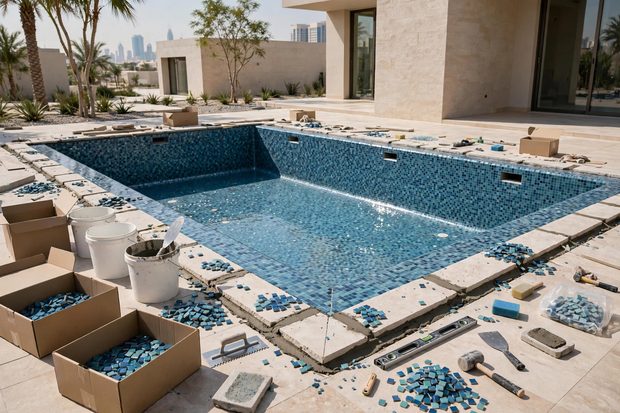
The specification underneath: where quality hides
The tile you see is the smallest part of the job. What decides how long a pool lasts is underneath it: the shell, the waterproofing, the hydraulics and the plant. This is the section to slow down on when comparing companies, because it is where a cheap quote quietly saves its money — and where both savings stay invisible until they fail. Start with the shell. A reinforced concrete shell, built by shotcrete or gunite spraying, is the standard for custom villa pools in Dubai because it can be shaped freely and engineered for local soil and groundwater conditions. A fiberglass shell is a factory-made alternative: faster to install and smooth to the touch, but limited in shape and size, and it still needs correct ground preparation and backfill to avoid movement. Whichever route is proposed, ask how the shell is engineered for your plot, what curing regime is specified, and how movement and settlement are handled. Then ask about waterproofing, because this is the single most critical step in Dubai’s climate. A proper system uses a waterproofing membrane applied to a correctly prepared shell, and — critically — a witnessed water test before any tile is fixed: the shell is filled and left standing with the level marked, so any drop is caught while it is still cheap to fix. Any company that wants to tile over an untested shell to save a few days is telling you something about its priorities. Next, the hydraulics and the plant room. Permit drawings are commonly checked against a water turnover of four hours or less — the whole volume of the pool passing through filtration within that time — with pumps, filters and pipework sized to achieve it. Ask which pump and filter are specified by name, not just by category, and whether the plant room is laid out so a technician can reach every valve, union and electrical connection without dismantling half the room. The same applies to the choices that shape your running costs and daily experience: a salt chlorinator versus traditional chlorine dosing, automated dosing and testing versus manual checks, a heat pump or pool chiller for summer comfort, LED lighting, and the finish itself — mosaic tiles, porcelain tiles or a plaster interior — each of which behaves differently under Dubai heat, sun and heavy chemical use. A good company explains these trade-offs for your villa specifically, rather than handing you a catalogue page. Finally, the finishes and details that separate careful work from rushed work: coping stones that sit level and shed water away from the pool, a deck that drains properly instead of puddling, skimmer or overflow-edge detailing that keeps the waterline clean, and lighting positions planned before the shell is poured rather than improvised afterwards. None of this appears in a render. All of it is what you will look at every day for years.Warranties in writing, before you sign
Warranties separate confident builders from those hoping you never call back, but only the written warranty counts. Verbal assurance is worth nothing when a defect appears in year three. A serious swimming pool company in Dubai stands behind the work in writing, and the document should distinguish clearly between its parts. The structural warranty covers the pool shell and the waterproofing — the parts that are hardest and most expensive to fix — and on a well-built pool it runs for several years. Equipment warranties on pumps, filtration, heating and chlorination are usually the manufacturers’ warranties, passed through by the company, and they run for their own periods. Workmanship cover deals with tiling, finishes and plumbing. Each of these should state its length, its exact coverage, and — just as important — what voids it: unauthorised alterations, poor water chemistry left uncorrected, or servicing by unqualified hands are common exclusions, and you should know them before you sign, not after a claim is refused. Two further questions complete the picture. First, who services the warranty — the company itself, or a third party you have never met? A warranty serviced by the company that built the pool is worth more than one serviced by whoever answers the phone. Second, what does the handover actually include? A proper handover gives you as-built drawings, warranty documents, equipment manuals, water-chemistry guidance and a schedule for the first months of maintenance — not just a set of keys and a wave. If a company cannot show you a sample warranty document and a handover checklist before you sign, it has not finished designing its own aftercare, and you will be the one who discovers that.Timelines and communication: judge honesty, not optimism
Ask for a written programme before work begins, and judge it by its honesty rather than its optimism. A realistic Dubai villa pool runs in two phases. First, design and approvals: drawings prepared, developer NOC obtained, municipality permit issued, a process that commonly takes several weeks and can take longer when a submission comes back with comments or when the developer’s review track runs separately. Second, the build itself: excavation, steel and shotcrete, curing, waterproofing and water testing, tiling and finishes, plant installation, commissioning and handover — a standard villa pool commonly takes a few months on site once the permit is in hand, with larger or more complex designs, infinity edges with balance tanks, and imported finishes all extending the programme. Two things most often knock that programme off course. The first is incomplete or non-compliant permit submissions, which is why the approvals conversation in this guide comes first, not last. The second is fragmented teams: when design, approvals and execution sit with different companies, each handoff is a delay waiting to happen, and nobody owns the gap between them. The other common cause of slippage is imported tile and finishes with long lead times — worth asking about explicitly if your design depends on a specific imported product. And throughout, judge the company by its communication: the complaint Dubai homeowners repeat most is not that a project slipped, but that nobody told them it had slipped. A company that reports progress against milestones, and flags a delay the week it appears rather than the month after, is worth more than a company that merely promises the earliest date.After handover: the part buyers forget to compare
A pool’s real cost of ownership starts the day it is filled. Water balancing, filter service, equipment life, cleaning and chemical dosing are not afterthoughts; they are the running reality of the pool, and they should be compared before the contract, not discovered after it. Ask who maintains the pool once it is built, and on what terms. An annual maintenance contract with a named schedule — regular visits, water testing and balancing, filter cleaning, equipment checks — keeps a healthy pool healthy, and it keeps the same technician visiting your pool, which is how small problems get caught early. Ask what happens when something goes wrong between visits: who answers, how quickly, and whether the person who answers is the company that built your pool or a call centre reading from a script. This is also where the cheapest build quietly becomes the most expensive pool. A poorly balanced pool damages finishes and equipment; a neglected filter strains the pump; an unserviced chlorinator drifts out of calibration and the water turns. None of that appears in a construction quote, and all of it is why the aftercare conversation belongs in the comparison, not after it. If you are comparing two companies and one of them talks seriously about maintenance, water chemistry and the first year of ownership while the other only talks about the build, you have learned something important about both of them. For ongoing care, see our guides to swimming pool maintenance in Dubai and swimming pool cleaning in Dubai, and if you are weighing heating and cooling for year-round swimming, our pool chiller guide covers that decision in depth.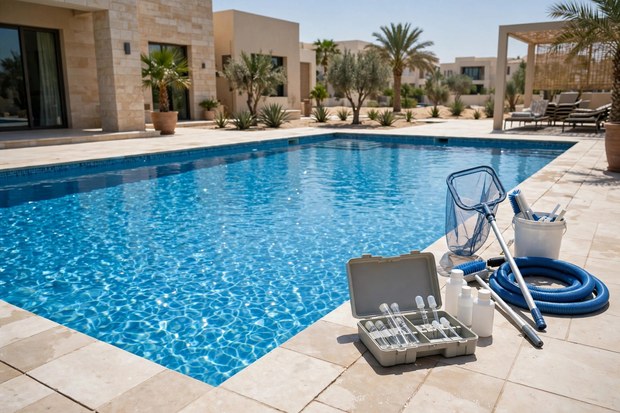
Red flags that should make you pause
Most bad pool experiences announce themselves early, if you know what to listen for. Be cautious when a company is evasive about its licence or about past permits, when its portfolio is renders rather than real finished pools, or when it cannot name a single past client willing to speak to you. Be cautious when the scope is vague — no named equipment, no waterproofing system described, no payment stages, no written programme — because vagueness at quotation stage becomes dispute at construction stage. Be cautious when you are pressed to sign quickly; good companies are busy, and they do not need to lock you into a decision before you have had time to do your research. Be cautious when the price is dramatically lower than every other quote without a clear explanation of what is different, and when full payment is demanded before excavation. And be cautious when approvals are dismissed as unnecessary or offered as something you should handle yourself: in Dubai, approvals are the builder’s job, and a company that will not own them will not own the delay when they go wrong either. None of these signs alone proves a company is bad. Together, they are a pattern worth respecting.Questions to ask on your own site visit
The site visit is where comparison becomes concrete, because a company that has walked your plot can no longer hide behind generic answers. Use the visit to test everything this guide has covered, on your own ground. Ask the visitor to walk the plot with you and talk through setbacks from the boundaries, soil and groundwater conditions, how excavation machinery and delivery trucks will reach the garden, and where the plant room will sit so a technician can actually service it. Ask how drainage for backwash water will be handled inside your plot, and what safety provisions are planned where children are present, such as a barrier with self-closing, self-latching gates. Then ask the commercial questions while you are standing on the plot: what exactly is included in the quotation and what is excluded, who files the municipality permit and the developer NOC and how long each commonly takes, who will be on site day to day and who supervises them, what the payment stages are, and what the written warranty covers and excludes. Ask what happens if the excavation meets rock or groundwater, how a mid-build change is priced, and what the handover package contains. A serious company answers these on the spot, in specifics, and follows up with an itemised written proposal. A company that cannot answer them on your own plot has not really surveyed your job — and its quotation, however attractive, is a guess.Making the decision
If you have read this far, you are already doing the single most useful thing a buyer can do: slowing the decision down long enough to compare properly. Shortlist two or three licensed companies, send all of them the same written brief, put the same questions from this guide to each of them, and compare their itemised scopes line by line on your comparison sheet. Visit one finished pool from each, speak to one past client from each, and read each warranty document before you sign. Then weigh the whole picture, not the headline figure: licence and approvals record, who actually does the work, the specification underneath the tile, the completeness of the quote, the honesty of the programme, the strength of the warranty, and the quality of the aftercare. The right company will welcome every question in this guide. That reaction, more than any brochure, is the signal to trust. Hello Landscaping & Pools LLC welcomes every question in this guide — message us on WhatsApp to arrange a site visit and walk your plot through this checklist with us. And if one company stands out on the lines that matter — while another wins only on the headline number — you have your answer. A pool is a permanent structure you will live with for decades; the few weeks spent comparing properly are the cheapest insurance you will ever buy for it.Frequently asked questions
How many swimming pool companies should I compare in Dubai?
Two or three credible companies is plenty. Shortlist on licence, completed work, verifiable testimonials and longevity in Dubai, then send all of them the same written brief so their proposals are genuinely comparable. More than three makes the comparison unmanageable, and fewer gives you nothing to compare against. What matters is not how many companies you speak to, but that each one answers the same questions: licence and approvals, who does the work, itemised scope, named equipment, payment stages and written warranty terms.Should I choose the cheapest quote for my pool?
Not on the headline figure alone. On a pool, a dramatically lower quote usually achieves its saving in exactly the two places you cannot see: waterproofing and plant. Thinner membranes, unnamed pumps, smaller filters and skipped water tests are all invisible on handover day and expensive later. Compare itemised scopes line by line instead: when one quote is much lower, ask precisely what has been left out, add a realistic figure for every excluded item, and only then compare totals. Value, not price, is what you live with for decades.What should a swimming pool quotation include?
Everything, named. A proper quotation is itemised: shell method, waterproofing system, equipment by name and category, finishes, electrical and plumbing connections, excavation and disposal, testing and commissioning, and the handover package — plus payment stages tied to completed milestones, the written programme, warranty terms, and a clear statement of exclusions and of who pays authority and developer charges. If a quotation is a single figure with no breakdown, you cannot compare it with anything, and you cannot hold anyone to it later.How do I check a pool company is licensed in Dubai?
Ask to see its trade licence covering swimming pool or building works, issued through the Department of Economic Development, and ask for examples of permits it has secured. A legitimate company shows both without hesitation. Also confirm it can submit drawings to Dubai Municipality through the Building Permits System and to your community developer. If a company is vague or evasive about its licence or past permits, treat that as an early warning, not a minor detail.Who handles Dubai Municipality approval and the developer NOC?
Your contractor should handle both as part of the build. Every private pool must be registered with Dubai Municipality through the Building Permits System before digging starts, and villas in master communities also need a No Objection Certificate from the developer, which often takes longer than the municipality permit. DEWA sign-off covers electrical and plumbing connections, Dubai Civil Defence clearance applies where safety systems are involved, and PCFC zones such as Palm Jumeirah are approved by Trakhees instead. If approvals are offered as something you should handle yourself, that is a warning sign.Is it better if one company designs, builds and maintains my pool?
Usually, yes, because accountability sits in one place. When design, build and servicing sit with three different companies, a defect becomes everyone’s problem and therefore nobody’s. When one company keeps design, engineering, site teams and aftercare under one roof, the technician who visits in later years knows the pool from its drawings and can spot small problems before they become expensive repairs. Subcontracting a specialist element to a qualified firm is normal; handing the whole build to the cheapest available labour is not — so ask every company which parts its own staff will do and which parts go to someone else.What should I ask a pool company’s past clients?
Ask about the build, not just the result: was communication clear, was the project finished when promised, did problems arise, and how were they fixed? Would they sign with the same company again? Listen most closely to how problems were handled, because every build has one — a short story with an ending, such as “they came back the next morning”, is a good answer, while “we are still discussing it” is not. Also ask whether the owner stayed with the company for maintenance afterwards, since owners who stay are telling you the relationship survived the build.What warranty should I expect from a pool company?
Expect it in writing, with its parts distinguished. The structural warranty covers the pool shell and waterproofing and, on a well-built pool, runs for several years. Equipment warranties on pumps, filtration, heating and chlorination are usually the manufacturers’ warranties passed through by the company, each with its own period. Workmanship cover deals with tiling, finishes and plumbing. Read the exclusions as carefully as the coverage, and confirm who services the warranty — the company that built the pool, or a third party — before you sign.How long does comparing companies and building a pool take?
Allow proper time for both stages. Comparing companies — shortlisting, site visits, itemised proposals and reference checks — is worth several weeks of careful work, and rushing it is how buyers end up with the wrong builder. Once you sign, approvals commonly take several weeks, and the build itself commonly takes a few months on site for a standard villa pool once the permit is in hand, with larger or more complex designs and imported finishes extending the programme. Be wary of any timeline that skips curing and water testing to sound faster.What are the biggest red flags when comparing pool companies?
Evasiveness about the licence or past permits, a portfolio of renders rather than real finished pools, and no past client willing to speak to you. Vague scopes with no named equipment, no waterproofing system, no payment stages and no written programme. Pressure to sign quickly, a price dramatically lower than every other quote without explanation, full payment demanded before excavation, and approvals dismissed as unnecessary or left to you. None of these signs alone proves a company is bad, but together they are a pattern worth respecting — and a reason to choose a different company.Related reading: our best contractors guide and our contractor vetting guide help you shortlist builders, and our pool cost factors guide explains what shapes a quotation.

