

Ask ten villa owners in Dubai what their swimming pool cost, and you will hear ten very different answers — and nearly all of them will be honest. That is the first thing to understand about swimming pool cost in Dubai: there is no single price for a pool, no official tariff, and no meaningful figure that applies to every villa. A pool is a permanent structure, engineered for a specific plot, approved by specific authorities, and finished to a specific standard. Its cost is the sum of dozens of decisions, and two pools that look identical in a photograph can differ enormously underneath the tile. This guide explains, in detail, what actually drives the cost up or down, why quotes for the “same” pool can sit far apart, where a cheap quote usually hides its savings, what a proper itemised quotation should list, and what a pool costs to run once it is filled. It answers the questions Dubai villa owners really ask — in community groups, on forums, and on site visits — and it ends with how to get an exact quote for your own villa, rather than a guess.
One promise first, because it shapes everything that follows: this guide contains no price figures at all. That is deliberate. Any article that prints a single figure for “a pool in Dubai” is either describing one specific pool in one specific garden, or it is guessing. Figures age quickly, they ignore your plot, and they anchor your expectations to a number that was never yours. What this guide gives you instead is the full picture of cost factors, so that when quotations arrive you can read them properly, compare them fairly, and spot the one that is cheap for a reason. For an exact figure for your villa, the honest route is a free site visit and an itemised quotation — and at the end of this guide we explain exactly what that visit covers and what your quotation should contain.
Why there is no single price for a Dubai pool
A swimming pool is not a product off a shelf. It is a construction project, and like any construction project its cost is set by scope: what exactly is being built, on which plot, to which specification, and with which equipment. A compact plunge pool in a townhouse garden and a large custom family pool with an infinity edge, a chiller, automation and a landscaped surround are both “swimming pools in Dubai”, but they share almost nothing in terms of excavation volume, concrete, waterproofing, plant size, finishes or approvals workload. Even two pools of the same water size can differ sharply: one may sit on level ground with easy machine access, while the other needs hand excavation through a narrow side passage, a retaining structure, or dewatering because of high groundwater. One may need only a municipality permit, while the other also needs a developer NOC, a consultant’s structural design and a longer approvals track.
That is why any responsible contractor answers a cost question with a site visit first. The visit is not a sales ritual; it is where the cost drivers are actually measured. A serious team checks the affection plan and setbacks, the soil and access, the distance from the pool to the plant room location, the existing electrical supply, the drainage route for backwash water, and the finishes and equipment you want — then prepares an itemised proposal for that plot. A price given over the phone, without that visit, is a guess, and guesses are where variation orders come from: extra charges that appear mid-build for things that were predictable from day one. When you compare contractors, compare the thoroughness of that first visit as carefully as you compare the final number, because the visit is what makes the number trustworthy.
Size, depth and shape: the first cost lever
Size is the most obvious cost driver, and it works in more ways than most buyers expect. A larger pool needs more excavation and spoil removal, more steel and concrete, more waterproofing, more tile or interior finish, and a larger plant — bigger pumps, a bigger filter, more pipework — to circulate and treat the greater water volume. Depth matters just as much as surface area: a deeper pool needs a stronger shell, more material and more careful engineering, and a pool with a varied depth profile, steps, benches or a beach entry needs more complex formwork and finishing than a simple rectangular basin of the same footprint. Shape follows the same logic. A straightforward rectangle is the most efficient shape to excavate, reinforce, waterproof and tile. Curves, freeform outlines, raised sections and split levels all add labour and complexity at every stage, from setting out to tiling, and that complexity is reflected in the quotation.
There is also a point buyers often miss: pool cost does not scale neatly with water surface alone. Pumps, filters, controls, approvals work and mobilisation are substantial even on a small pool, and the interior finish is applied to the floor and the walls, not only to the footprint you see from above. That is why a compact pool is not simply a large pool at a fraction of the cost, and why a per-area shortcut is a misleading way to compare quotations. The honest comparison is system by system — shell, waterproofing, plant, finishes, deck, approvals — which is exactly how a proper itemised quotation is structured, as this guide explains later.
The shell: concrete or fiberglass, and what each means for cost
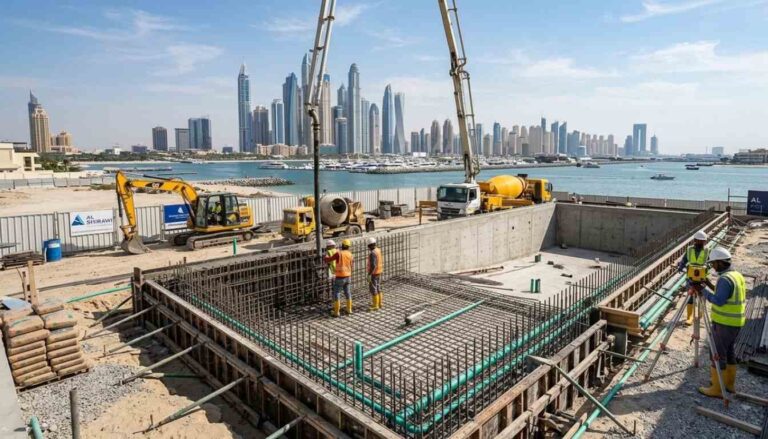
The shell is the structural heart of the pool, and the choice of shell method is one of the biggest single cost decisions. A reinforced concrete shell, built by shotcrete or gunite spraying, is the standard for custom villa pools in Dubai. It can be shaped freely, engineered for local soil and groundwater conditions, and finished in any tile or interior. It is also the most labour-intensive route: excavation, steel fixing, spraying, curing and waterproofing all happen on site, in sequence, and none of those stages compresses safely. A fiberglass shell is a factory-made alternative: the shell arrives complete, which makes installation faster and the surface smooth to the touch, but it limits shape and size to catalogue options, and it still needs correct ground preparation, backfill and levelling to avoid movement over time. Transport and crane access for a large factory shell can also become a significant part of that route’s cost, especially on a plot with restricted access.
Which route costs more depends on your design, not on a universal rule. A simple fiberglass shell can come in below a fully custom concrete pool, while a large or unusually shaped fiberglass installation, with crane hire and difficult access, can close that gap quickly. What matters for your quotation is that the shell method is named, the engineering for your plot is described, and the waterproofing and testing regime is specified alongside it — because a shell quoted without those details is not a complete shell quotation at all. For a deeper explanation of how each build stage works, see our guide to the swimming pool construction process in Dubai.
Waterproofing: the hidden specification where cheap quotes save money
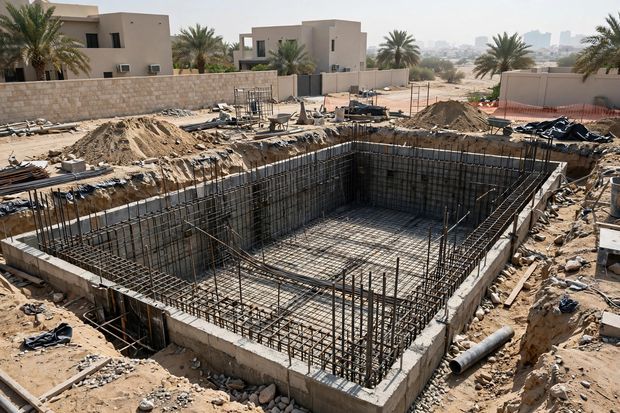
If there is one section of this guide to read twice, it is this one, because waterproofing is where a cheap quote most often hides its saving — and where that saving stays invisible until it fails. Concrete on its own is not waterproof. A proper system uses a waterproofing membrane applied to a correctly prepared shell, and — critically — a witnessed water test before any tile is fixed: the shell is filled and left standing with the level marked, so any drop is caught while it is still cheap to fix. That test takes days, and it is the first thing a rushed or cut-price build skips. A quotation that names the membrane system and includes the water test is describing a different pool from a quotation that mentions neither, even if the headline figures look close.
The same logic applies to the specification underneath the tile generally. Concrete strength and curing regime, steel detailing, pipe sizes worked out from flow rather than guessed, and the quality of the plant all sit invisibly inside the finished pool. A thinner membrane, unnamed pumps, a smaller filter or a skipped water test will not show on handover day. They show later, as a slow leak into the ground, poor circulation, tiles lifting at the waterline, or a repair that means draining the pool, removing finishes and treating the shell — work that costs a multiple of what the original specification would have cost. When one quotation sits dramatically below the others, the first question is not how the contractor achieved it, but what has been left out of the specification. That discipline is the single most valuable habit in this guide.
Equipment and the plant room: the engine room of the cost
Once the shell is built, the next major cost block is the equipment that keeps the water clean, safe and comfortable — and this is where the gap between a basic pool and a well-specified pool opens up. At minimum, a pool needs circulation pumps, filtration, pipework, a treatment system and electrical protection, all sized for the pool’s volume. Permit drawings are commonly checked against a water turnover of four hours or less — the whole volume of the pool passing through filtration within that time — so pump and filter sizing is a matter of engineering, not preference. A variable-speed pump, a correctly sized sand or cartridge filter, and a plant room laid out so a technician can reach every valve, union and electrical connection without dismantling half the room are all signs of a contractor thinking beyond handover day, and they all belong in the quotation by name and model, not merely by category.
Beyond that baseline, each addition carries its own cost and its own running cost. A salt chlorinator versus traditional chlorine dosing changes both the upfront plant and the daily chemistry routine. Automated dosing and testing adds equipment but reduces manual work and keeps the water steadier. In Dubai’s climate, temperature control is often the decision owners feel most: a heat pump for winter swimming, a pool chiller for summer comfort, or both, each with its own plant, pipework and electrical demand. Our pool chiller guide and saltwater versus chlorine comparison explain those choices in depth. The important cost point is that equipment should be specified for your pool’s actual volume and use, not fitted as a standard package: oversized plant costs more to buy and more to run without delivering anything extra, while undersized plant circulates poorly, treats unevenly and wears out early. Either mistake is paid for twice — once at purchase and again in running costs.
Finishes, coping, deck and surrounds: what you see every day
Finishes are the part of the pool you look at every day, and they are also a wide cost spectrum. The interior finish — mosaic tiles, porcelain tiles or a plaster interior — behaves differently under Dubai heat, sun and heavy chemical use, and each carries a different material and labour cost, with mosaic work typically the most labour-intensive because of the sheer number of pieces and the care needed at curves, steps and fittings. The waterline tile, the steps and benches, and the choice of interior all need to be named in the quotation, because “tiling” on its own is not a specification: two tilings of the same pool can differ enormously in material quality, fixing method and grout system, and therefore in how long they stay put.
Around the water, coping stones and the deck are a cost block of their own, and one that buyers frequently underestimate. Coping needs to sit level, shed water away from the pool, and stay comfortable underfoot in July heat — natural stone, porcelain and other coping materials differ in cost, heat performance and slip resistance. The deck itself needs a proper fall to drainage, a non-slip finish, and an area that meets the approved drawing, typically with a continuous walkway around the pool. Then there is the surround: paving, garden works, planting, irrigation, shade structures such as a pergola, outdoor lighting and seating. None of that is strictly “the pool”, but all of it is what makes a pool usable rather than merely present, and a quotation that stops at the water’s edge while another includes the surround is not a like-for-like comparison. Ask every contractor to state clearly where its scope ends, so the surround is a planned decision rather than a surprise.
Water features, lighting, infinity edges and the extras that multiply cost
Features are where a pool’s character comes from, and where its cost can multiply fastest. A raised spa or jacuzzi section needs its own shell work, heating and jets. Water features — sheer descents, fountains, deck jets — need additional pumps, pipework and controls. Underwater LED lighting needs positions planned before the shell is poured, low-voltage protection, and cable routes that are fixed early; adding lights after the shell is built is a different job entirely. Automation — app control of pumps, lighting, temperature and dosing — adds controllers, sensors and commissioning time. Each feature on its own is a modest addition; together, they add plant, pipework, electrical load and commissioning complexity, and the quotation should price them as separate lines so you can add or remove them with your eyes open.
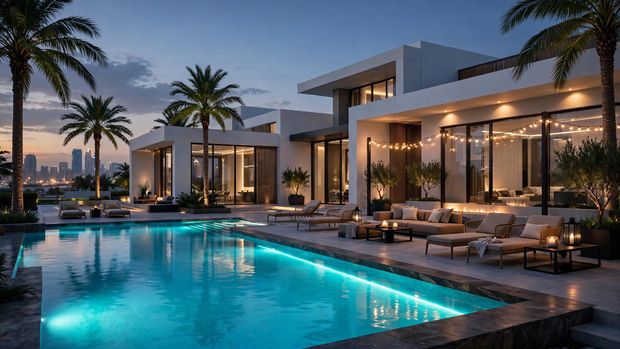
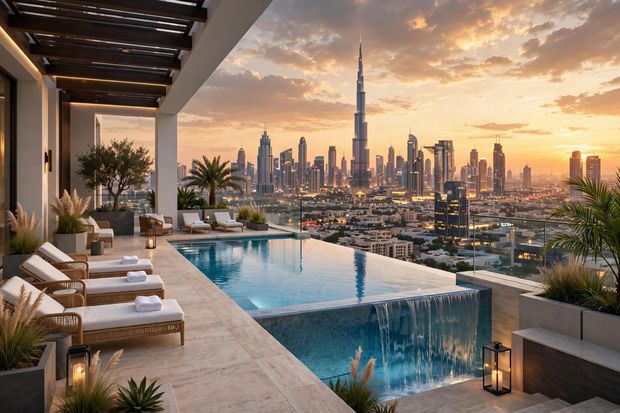
The most expensive feature of all is the infinity or overflow edge. An infinity edge is not a cosmetic detail: it needs a balance tank to catch the overflowing water, a second pump set to return it, precise levelling of the edge itself, and structural detailing that a standard skimmer pool does not require. The edge tolerance is measured in millimetres, and the plant room grows accordingly. That is why overflow and infinity pools sit in a different cost class from skimmer pools of the same size, and why a quotation for one should never be compared with a quotation for the other. If your heart is set on an infinity edge, budget for the whole system — edge, tank, pumps and levelling — not merely for a prettier wall.
Access, excavation, soil and groundwater: your plot’s hidden bill
Two identical pools on two different plots can cost very differently, and the difference is usually underground or at the garden gate. Access is the first factor: if an excavator, a concrete pump and delivery trucks can reach the garden directly, excavation and spoil removal are fast and mechanical. If the only route is a narrow side passage, a landscaped frontage or a shared community road with restrictions, excavation may have to happen partly by hand, spoil may have to be carried out rather than trucked, and a crane may be needed for a factory shell or for lifting plant into place. Restricted access is one of the largest single swing factors in a quotation, and it is exactly the kind of factor a site visit reveals and a phone quote misses.
Below ground, soil and groundwater set the engineering. Dubai’s sandy soils, and groundwater in some areas, change the structural requirements of the shell, the dewatering needed during excavation, and the waterproofing regime. Rock, an unmarked service, or a high water table discovered after excavation has started becomes a variation order unless the quotation has anticipated it and stated how it will be handled. A serious contractor asks about ground conditions, checks what is known about your community, and writes the “what if we hit this” process into the quotation — who pays, how it is priced, and who decides. That written process is worth more than any reassurance, because it turns a surprise into a procedure.
Approvals: the paperwork line in every quotation
Approvals are a real cost line, and they vary by plot, so a quotation should show them rather than bury them. Every private pool in Dubai must be registered with Dubai Municipality through the Building Permits System before any digging starts, with drawings covering the site plan, pool structure, pump room, pipework and electrical layout. If your villa sits in a master community, you will also need a No Objection Certificate from the developer, and community review often takes longer than the municipality permit, so it should start early. DEWA sign-off covers the electrical and plumbing connections, Dubai Civil Defence clearance applies where safety systems are involved, and properties in PCFC zones such as Palm Jumeirah are approved by Trakhees instead of Dubai Municipality. Authority fees, developer charges and consultant drawings may sit inside the contractor’s figure or outside it — either arrangement is legitimate, but the quotation must say which, because an approval fee discovered after signing is not a small surprise.
There is also a safety scope that belongs in the approved design and therefore in the cost: a compliant barrier around the pool with self-closing, self-latching gates where children are present, and drainage for backwash water that stays inside your plot and follows an approved route. These are not optional extras, and a quotation that omits them is not cheaper — it is incomplete. Ask every contractor who files each approval, who chases it, and what happens to the programme if a submission comes back with comments. A contractor that files these routinely will answer immediately and in specifics, and that answer is part of what you are paying for.
Running costs: what the pool costs after it is filled
A pool’s real cost of ownership starts the day it is filled, and buyers who only compare build figures miss the larger number. The ongoing costs are electricity for filtration and, where fitted, chilling or heating; water to replace evaporation, which is substantial in a Dubai summer; chemicals and dosing; and regular servicing — water testing and balancing, filter cleaning, equipment checks and consumables such as salt for a chlorinator. Of these, temperature control is typically the largest single running cost in summer: an unchilled pool in June, July and August reaches temperatures most people find unpleasant to swim in, which is why chilling is the item most frequently left out of a build quotation and most often wanted afterwards. Retrofitting a chiller later is possible, but it is a bigger job than including it in the original plant design.
The build decisions in this guide are also running-cost decisions. Correctly sized plant uses less electricity than oversized plant and lasts longer than undersized plant. A salt system changes the chemical routine and its consumables. A well-balanced pool protects finishes and equipment, while a neglected one damages both: grout washes out, plaster roughens, pumps strain, and what began as a servicing gap becomes a repair. That is why the cheapest build can quietly become the most expensive pool over its first decade, and why an annual maintenance contract deserves a place in your cost thinking from the start. For ongoing care, see our guides to swimming pool maintenance in Dubai and swimming pool cleaning in Dubai. A contractor that talks seriously about the first year of ownership while quoting the build is telling you something important about both numbers.
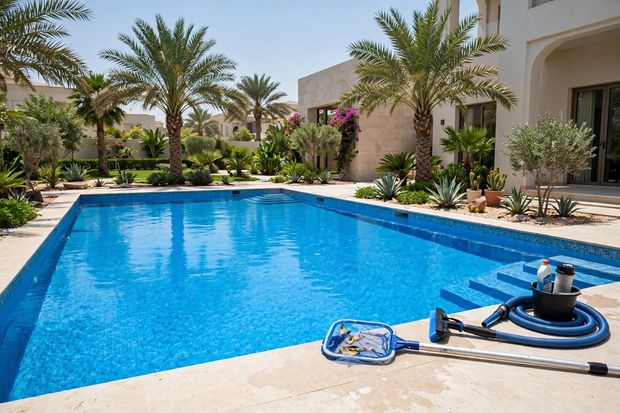
The cheapest-quote trap, and how to compare quotations properly
The most expensive mistake in pool buying is comparing headline numbers instead of scopes. A pool dispute is almost always a scope dispute: something was assumed, not written down, and the argument starts when it appears as an extra charge. The discipline that prevents it is simple, and it is worth applying to every quotation you receive: compare structure, waterproofing, equipment, finishes, deck, approvals and handover separately — not only the final number. Ask every contractor for a written, itemised scope that names the shell method, the waterproofing system, the equipment by brand and model, the finishes, the electrical and plumbing connections, excavation and disposal, testing and commissioning, and the handover package. Then lay the quotations side by side and mark what each one includes, excludes, or leaves vague.
That exercise is also what exposes the cheapest-quote trap. In Dubai’s pool market, the lowest number usually achieves its saving in exactly the two places you cannot see: waterproofing and plant. Thinner membranes, unnamed pumps, smaller filters, skipped water tests — all invisible on handover day, all expensive later. Treat any quote that sits dramatically below the others as a question, not a bargain: ask precisely what has been left out, and weigh the missing lines against the fuller quotes. The same discipline applies to payment. Payments are normally staged against completed milestones — design approval, shell completion, tiling and finishes, commissioning and handover — rather than paid as one lump sum upfront, and a contractor asking for full payment before excavation starts is a warning sign. Read the exclusions with the same care as the inclusions: who pays authority and developer charges, what happens if excavation hits rock or groundwater, and how a mid-build change is priced in writing. Variation orders are normal in construction; surprise variation orders are not.
Renovation versus new build: different cost drivers
If you already own a pool, the cost question changes shape. A renovation does not need excavation or a new shell, but it brings its own cost drivers: diagnosing the existing structure, draining and preparing the shell, repairing cracks or failed waterproofing, retiling or replastering, replacing ageing plant, and bringing older electrical and plumbing work up to current requirements. In some cases — a shell that has moved, waterproofing that has comprehensively failed, or a layout that no longer suits the villa — a renovation can approach the complexity of a new build, and an honest contractor will say so rather than selling a cosmetic re-tile over a structural problem. Our swimming pool renovation guide covers what to check when an older pool needs work, and our renovation services page explains the approach in full.
The comparison that matters is lifetime, not first invoice. A re-tile over a leaking shell is the cheapest invoice and the most expensive decision, because the leak continues underneath the new finish and the work must be done twice. A proper renovation diagnoses first — water testing, shell inspection, plant assessment — and prices the repair that actually lasts. The same logic applies when weighing renovation against a full rebuild: compare the scope that solves the problem, not the smallest number that postpones it. And if your existing pool’s equipment is failing, remember that plant replacement can often be staged separately from cosmetic work, which lets you spread the investment while fixing the most urgent items first.
Getting your exact quote: what a free site visit covers
After all of that, the practical question remains: what will your pool cost? The honest answer is that it takes a visit. A free site visit from Hello Landscaping & Pools LLC covers the affection plan and setbacks, soil and access, existing services and drainage, the plant room location, and a discussion of size, shape, shell, finishes and equipment — and from that visit you receive an itemised quotation for your own villa, with the shell method, waterproofing system, named equipment, finishes, approvals handling, payment stages and warranty terms all written down. That document is the thing to compare against other contractors’ quotations, line by line, using the checklist in this guide. If another contractor’s quotation is a single figure with no breakdown, you cannot compare it with anything, and you cannot hold anyone to it later.
When you are ready, the fastest route is WhatsApp: send your villa location and a rough idea of the pool you want, and we will arrange the visit. There is no charge for the visit and no obligation in the quotation — the visit exists precisely because a pool should never be priced blind. The right time to get that number is before you commit to a design, because the site visit often changes the design itself: a setback, a soil condition or an access constraint found early is a detail; found late, it is a variation order.
Frequently asked questions
Why do quotes for the same pool differ so much?
Because quotations rarely describe the same pool. One may include a named waterproofing system, a witnessed water test, named pumps and filters, approvals handling and a deck, while another covers only the shell and basic tiling, leaving the rest as extras or omissions. Size, depth, shape, shell method, finishes, equipment, access, soil, approvals and the surround all move the figure, and a site visit is what pins those variables down. Compare quotations line by line — shell, waterproofing, plant, finishes, deck, approvals, handover — rather than comparing headline numbers, and ask any contractor whose figure sits far below the others precisely what has been left out.
What should a proper pool quotation list?
Everything, named. A proper quotation is itemised: the shell method, the waterproofing system, the equipment by brand and model, the finishes, the electrical and plumbing connections, excavation and disposal, testing and commissioning, and the handover package — plus payment stages tied to completed milestones, the written programme, warranty terms, and a clear statement of exclusions and of who pays authority and developer charges. It should also state how mid-build changes are priced and what happens if excavation hits rock, groundwater or an unmarked service. If a quotation is a single figure with no breakdown, you cannot compare it with anything, and you cannot hold anyone to it later.
Is a fiberglass pool cheaper than a concrete pool?
It depends on the design, not on a universal rule. A fiberglass shell arrives factory-made, which makes installation faster, and a simple fiberglass pool can come in below a fully custom concrete pool. But fiberglass limits shape and size to catalogue options, still needs correct ground preparation and backfill, and transport and crane access for a large shell can add significantly on a plot with restricted access. A reinforced concrete shell, built by shotcrete or gunite, can be shaped freely and engineered for local soil and groundwater, but it is more labour-intensive on site. Compare the complete system — shell, waterproofing, testing, plant and finishes — for your own plot, not one material against another in the abstract.
What affects pool cost more: size or finishes?
Both matter, and they pull in different directions. Size drives excavation, concrete, waterproofing, tile area and plant size, so a larger pool costs more at every stage. Finishes drive the visible cost: mosaic work is labour-intensive, premium coping and deck materials add up across the whole surround, and the interior finish sets both the material bill and the fixing time. Depth and shape sit alongside them — a deeper pool needs a stronger shell, and curves and split levels add labour at every stage. The practical answer is that no single factor dominates: the quotation is the sum of size, depth, shape, shell, finishes, plant, access, soil and approvals together.
What adds the most cost: heating, chilling, an infinity edge or automation?
An infinity or overflow edge typically adds the most, because it is a whole system rather than a single item: a balance tank, a second pump set, precise edge levelling and structural detailing that a skimmer pool does not need. Heating and chilling each add plant, pipework and electrical demand, and chilling in particular also becomes the largest ongoing running cost in summer. Automation adds controllers, sensors and commissioning time. Each feature should be priced as a separate line in your quotation, so you can add or remove items with your eyes open rather than discovering them bundled into a single figure.
Are approvals included in a pool quotation?
Sometimes, and the quotation must say so. Every private pool needs Dubai Municipality registration through the Building Permits System before digging starts, and most villas in master communities also need a developer NOC, which often takes longer than the municipality permit. DEWA sign-off, Civil Defence clearance where applicable, and Trakhees approval in PCFC zones may also apply. Authority fees, developer charges and consultant drawings may sit inside the contractor’s figure or outside it — either arrangement is legitimate, but it must be stated in writing. An approval fee discovered after signing is not a small surprise, and a contractor that files and chases all approvals as part of the build is providing a real part of the service.
What does a pool cost to run each month?
Running costs have four parts: electricity for filtration and, where fitted, chilling or heating; water to replace evaporation, which is substantial in a Dubai summer; chemicals and dosing; and regular servicing such as water testing and balancing, filter cleaning and equipment checks. Temperature control is typically the largest single running cost in summer, which is why chilling is worth deciding during the build rather than retrofitting later. Plant sized for your pool’s actual volume costs less to run than oversized plant, and a well-balanced pool protects finishes and equipment, while a neglected one damages both and turns a servicing gap into a repair bill.
Is renovating my existing pool cheaper than building a new one?
Usually, but not always, and the honest answer depends on diagnosis. A renovation avoids excavation and a new shell, but it brings its own cost drivers: draining and preparing the shell, repairing cracks or failed waterproofing, retiling or replastering, replacing ageing plant, and bringing older electrical and plumbing work up to current requirements. If the shell has moved or the waterproofing has comprehensively failed, a renovation can approach the complexity of a new build, and a cosmetic re-tile over a structural problem is the most expensive decision of all, because the work must be done twice. Diagnose first — water testing, shell inspection, plant assessment — and price the repair that actually lasts.
Why is the cheapest quote risky?
Because on a pool, the saving is normally taken out of the two things you cannot see: waterproofing and plant. A thinner membrane, unnamed pumps, a smaller filter, a skipped water test — none of it shows on handover day, and all of it shows later as leaks, poor circulation, higher running costs or early failure. That is not an argument for choosing the most expensive quote either. It is an argument for comparing itemised scopes: when one quote sits dramatically lower, ask precisely what has been left out, and weigh the missing lines against the fuller quotes. Value, not price, is what you live with for the next twenty years.
How do I get an exact quote for my villa pool?
Through a free site visit. Hello Landscaping & Pools LLC visits your plot, checks the affection plan and setbacks, soil and access, existing services and drainage, and the plant room location, and discusses size, shape, shell, finishes and equipment with you — then prepares an itemised quotation for your own villa, with the shell method, waterproofing system, named equipment, finishes, approvals handling, payment stages and warranty terms all written down. There is no charge for the visit and no obligation in the quotation. The fastest route is WhatsApp: send your villa location and a rough idea of the pool you want, and we will arrange the visit.
Related reading: our swimming pool construction process guide walks through each build stage, our contractor buyer’s guide explains how to compare builders, and our renovation guide covers what to check when an older pool needs work.
Related reading: our guide to the best swimming pool companies in Dubai and our contractor vetting and hiring guide will help you compare quotes and shortlist builders.