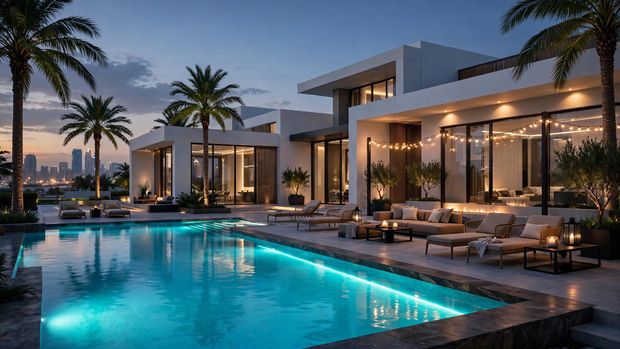


A lot of villa owners hear the word landscaping and picture the finishing touches: a few palms, some grass, maybe a flower bed by the entrance. In construction, it means something much bigger — and much earlier. Landscaping in construction is the planned shaping of everything outside your villa’s walls: the levels of the ground, the drainage that keeps water away from the building, the paths and patios you’ll walk on, the soil, the irrigation, the planting, the lighting and often the pool surround too.
This guide explains what landscaping in construction actually covers, where it fits in a villa build timeline, and how each stage works in Dubai’s conditions — heat, dust, sandy soil and almost no rain. If you’re building a new villa, renovating, or just trying to understand a quote that lists “landscape works”, this is the piece that ties it all together.

What landscaping in construction actually means
In construction, landscaping is the trade that builds the outdoor environment as an engineered system — not just a decorated one. It starts with the ground itself: surveying levels, shaping falls so water drains away from the villa, and preparing a base that paths, walls and planting can sit on for decades. Then it layers the built elements (paving, edging, retaining walls, steps, pergolas, outdoor kitchens) with the living ones (soil, irrigation, trees, palms, shrubs, lawn), and ties them together with lighting and drainage. Think of it this way: the villa builder constructs the house; the landscape contractor constructs everything the house sits in. The two have to be coordinated — levels, drainage runs, service ducts and access all cross the boundary between building and garden. When they’re planned together, the threshold from your living room to the patio is flush, the AC condensate has somewhere to go, and the garden lighting cable doesn’t have to be retrofitted through a finished driveway. In Dubai, landscaping in construction also carries a regulatory and practical weight it doesn’t have in milder climates. Irrigation isn’t optional — it’s the life-support system for every plant. Drainage has to handle rare but violent downpours. Materials and adhesives must survive 50°C surface temperatures. And many communities require approvals before you change levels, add structures or plant near boundaries. A proper landscape contractor in Dubai plans for all of this from the survey stage, not as an afterthought.The two halves of every project: soft landscaping and hard landscaping
Every landscaping project, large or small, splits into two halves that are planned together but built by different skills:- Soft landscaping is everything living and growing: trees, palms, shrubs, hedges, flower beds, lawns, groundcovers, the soil they grow in and the mulch that protects it. It needs water, sun and ongoing care — it’s the part that changes with the seasons.
- Hard landscaping is everything built and inert: paving, patios, paths, steps, retaining walls, boundary walls, pergolas, decks, outdoor kitchens, water features and the drainage and irrigation infrastructure buried beneath. It’s the part that should still be perfect in twenty years.
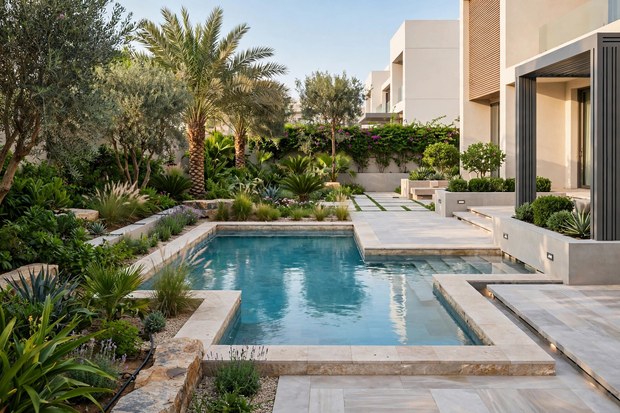
Where landscaping fits into a villa build timeline
Landscaping isn’t the last trade on site — or at least, it shouldn’t be. On a well-run villa build in Dubai, the landscape contractor is involved from surprisingly early:- Before construction starts: the site survey records existing levels, trees worth keeping, soil conditions and where services enter the plot. The concept design fixes the big moves — where the pool goes, how the levels step down from the villa, where cars and people arrive.
- During the villa build: underground drainage, irrigation sleeves under future paths, and service ducts are installed while the ground is open. Levels are set to the villa’s finished floor height. Retaining structures that hold back soil go in alongside the building’s own earthworks.
- After the villa structure is complete: the visible landscape is built — grading, hardscape, soil, planting, lighting — timed so heavy work doesn’t damage finished villa interiors, and so planting goes in during the cooler months if the schedule allows.
The design stage: from site survey to drawings
Every proper project starts with a survey, not a sketch. The surveyor measures the plot’s exact size and levels, records sun paths and prevailing winds (the Shamal matters for both plants and outdoor comfort), notes existing trees and palms, and maps every underground service — DEWA, Etisalat/du, drainage connections. In Dubai’s newer communities, the developer’s own guidelines are pulled at this stage too, because they often dictate setbacks, height limits and what you can build near the boundary. From the survey, the designer develops a concept: zones for dining, lounging, play and planting; the pool’s position and shape; how levels transition from the villa floor to the garden; and the overall style. Then come the construction drawings — the documents the build team actually works from. These show exact levels and falls, paving patterns and joints, wall construction, drainage runs with invert levels, irrigation zones, planting plans with species and spacings, and lighting layouts. A project built without proper drawings is where “we’ll figure it out on site” turns into “we’ll be re-doing it in August”. For villa owners, the design stage is also when the budget gets honest. A concept tells you what the garden will feel like; the construction drawings and the bill of quantities tell you what it will cost. Changes on paper are cheap. Changes in concrete are not.Site preparation: grading, soil and drainage
Site preparation is the unglamorous work that decides whether everything after it lasts. First the site is cleared — demolition of old structures, removal of rubble, and protection of anything worth keeping. Then comes grading: shaping the ground to the levels on the drawings, with gentle falls (typically 1–2%) carrying surface water away from the villa and toward drains or soakaways. In Dubai’s flat, sandy plots, grading also means importing and compacting engineered fill where levels need to rise. Drainage goes in during this phase, while the ground is open. Channel drains along patios and driveways, underground pipe runs to soakaways or the community storm system, and gullies at low points — all of it buried before a single paver is laid. Dubai’s rain is rare but intense when it comes, and a garden without drainage doesn’t just puddle; it floods toward the villa. This is also when irrigation mainlines and sleeves under future paths are installed, for the same reason: bury it now or dig it up later. Soil is the third part of preparation, and in Dubai it’s a project in itself. Native sandy soil drains too fast and holds almost no nutrients, so planting beds are excavated and backfilled with a proper planting mix — sweet soil blended with compost and conditioners — while lawn areas get their own prepared profile. Get this wrong and even the best irrigation can’t save the planting; get it right and everything you plant has a fighting chance.Irrigation: the system that keeps a Dubai garden alive
If there’s one system you shouldn’t economise on, it’s irrigation. In Dubai’s summer, most garden plants need water every single day, delivered precisely to the root zone — and a well-designed system does this automatically, in the cool hours, with almost no waste. A poorly designed one waters the paving, drowns some beds while starving others, and doubles your DEWA bill. A proper irrigation design zones the garden by water need: lawns on pop-up sprinklers or subsurface drip, shrubs and hedges on drip lines, palms and trees on bubblers or drip rings, pots on their own micro-zone. Each zone runs on its own valve and schedule from an automatic controller, with a rain sensor to pause watering after the rare storm. Drip irrigation — slow, targeted delivery straight to the soil — is the workhorse of a Dubai garden: it loses almost nothing to evaporation or wind, unlike sprinklers spraying into 45°C air. Installation quality matters as much as design. Pipes buried at the right depth, joints properly glued, valves in accessible boxes (not buried under a patio), the controller somewhere the owner can actually reach it. And before handover, every zone should be run, checked and adjusted — emitter by emitter — so coverage is even. A system that’s never been commissioned properly will quietly underwater half the garden from day one.
Planting for Dubai’s climate: desert-adapted planting, palms and lawns
Planting in Dubai starts with accepting the climate, not fighting it. The plants that thrive here are desert-adapted: deep-rooted, sun-tolerant, and able to handle both 50°C summers and the occasional cool winter night. That doesn’t mean a garden of cacti — it means choosing from a proven palette and using water-hungry plants (like lawns) deliberately, where they’ll be used and enjoyed, rather than by default. Palms are the backbone of most Dubai villa gardens — date palms for presence, Washingtonia or Bismarckia for drama — underplanted with hardy shrubs like bougainvillea, hibiscus, ixora and jasmine that flower for months. Native and adapted species (ghaf, sidr, desert rose, various acacias) need far less water once established and anchor the garden in its place. Lawns have their role — a play area, a visual foil to paving — but every square metre of grass is a square metre of daily irrigation, mowing and feeding. Use it where it earns its keep. Planting goes in after the hardscape is finished and the irrigation is running — never before. Roots need the soil prepared, the water on, and protection from construction traffic. And it should ideally happen in the cooler months (October to March), when heat stress is low and plants establish fast. Summer planting isn’t impossible, but it needs far more water and care to survive.Hard landscaping features: paths, decks, pergolas and outdoor living
Hard landscaping is what makes the garden usable — and in Dubai, “usable” increasingly means outdoor living for much of the year. Paths and patios in porcelain, natural stone or quality pavers, laid on a proper compacted base with falls for drainage. Steps where levels change, with consistent risers and non-slip surfaces. Retaining walls where the garden steps down, built with drainage behind them so they don’t fail in the first heavy rain. Then the structures that turn a garden into rooms: pergolas for filtered shade (ideally positioned for the afternoon sun), decks in composite or hardwood, outdoor kitchens with water and drainage roughed in, fire pits, seating walls, water features. Each of these is a small construction project in its own right — footings, levels, services — which is why they’re part of “landscaping in construction”, not afterthoughts bolted on later. Material choice in Dubai is unforgiving. Dark paving that looks elegant in a showroom becomes too hot to walk on barefoot by noon. Cheap adhesives and grouts fail in the heat. Timber needs to be properly specified or it warps. A contractor who builds here regularly will steer you toward materials that survive — and tell you honestly which ones won’t.Pools and water features as part of the landscape
In Dubai, the pool is often the centrepiece the whole landscape is designed around — and it has to be planned as part of the landscape construction, not as a separate afterthought. The pool’s position fixes levels across the garden; its backwash and overflow need drainage; the equipment pad needs access, ventilation and somewhere for noise to go; and the surround — coping, decking, planting — has to meet the pool shell cleanly. Smaller water features (wall fountains, rills, reflection pools) follow the same logic on a smaller scale: they need a level base, a power supply, water top-up and drainage for cleaning. Planned from the start, they’re simple. Retrofitted, they’re a headache. If the pool comes first and the landscape second — or vice versa — make sure the two contractors are talking. The most common failure is levels: a pool coping set without reference to the future patio level, leaving an awkward step or a drainage trap that’s expensive to fix.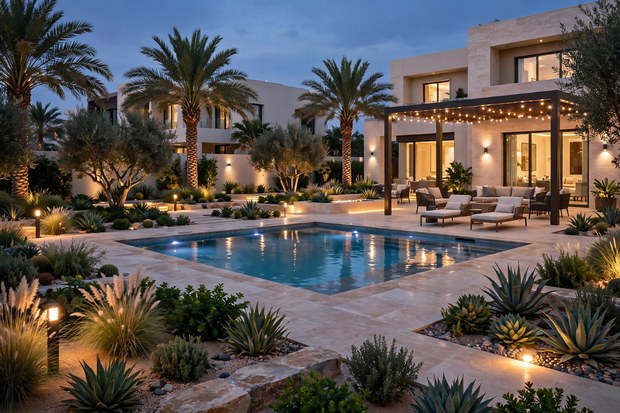
Lighting: making the garden usable after dark
Dubai’s gardens come alive after sunset for much of the year — which makes lighting part of construction, not decoration. The cable runs go in during the groundworks phase (another reason to plan early): low-voltage LED circuits to uplights for palms and feature trees, path lights, step lights, underwater pool lights and wall washes. The transformer and controls sit somewhere accessible, and the whole system is zoned so you can light the dining terrace without floodlighting the bedrooms. Good garden lighting is layered and restrained: a few well-placed uplights do more than a dozen scattered fittings. And in Dubai, every fitting needs to be specified for heat, dust and the occasional downpour — cheap garden lights fail within a season or two. Plan the lighting with the planting, so a palm isn’t planted where its uplight will be buried, and a path light doesn’t glare into the majlis windows.Community and developer rules: approvals, setbacks and what needs permission
Before you build, check what your community allows. Most Dubai master communities — Emaar, Nakheel, Dubai Hills, Arabian Ranches and the rest — have their own landscaping guidelines and an approval process for external works. Typical controls include: how close structures can go to the boundary (setbacks), maximum heights for pergolas and screens, what you can plant near boundary walls, drainage requirements, and rules about changing levels or adding hard surfaces that increase runoff. Approvals usually need drawings — which is another reason the design stage matters. Submitting a proper landscape plan gets a faster yes than a vague description. And some works need municipality permits too, particularly anything structural or anything affecting drainage connections. A contractor who works regularly in your community will know the process, the forms and the people — which is worth more than it sounds. Ignoring approvals is a gamble that rarely pays. Enforcement in Dubai’s communities is real, and retrospective approval for something already built is slower, more expensive and sometimes impossible. Build it right, with permission, the first time.Handover, aftercare and maintenance: when construction ends
Handover is when the contractor proves everything works — not just that it’s finished. The snag list walkthrough covers: every irrigation zone run and checked, lighting scenes demonstrated, drainage tested (a hose pipe is the honest test), levels checked against the drawings, and all planting inspected for health. Get the controller settings, the planting schedule and the maintenance manual in writing, not as a verbal handover. Aftercare is the bridge between construction and maintenance. Most reputable contractors include a defects period — typically a few months — during which anything that fails (a plant that doesn’t establish, a paver that settles, an emitter that clogs) is put right. This isn’t generosity; it’s how a garden is supposed to be finished. Plants need a season to prove themselves, and the contractor should be around to see it through. Then comes maintenance: the ongoing rhythm of mowing, pruning, fertilising, irrigation checks and seasonal planting that keeps the garden at its best. In Dubai, this is non-negotiable — a garden without maintenance declines fast. Many villa owners keep the same contractor on for maintenance, which makes sense: they built it, they know where everything is, and they have a stake in it thriving.Frequently asked questions
What does “landscaping in construction” actually include?
Everything outside the villa’s walls built as an engineered system: site survey and levels, grading, drainage, soil preparation, hard landscaping (paving, walls, steps, pergolas, decks, outdoor kitchens), irrigation, planting, lighting and often the pool surround. It’s the construction of the outdoor environment — not just decoration added at the end.
When should the landscape contractor get involved in a villa build?
From the design stage — ideally while the villa is still on paper. The survey, concept and construction drawings should be coordinated with the villa build so levels, drainage runs, service ducts and access all line up. Underground work (drainage, irrigation sleeves, ducts) happens during the villa build; the visible landscape is built after the structure is complete.
What’s the difference between soft landscaping and hard landscaping?
Soft landscaping is everything living: trees, palms, shrubs, lawns, planting beds, soil and mulch. Hard landscaping is everything built: paving, patios, paths, steps, walls, pergolas, decks, water features and the buried drainage and irrigation infrastructure. They’re planned as one system — the hardscape creates the conditions the softscape needs to survive, especially in Dubai’s climate.
Why is irrigation such a big deal in Dubai landscaping?
Because it’s the life-support system for the entire garden. In Dubai’s summer, most plants need water daily, delivered precisely to the roots. A well-designed automatic system (zoned drip irrigation on a controller, running in the cool hours) keeps everything alive with minimal waste. A bad one waters the paving, starves half the beds and doubles the water bill. It’s the one system never to economise on.
Can I plant a lawn in Dubai, or is it a bad idea?
You can — lawns work fine in Dubai if they’re planned for. But every square metre of grass means daily irrigation, regular mowing, feeding and care, so use lawn deliberately (play areas, visual contrast) rather than by default. Desert-adapted planting, palms and groundcovers give you a lush look with far less water and upkeep.
Do I need approval for landscaping work in my community?
Usually, yes. Most Dubai master communities have landscaping guidelines covering setbacks, structure heights, boundary planting, drainage and level changes — and an approval process that needs proper drawings. Some works also need municipality permits. A contractor experienced in your community will know the process. Building without approval risks enforcement action that’s far more expensive than doing it properly.
Should the pool be planned with the landscaping or separately?
Together, always. The pool’s position fixes levels across the garden; it needs drainage for backwash and overflow, an equipment pad with access and ventilation, and a surround that meets the shell cleanly. If the pool and landscape contractors aren’t coordinating on levels and services, you end up with awkward steps, drainage traps or retrofitted services — all expensive to fix.
What happens at handover of a landscaping project?
A proper handover proves everything works: every irrigation zone run and checked, lighting demonstrated, drainage tested, levels verified against drawings, planting inspected. You should receive the controller settings, planting schedule and maintenance manual in writing. Then a defects/aftercare period (typically a few months) covers anything that fails to establish — before routine maintenance takes over.
How long does a full villa landscaping project take?
It depends on size and complexity, but the visible build phase for a typical villa garden is usually several weeks to a few months — after the design stage (survey, concept, construction drawings) which itself takes weeks. The full timeline from first survey to established planting spans the villa build, because underground works happen during construction. A contractor who gives you a realistic programme with design, approvals and aftercare built in is more trustworthy than one who promises “two weeks, start to finish”.
Is maintenance really necessary, or can a Dubai garden look after itself?
It’s necessary — non-negotiable, in fact. Irrigation needs checking, plants need pruning and feeding, lawns need mowing, and the summer heat punishes neglect fast. A garden without maintenance declines within months in Dubai. Most owners keep their landscape contractor on for maintenance, since they know the system and have a stake in it thriving.
Related reading: our landscape design tips cover shade, soil and irrigation, our landscape lighting ideas show gardens after dark, and our lighting design guide covers layers, glare and controls.