


A Dubai pool does not get dirty like a pool in a cooler place. Leaves are rarely the problem. Fine desert dust is the problem. Heat burns off the sanitiser, water evaporates, and everything dissolved in the water stays behind. So swimming pool maintenance in Dubai is not a chore you dip in and out of. It is a routine. The pools that stay clear, safe and pleasant all year are the ones whose routine never stops. This guide covers that routine in full. You will learn what a proper visit includes. It also covers water testing and balancing. And pump care, filter care, salt cells and annual contracts. Plus the signs that show your pool needs more than maintenance.
This guide is for villa pool owners across Dubai. It helps you see what you pay for, what you can safely do yourself between visits, and which warning signs mean you should call a professional. Your pool may be a simple family pool, a saltwater pool, or a larger pool with a chiller, a heat pump and water features. The rules stay the same in every case. Keep the water balanced. Keep the water moving. And keep the plant room healthy. And catch small problems before they turn into costly ones.
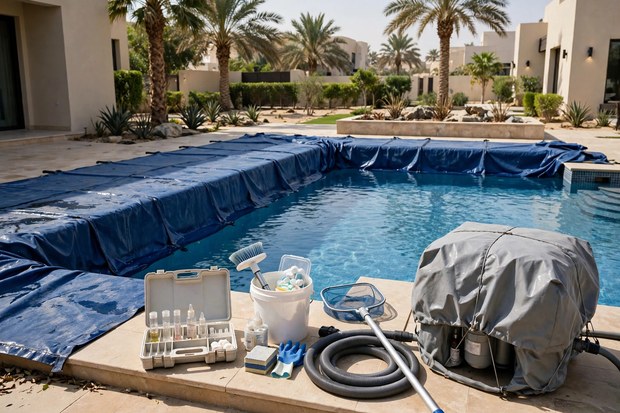
Why Dubai pools demand more attention than pools elsewhere
Three things set Dubai apart. All three point the same way: your pool needs care more often. First, heat and strong sun break down free chlorine fast. A level that looked fine a few days ago can drop to zero while no one watches. Once free chlorine hits zero, algae can take hold fast. In peak summer, that can happen in less than a day. Second, dust. Fine desert dust settles on the surface every day. It blows into skimmers, loads the filter, and feeds algae, most of all after windy days and sandstorms. Third, evaporation. Water leaves the pool, but minerals and chemicals stay behind. They grow more concentrated, shift the water balance, and leave scale on tiles, grout and equipment.
A routine made for a mild climate does not survive a Dubai summer. So most local pools need a weekly service at least. In the hot months, or where the pool gets heavy use, visits come more often.
Evaporation: the fourth factor
There is a fourth factor, and it surprises new villa owners: evaporation. Dubai’s dry air and hot sun pull water out of the pool day after day. As water leaves, everything dissolved in it stays behind. Minerals build up, pH drifts, and the water slowly grows harder. A top-up with fresh water thins things out again. But each top-up also shifts the chemistry a little. That is one more reason to test the water often. None of this means a Dubai pool is hard to own. It means the routine must match the climate. Test more often. Clean the filter more often. And never let a small drift run for weeks. In this heat, a small drift turns into a clear problem fast.
What a proper maintenance visit actually includes
A good maintenance visit checks the whole pool and its plant. It is far more than a skim and a splash of chlorine. The visit starts at the surface. Your technician skims off floating dust and debris. Then comes brushing: walls, steps and waterline tiles, where algae and scale first take hold. Brushing matters more than most owners think. Algae clings to surfaces in a thin film, and chemicals alone struggle to shift it. Dose a pool but never brush it, and it still turns green at the waterline and in corners where the water moves least. Next, your technician vacuums the floor to clear settled dust. Then your technician empties the skimmer and pump baskets. Clogged baskets choke the flow, strain the pump, and force the filter to do work it was not built for.
Water testing and the plant room
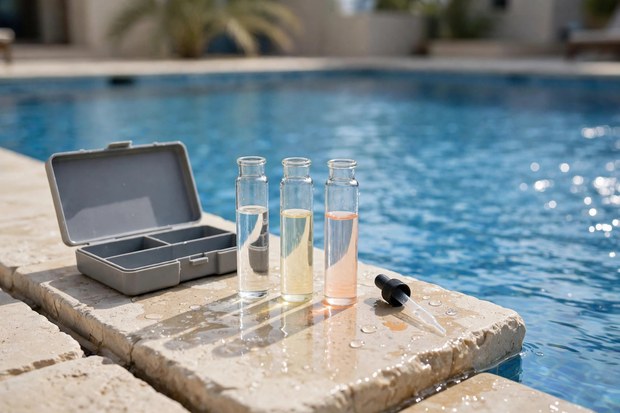
Next comes the water itself. Each visit includes a full test: free chlorine, pH and total alkalinity. On a sensible cycle, the test also covers calcium hardness, stabiliser (cyanuric acid) and salt level for saltwater pools. It covers total dissolved solids too, where the pool has had many top-ups. The results drive the dosing. Your technician adds chemicals to fix the balance, not out of habit.
Then the plant room gets its turn. Your technician backwashes the filter when the pressure gauge says so. Or, with a cartridge filter, takes the cartridge out and cleans it. Your technician checks the pump, chlorinator, heater or chiller and underwater lights for leaks, odd noises and correct working. Check the water level too. A low level can starve the pump. A high level can weaken the skimming. A visit that skips any of these steps leaves part of the job undone. The baskets, the brushing, the test, the plant check — all of them matter. Sooner or later, the pool will show it if you miss one.
The right order for each visit
The order matters more than it looks. Take vacuuming. If you vacuum before you brush, the dirt you just brushed off the walls sits on the floor for another week. So brushing comes first and vacuuming second. Testing comes before adjusting too. If you add chemicals blind, the pool ends up over-chlorinated one week and under-sanitised the next. The equipment check is not a formality either. A pump that sounds a little different, a gauge that reads a little higher than last month, or a damp patch under a valve — these are all early warnings. They cost little to act on now and a great deal later. A good technician will also tell you what was found, in plain words. Then you know if your pool is truly healthy or if something is quietly heading the wrong way.
Water testing and balancing, explained properly
Water balance sits at the heart of pool maintenance. It is worth understanding, not leaving to guesswork. Free chlorine is the sanitiser. It kills bacteria and keeps algae away. It also falls fastest in Dubai heat and sun. The pH of the water decides how well chlorine works and how the water feels. When pH runs high, chlorine turns sluggish and scale forms more easily. When pH runs low, the water can sting eyes and skin and eat into fittings. Total alkalinity acts as a buffer. It steadies pH. So a pool with alkalinity off track will see its pH swing all the time, no matter how carefully you dose it.
Calcium hardness tells you how much calcium sits dissolved in the water. Too little, and the water can attack plaster and grout. Too much, and scale shows up on tiles and inside equipment. Stabiliser, or cyanuric acid, shields chlorine from UV light. That matters a lot under the Dubai sun. Salt level matters only for saltwater pools. There, the chlorinator turns dissolved salt into sanitiser.
Target readings to aim for
As a rough guide, most technicians aim for pH around 7.2 to 7.6. They aim for free chlorine around 1 to 3 parts per million. Total alkalinity sits around 80 to 120 parts per million. Calcium hardness sits around 200 to 400 parts per million. Stabiliser and salt levels depend on your sanitising system. Treat these as targets to steer by, not numbers to chase with a home kit. What matters is the pattern across visits. A reading that creeps one way week after week is telling you something. Rising pH may point to heavy aeration from a water feature. Falling chlorine may point to a tired salt cell or a filter that is not turning the water over well.
Test little and often. That beats testing rarely and in a panic. In Dubai, a basic check two or three times a week works well. Add a full professional test at every service visit. That rhythm stops small drifts from turning into green water. If you test nothing yourself between visits, tell your maintenance company. Then they can set the visit schedule to match.
How often should your pool be serviced?
For most Dubai villa pools, weekly service is the least that truly works. Heat, dust and UV light break down chlorine within days. A pool no one services for two weeks in summer invites algae. Twice-weekly service is common in the hot months, roughly May to September. It also suits pools that get heavy use, host guests often, sit uncovered in a windy spot, or run water features. Water features keep the surface moving and make the chlorine work harder. Lightly used pools can sometimes stretch a little longer between visits in the cooler months. But the sun and dust never take the winter off. A pool no one swims in still needs its chemistry checked and its plant run. Hotels, gyms and other commercial pools are different again. They need daily checks, because bather load and hygiene rules are far higher.
Events and weather should reset the schedule too. A pool used for a party needs cleaning and rebalancing soon after. Swimmer load spikes sanitiser demand and leaves the water cloudy. A dust storm does the same from the other side. It dumps fine sediment that loads the filter and feeds algae. So the honest answer to “how often” is not one number. It is a rhythm set by your pool: its size, its cover, its features, how many people swim, and how open it is to wind and dust. A good maintenance company sets that rhythm with you at the first visit. Then it adjusts the rhythm with the seasons, instead of selling a fixed schedule and never looking at it again.
Pump, filter and plant room care
The plant room is the engine room of the pool. Most equipment trouble shows up there long before it shows in the water. The pump gets the first look on every visit. Your technician empties the baskets, checks the seals for drips, listens to the motor for new noises, and reads the pressure gauge on the filter. A rising gauge means the filter is full and needs care. To clean a sand filter, reverse the flow and flush the trapped dirt out. Backwash too rarely, and the filter clogs and the flow weakens. Backwash far too often, and you waste water and disturb the filter bed. A cartridge filter has no backwash. Your technician takes its cartridges out and hoses them down. In time, cleaning stops restoring the flow, and the cartridge needs replacing. Trust the gauge, not the calendar. A technician who skips it is guessing.
Past the weekly rhythm, the plant room needs longer-cycle care. Seals, o-rings and pump parts wear out. Filter media ages. Valves stiffen. Dosing pumps and sensors drift out of calibration. That is why a full check once a year is worth doing, even for a pool that looks fine. It catches slow failures while they are still small jobs: a weeping seal, a cracked basket, a heater or chiller working harder than it should. The layout of the plant room matters too. A room where a technician can reach every valve, union and power point without pulling half the kit apart is a room that a technician services well. If your plant room feels cramped, dark or wet at the floor, tell your maintenance company. Access problems quietly turn into neglected problems.
What you can do between visits
Between visits, you can do a lot with little effort. Skim the surface most days in windy weather. Empty the skimmer baskets when they fill. Watch the water level and top it up before the pump starts drawing air. And listen for changes. A pump that suddenly sounds different, a gauge that climbs fast, or a return jet that feels weaker than usual — all of these are early warnings. Report them at the next visit. Do not wait for the water to turn. None of this replaces professional service. But it stretches the value of each visit, and it means you report problems in days, not find them in weeks.
Two common pump problems
Two pump problems come up often. The first is a pump losing prime. Air shows in the pump basket. Bubbles show in the return jets. Or the pump runs dry. The cause often sits on the suction side. A low water level lets the skimmer suck air. Or the seal wears out, the basket cracks, or a valve stays shut. Running dry damages a pump fast. So a pump that will not prime is a stop-and-call problem, not a wait-and-see one. Second, a pressure gauge that does not behave. Low pressure, even with a dirty filter, can mean the pump is not delivering, a blockage sits before the filter, or the gauge has failed. High pressure after backwashing can mean channelled sand or a deeper fault. Both need a technician’s eyes. The gauge is the cheapest tool in the plant room, and the most ignored.
Saltwater pools: the salt cell and what changes
Saltwater pools are popular in Dubai, and for good reason. The water often feels softer on eyes and skin. And the pool makes its own sanitiser on site, instead of you adding it by hand. But a salt pool still cleans with chlorine. The salt cell turns dissolved salt into chlorine by electrolysis. So it still needs testing, balancing and care.
What changes is where you look. Check the salt level on a regular cycle. A cell short of salt makes little sanitiser. A pool with too much salt can taste brackish and stress the fittings. The cell itself needs cleaning from time to time. This matters more in Dubai than in soft-water areas. Calcium scale builds up on the cell plates in hard water. A scaled cell makes less and less chlorine, until the pool drifts green for no clear reason. Many modern cells flip their polarity to shed scale on their own. That helps. But it does not remove the need for checks and the odd manual clean.
Cell age and salt tolerance
Two more checks belong on a salt pool’s routine. First, the age and output of the cell. A cell that has served for years may simply make less than it once did. No amount of salt will fix a worn-out cell. Falling chlorine, with salt right and plates clean, is the classic sign.
Second, how well the pool itself copes with salt. Tile, grout, coping and any metal fittings should suit salt water. Salt eats into the wrong materials over time. If you plan to convert a chlorine pool to salt, get a survey first. The pump and filter must suit the cell, and the finishes must cope with salt. If you already own a salt pool, make sure each visit covers cell checks and salt testing. A generic visit that treats a salt pool like a chlorine pool will miss the one part the whole system rests on. For a fuller look at both systems, see our guide to saltwater versus chlorine pools in Dubai.
Treat a “no flow” warning as urgent
One more saltwater habit matters. Salt systems run on flow. So anything that cuts flow also stops chlorination: a dirty filter, a full basket, a pump losing prime. That is why salt-pool owners should treat a “no flow” warning as an urgent circulation problem, not a settings problem.
Summer versus winter routines in Dubai
Dubai has no closed season for pools. But it has two clear maintenance seasons, and the routine should shift with them. Summer runs roughly May to September, and it is the hard season. Heat and UV light burn through chlorine. Evaporation packs minerals in. Dust loads the filter. Swimmer load peaks. So chemistry needs checks more often. Visits come more often. The filter needs cleaning more often. And the chiller or heat pump works hardest. That is when its own service matters most. A chiller that fails in August leaves a pool no one wants to swim in. Daily skimming in windy spells, quick cleaning after dust storms, and rebalancing after heavy use — these are summer habits, not extras.
Winter runs roughly October to April. It is lighter, but not empty. Cooler water slows algae and cuts chlorine demand. So visits can space out a little for lightly used pools. But wind and sand still bring debris. Evaporation still packs minerals in. Scale still forms. In fact, scale and stains that built up unseen through summer often show up in winter. That is why the cooler months suit heavier corrective work. An acid wash strips a fine layer off the surface to clear bonded stains, scale or algae film. It needs the pool empty, so book it for the cooler months, when the pool sees least use.
Winter work worth planning
The same goes for drain-and-fill work, re-grouting, and any job that takes the pool out of action for days. The mistake to avoid is treating winter as a break from maintenance. A pool no one tends for months does not reopen itself in April. And the spring recovery — green water, scaled tiles, a filter full of winter dust — often costs more care than the winter routine ever would.
What to do after a sandstorm
After a sandstorm, skim the surface first. Then brush the walls and floor to loosen the settled dust. Then vacuum it up. Empty the skimmer and pump baskets too — they will have filled fast. Test the water next. Dust shifts chemistry as well as clarity. And check the filter pressure. Fine desert sand works into the filter media and clogs it bit by bit. So a backwash or cartridge clean is often due sooner after a storm than the normal schedule says. Run the pump long enough for a full turnover, so the water clears well. And do not let debris sit for days. Settled dust feeds algae and strains the pump.

Green, cloudy or stained water: what it means and what to do
Most pool problems first show as a change in the water. Each change points a different way. Green water almost always means free chlorine has hit zero and algae has taken hold. In a Dubai summer, that can happen fast once dosing stops or a salt cell scales over. Recovery takes method, not magic. Restore the sanitiser with a shock dose. Treat with algaecide where it fits. Brush every surface to break the algae’s hold. Run the filter without a break. And rebalance the water. Expect days, not hours, for the full clear-up. How long it takes depends on how far the bloom has gone. If the pool keeps turning green after recovery, an underlying cause is still there. The filter may not turn the water over. The cell may no longer make chlorine. Or algae may shelter in a circulation dead spot.
Cloudy water is often a filter or balance problem, not an algae problem. A loaded filter, a pump that runs too few hours, or water whose chemistry has drifted will all leave fine bits floating. Cloudy water is also a safety issue. If you cannot see a swimmer who has gone under, the pool is not safe to use.
Stains, scale and the bucket test
Stains and scale tell yet another story. Brown or greenish stains can point to metals in the water. White crust at the waterline points to calcium scale from hard, evaporating water. A stain or film that will not brush off has bonded to the surface. That is when an acid wash or a targeted stain treatment comes into play, not another round of brushing. And if the water level keeps falling faster than evaporation explains, check for a leak first. The bucket test is the simple first step. Stand a bucket of pool water on a step, so inside and outside levels match. Mark both levels. Compare them after a day with the pool running as normal. If the pool drops far more than the bucket, water is escaping somewhere. That is a job for leak detection, not for topping up.
Stubborn algae and odd smells
Mustard-coloured patches in shady corners are a different, tougher algae. It clings hard and often comes back if the first treatment falls short. Dark spots rooted into plaster need a different approach again. A strong chlorine-like smell, oddly enough, often means chloramines — used-up sanitiser — not too much chlorine. It calls for proper treatment and fresh flow, not simply less chemical. Treating each colour change the same way is why so many pools turn green again after a clear-up that looked like a success.
Equipment lifespan: what lasts, what wears, and what to watch
No piece of pool equipment lasts for ever. But almost every piece lasts longer with regular checks and good care. That is the real value of routine maintenance. Pumps, filters, heaters, chillers and salt cells all wear with use, heat and water chemistry. Their working lives rest far more on those three things than on any calendar. A pump with clean baskets, correct flow and balanced chemistry will often serve for many years. The same pump will fail far sooner if clogged baskets starve it, a low water level runs it dry, or a worn seal leaves it shaking. Filter media ages and channels. Seals and o-rings harden and weep. Salt cells lose output. Heating and cooling systems lose power when their coils scale. Underwater lights fail when seals let water in. None of this is a mystery. It is wear, and wear shows to a technician who looks.
Watch for early signs at every visit
The practical habit is a small health check at every visit, and a full one each year. Watch for the early signs. Listen for a pump that sounds different. Check the filter gauge if it climbs faster than it used to. Note a heater or chiller that runs longer for the same result. Look at the chlorinator if its output no longer holds the chlorine level. Watch for lights that flicker or dim. And check for any damp patch, drip or stain in the plant room.
Report these at the next visit. Do not wait for a breakdown. Fix a seal early, and the job stays small. Fix a pump late, and it does not. And when a big part does reach the end of its life, ask what the replacement should be. A well-sized variable-speed pump will often run more cheaply than the single-speed unit it replaces. A chiller matched to the pool’s size holds the temperature without running all the time. For year-round swimming comfort, see our guide to pool chillers in Dubai.
Three early warnings to act on
Three early warnings deserve a technician’s visit on their own. First, any new noise. Grinding, rattling or whining from the pump often means bearings or debris. If a pump runs noisy for weeks, it rarely recovers. Second, any water where it should not be. A damp plant-room floor, a dripping union, or a valve that weeps may be a small seal today and a failed joint tomorrow. Third, any electrical warning. A chlorinator showing a fault, a breaker that trips, lights that flicker — never work around these, most of all where water meets power. Keep a simple log of visits, readings and replacements. A log turns “it was fine last year” into proof. It shows if a problem is new, recurring, or getting worse. And it helps any technician grasp your pool in minutes, not visits.
Annual maintenance contracts: what they cover and whether one is worth it
An annual maintenance contract (AMC) is a service deal. Under it, a swimming pool maintenance company looks after your pool for a full year, on a set schedule of visits. For most Dubai villa owners, it is the simplest way to keep the routine honest. The schedule, the testing and the plant checks happen whether you remember to book them or not. A typical AMC covers the regular cleaning visits: skimming, brushing and vacuuming. It covers water testing and chemical balancing at each visit. It covers filter cleaning and backwashing, equipment checks and servicing, and a priority response when something goes wrong between visits. Chemicals often come as part of the deal. Some deals also add monthly water reports, seasonal treatments such as shock dosing after dust storms, and free equipment checks. Then a growing problem reaches you as a report with a fix, not as a breakdown.
What an AMC usually does not cover
What an AMC leaves out matters just as much. So read the inclusions before you sign. Spare parts, big equipment repairs, leak fixes, acid washes and re-grouting often carry a separate quote. That is fair, since they rest on the state of your pool and cannot sit inside a flat routine. But it must be said up front.
Is an AMC worth it for you? That rests mostly on how you use your pool. If you swim often, travel a lot, own a large or heavily featured pool, or simply do not want to run testing, dosing and plant checks yourself, a contract will often work out better than calling for help only when the water turns. Emergency recoveries, rushed repairs and damage from weeks of neglect are what make pool ownership costly.
If you barely use the pool and enjoy the basics yourself, a lighter schedule of pro visits may suit you better. Either way, ask the same questions before you sign. How many visits, and how do they sit across summer and winter? What does it cover, and what carries a separate quote? Who is the technician — the same person each visit, or whoever is free? And how fast is the emergency response when the water turns green or the pump stops? For pricing on any deal, message us on WhatsApp and we will quote for your pool after a free site visit.
When maintenance alone is no longer enough
Good maintenance keeps a healthy pool healthy. But it cannot bring back a pool whose structure or surfaces have truly worn out. Knowing the difference saves you from paying for cleaning that cannot fix the real problem. The signs stay the same. Stains or scale that will not shift after proper treatment. Grout that crumbles, or tiles that keep coming loose. A rough or pitted surface that holds algae, no matter how well you brush it. A shell that keeps losing water, even after leak repairs. Or kit that fails again and again, because the plant itself has passed its working life. These are not maintenance failures. They are renovation signals.
The same holds when a pool’s design no longer suits its owners: a depth that does not work for children, a plant room no one can service, or finishes that have simply reached the end of their life after years of Dubai sun and chemistry.
From servicing to scope
At that point, the honest talk shifts from servicing to scope. What needs repair? What needs new surfacing? Or a full rebuild? Start with waterproofing. A renovation that skips the waterproofing-first rule will fail the same way the old finish did. If your pool has reached that stage, our guides to swimming pool renovation in Dubai and renovation cost factors set out the options. And if the pool is new or newly planned, our swimming pool construction services and pool cost factors guide cover what shapes a build. The thread runs through this whole guide: catch problems early, grasp what your pool needs, and let the routine do the quiet work that keeps the water clear and the kit alive.
Frequently asked questions
How often should a swimming pool be maintained in Dubai?
For most Dubai villa pools, weekly service is the least that truly works. Heat, dust and UV light break down chlorine within days. Twice-weekly service is common in the hot months, roughly May to September. It also suits pools that get heavy use, sit uncovered in windy spots, or run water features. Lightly used pools can sometimes stretch a little longer between visits in the cooler months. But the sun and dust never take the winter off. Commercial pools are different, with daily checks the norm. The right rhythm rests on your pool’s size, cover, features, swimmer load and exposure. A good maintenance company will set it with you and adjust it with the seasons, not sell a fixed schedule and never look at it again.
What does a maintenance visit include?
A proper visit covers the whole pool and its plant, not just a skim. It covers skimming the surface, brushing walls, steps and waterline tiles, and vacuuming the floor. Your technician empties the skimmer and pump baskets. Then comes a full water test, with chemical dosing to fix the balance. Your technician backwashes or cleans the filter. Your technician also checks the pump, chlorinator, heater or chiller, lights and water level. Saltwater pools also need salt-level testing and salt cell checks. A visit that skips the baskets, the brushing, the test or the plant check leaves part of the job undone.
How do I keep pH and chlorine balanced in Dubai heat?
Test little and often. Dubai heat and sun burn through free chlorine fast, and evaporation packs everything else in. A basic check two or three times a week works well. Add a full pro test at each service visit. That rhythm stops small drifts from turning into green water. As a rough guide, aim for pH around 7.2 to 7.6, free chlorine around 1 to 3 parts per million, and total alkalinity around 80 to 120 parts per million. Stabiliser shields chlorine from UV light. What matters most is the pattern across visits. A reading that creeps one way week after week points to a cause beneath: a tired salt cell, a loaded filter, or heavy aeration from a water feature.
Why does my pool keep turning green?
Green water almost always means free chlorine has hit zero and algae has taken hold. In a Dubai summer, that can happen fast once dosing stops or a salt cell scales over. To fix it, restore the sanitiser with a shock dose. Treat with algaecide where it fits. Brush every surface. Run the filter without a break. And rebalance the water. Expect days, not hours. If the pool keeps turning green after recovery, a cause beneath is still there. The filter may not turn the water over. The cell may no longer make chlorine. Or algae may shelter in a circulation dead spot. Repeat greening is a signal to check, not bad luck. It needs a proper look, not just one more shock dose.
How do I care for a saltwater pool cell?
Check the salt level on a regular cycle. Ask your technician to check and clean the cell from time to time. Calcium scale builds up on the cell plates in Dubai’s hard water. A scaled cell makes less and less chlorine, until the pool drifts green. Many modern cells flip their polarity to shed scale on their own. That helps, but it does not remove the need for checks and the odd manual clean. Falling chlorine, with salt right and plates clean, is the classic sign of a worn-out cell that needs replacing. Also check that tile, grout, coping and metal fittings suit salt water. And make sure each visit covers cell checks. A generic visit that treats a salt pool like a chlorine pool will miss the one part the whole system rests on.
Does my pool need different care in summer and winter?
Yes. Summer, roughly May to September, is the hard season. Chemistry needs checks more often. Visits come more often. Filters need cleaning more often. And the chiller or heat pump works hardest. Dust storms and heavy use should each trigger quick cleaning and rebalancing. Winter, roughly October to April, is lighter but not empty. Debris and scale still arrive. And the cooler months suit heavier work, such as acid washes, drain-and-fill jobs and re-grouting, when the pool sees least use. Treating winter as a break from maintenance is the common mistake. A pool no one tends for months does not reopen itself. And the spring recovery often costs more care than the winter routine ever would.
What does an annual maintenance contract (AMC) cover, and is it worth it?
A typical annual maintenance contract covers a set schedule of cleaning visits each year. It covers water testing and chemical balancing at each visit, filter cleaning and backwashing, equipment checks and servicing, and a priority response when something goes wrong between visits. Chemicals often come as part of the deal. Spare parts, big equipment repairs, leak fixes, acid washes and re-grouting often carry a separate quote. So read the inclusions before you sign. Is it worth it? That rests on how you use your pool. For regular swimmers, frequent travellers, and larger pools, a contract often works out better than calling for help only when the water turns. Emergency recoveries and damage from weeks of neglect are what make pool ownership costly. For pricing on any deal, message Hello Landscaping & Pools LLC on WhatsApp and we will quote for your pool after a free site visit.
How long does pool equipment last?
There is no single answer. Working life rests far more on use, water chemistry and servicing than on any calendar. A pump with clean baskets, correct flow and balanced chemistry will often serve for many years. The same pump will fail far sooner if clogged baskets starve it or a low water level runs it dry. Filter media ages and channels. Seals and o-rings harden and weep. Salt cells lose output. Heating and cooling systems lose power when their coils scale. The practical habit is a small health check at each visit and a full check once a year. Watch for early signs: a changed pump sound, a fast-climbing filter gauge, a heater or chiller that runs longer for the same result, or damp patches in the plant room. Report those early. Fix a seal early, and the job stays small. Fix a pump late, and it does not.
How do I know if my pool is leaking or just evaporating?
Use the bucket test before you assume a leak. Stand a bucket of pool water on a step, so the inside and outside water levels match. Mark both levels. Leave the pool running as normal for a day. If the pool drops far more than the bucket, water is escaping somewhere. That is a job for leak detection, not for topping up. If both drop by roughly the same amount, the loss is evaporation. That is heavy in Dubai heat, and fully normal. Either way, a water level that keeps falling faster than evaporation explains needs pro care, not repeated top-ups.
When is maintenance no longer enough, and repair or renovation needed?
When the problem sits in the structure or the surfaces, not in the water. Stains or scale that will not shift after proper treatment. Grout that crumbles, or tiles that keep coming loose. A rough or pitted surface that holds algae, no matter how well you brush it. A shell that keeps losing water, even after leak repairs. Or kit that fails again and again, because the plant itself has passed its working life. These are renovation signals, not maintenance failures. At that point, the talk shifts from servicing to scope: what needs repair, what needs new surfacing, and what needs a rebuild, starting with waterproofing. Our swimming pool renovation services can check which of those fits your pool.
Related reading: our pool chiller guide covers keeping a Dubai pool comfortable through summer, our saltwater versus chlorine comparison helps you choose a sanitising route, and our pool cost factors guide explains what shapes a quotation for maintenance and repair work.
Related reading: our villa pool cleaning guide covers the cleaning routine in detail, our chlorine guide explains water chemistry, and our saltwater versus chlorine comparison helps you choose a system.