

Blog
What lighting ideas actually make a Dubai backyard look good at night? Honestly? It’s not about having more lights. It’s about having the right ones, in the right places, doing different jobs. In Dubai we live outside in the evening — that’s when the heat finally drops and the garden becomes the best room in the house. So the lighting has to work hard: it should help you see where you’re walking, show off the pool and the palms, and still feel soft enough for a late dinner on the patio.
We’ve been lighting Dubai villa gardens since 2013, and the gardens that look best at night all share one thing. They don’t glow like a car park. They layer gentle light — a little on the paths, a little drama on the trees, a warm wash over the seating area — so your eye moves around the garden instead of getting blinded in one spot. Below, you’ll find the ideas that work best here, in our heat, dust and long outdoor evenings, plus what each one is really good for.
Get an exact lighting plan for your villa — free evening site visit.
Tell us your area and garden size; we’ll confirm a visit time on WhatsApp within minutes.
Why Dubai gardens come alive after dark
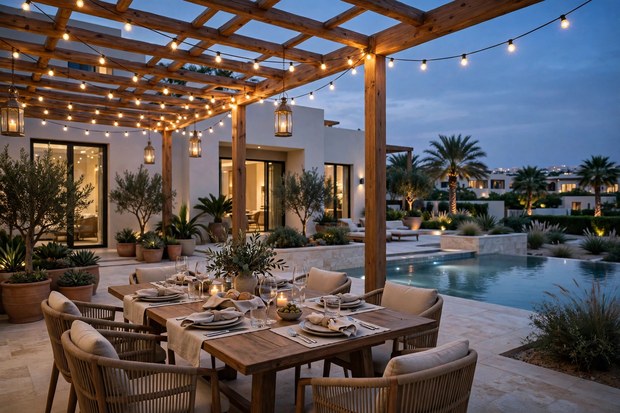
For half the year, a Dubai garden is simply too hot to enjoy before sunset. The garden’s real shift starts at dusk — and that’s exactly when lighting earns its keep. Good lighting doesn’t just let you see the garden; it decides how the garden feels. A well-lit backyard feels bigger, safer and more inviting, and it pulls the indoors and outdoors together so the whole villa feels connected.
There’s a practical side too. Steps, level changes, pool edges and dark corners are all safer with light on them. And in a city where outdoor entertaining runs late into the night for much of the year, lighting is what makes the garden usable — not just visible.
Light in layers: the scheme that actually works
The single biggest mistake in garden lighting is relying on one type of light to do everything. A row of bright floodlights makes a garden feel like a car park; a few decorative lanterns leave it too dark to walk through safely. The schemes that work layer three kinds of light.
- Ambient light — the general glow that lets you move around comfortably. Wall lights, soft downlights under a pergola, or low bollards along the main routes.
- Task light — brighter, focused light where you actually do things: over the barbecue, by the outdoor kitchen, on steps and at the front door.
- Accent light — the drama. Uplights on palms, a wash across a feature wall, small spots picking out sculpture or a water feature.
Get the balance right and the garden reads as a series of inviting spaces rather than one flat, over-lit yard. Most Dubai villas need all three — the trick is keeping the accent layer restrained so it stays elegant, not theme-park.
Warm or cool? Choosing colour temperature
Colour temperature — measured in kelvin (K) — is the difference between a garden that feels welcoming and one that feels like a hospital car park. For Dubai villa gardens, warm white (around 2700K to 3000K) wins, and it’s not close.
Warm light flatters skin tones, makes food look appetising, turns stone and timber golden, and sits comfortably against the warm tones of most villa architecture. Cool white (4000K and above) feels harsh outdoors, washes out planting, and attracts more insects. The one exception: task areas like an outdoor kitchen or a workshop corner, where a slightly cooler, brighter light helps you see what you’re doing.
Whatever you choose, keep it consistent. Mixing warm and cool fittings in the same view looks accidental. Pick one temperature for the whole garden — warm white — and stick to it.
Paths, steps and driveways: safety first
If the budget only stretches to one thing, light the routes people walk after dark. Paths, steps, level changes and the driveway are where lighting prevents accidents — everything else is atmosphere.
For paths, low bollards or small recessed path lights, staggered on alternate sides rather than lined up in two perfect rows, guide you without shouting. Keep them low and shielded so they light the ground, not your eyes. For steps, recessed step lights set into the riser or the wall beside a stair make level changes safe and look quietly expensive. Driveways need enough light to park by — wall-mounted downlights or a couple of well-placed bollards — without flooding the neighbours.
Uplighting palms and feature trees
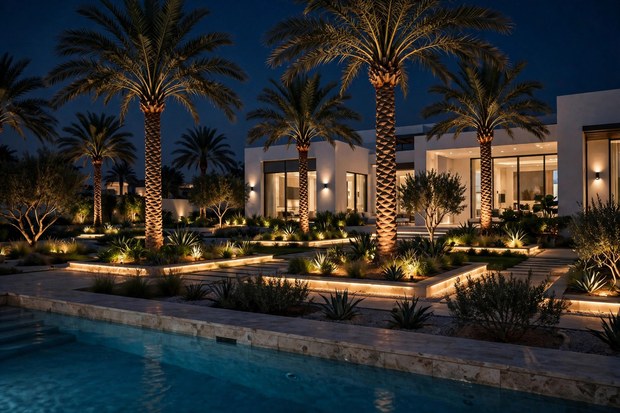
This is the signature Dubai garden feature, and for good reason. A palm lit from below, with a single uplight tucked at its base, is the most Dubai image there is: trunk, fronds and shadow against the night sky. One fitting per feature tree is usually plenty. More than that and the effect flattens out.
Place the uplight close to the trunk, angled slightly outward so it grazes the bark and throws the crown into silhouette. For multi-stem specimens or broad-canopy trees like frangipani, two fittings from different angles give depth. And plan for growth — a light buried under a fast-growing shrub will be swallowed within a season if nobody plans for it.
Walls, water features and focal points
A boundary wall is a big dark surface after sunset — which makes it a big opportunity. Wall washing (fittings set back from the wall, aimed up at it) makes the space feel bigger; grazing (fittings close to the wall, skimming across textured stone or render) shows off the material itself. Either way, a lit wall pushes the garden’s visual boundary outward at night.
Water features deserve light because moving water sparkles on top of that glow. Underwater LED lights that sit inside the pool wall and shine through the water turn the whole pool into a lantern. Add a lit water feature, like a sheer descent or a small waterfall, and the moving water sparkles on top of that glow. Around the edge, low coping lights mark where the water ends, which matters a lot when children or guests are walking around after dark.
Lighting the pool area without glare
Pool areas need light on the water, not in anyone’s eyes. The classic mistake is a bright floodlight aimed across the pool — it blinds swimmers and anyone sitting nearby, and it kills the atmosphere stone dead.
Instead: underwater lights for the pool itself (warm white, evenly spaced), low-level lights around the coping and deck so people can move safely, and any feature lighting — palms, walls — kept outside the direct sightlines of the seating and lounging areas. If you can see the bare bulb or LED from where you sit, the fitting is wrong or it’s aimed wrong.
Want it designed properly? Evening site visits available.
We visit after dark where possible, so we see the dark spots and the features worth showing.
Solar or wired low-voltage: the honest comparison
Solar path lights have their place as small accents, but for a proper garden scheme, wired low-voltage wins — and it’s not close in Dubai’s conditions.
Solar pros: no wiring, easy to move, cheap to try. Solar cons: dust coats the panels (and Dubai has a lot of dust), batteries fade in the heat, light output is weak and inconsistent, and they die just when you need them on a long winter evening. They’re fine for a little sparkle along a secondary path — not for the main scheme.
Wired low-voltage pros: reliable, bright, consistent, dimmable, and controllable in zones. Wired cons: needs a transformer, cabling, and professional installation — a real upfront cost. But it’s the only option that still looks good in year three.
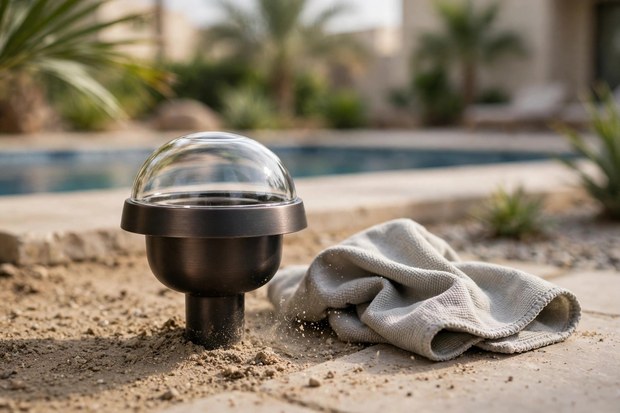
One honest warning: solar or wired, dust is the enemy. Any fitting’s output drops fast when the lens is dusty. If you go solar, commit to wiping the panels; if you go wired, the maintenance section below still applies.
Built for Dubai: IP ratings, heat and dust
Garden fittings live a hard life here. The IP rating tells you how well sealed a fitting is against dust and water — the two digits mean solids and liquids. For Dubai gardens, look for IP65 or better for anything exposed (dust-tight, protected against water jets), and IP67/IP68 for underwater or in-ground fittings that might sit in water.
Heat is the other killer. Cheap plastic housings warp in summer sun; stainless steel or marine-grade materials near the pool resist both heat and chlorine air. Sealed LED fittings — where the LED, driver and lens are one sealed unit — keep dust out far better than fittings with replaceable bulbs and screw-together housings.
Timers, photocells and smart controls
The best lighting scheme in the world is useless if nobody turns it on — or if it burns all night because nobody turns it off. Controls solve both.
A photocell (dusk sensor) switches the garden on automatically at sunset — essential, because sunset times shift through the year and nobody wants to adjust timers monthly. A timer then switches zones off at a sensible hour (midnight for entertaining areas, earlier for purely decorative zones). Smart controls or a simple multi-zone timer let different areas switch, dim and switch off independently: the path stays on late for security, the feature uplights go off at midnight, the pool area follows its own schedule.
Glare, neighbours and light trespass
Being a good neighbour matters — and in Dubai’s villa communities, it matters a lot. Light trespass (your garden lighting spilling into the neighbour’s windows or garden) is the fastest way to fall out with the people next door.
The fixes are simple: shield every fitting so the light source isn’t visible from outside your garden, aim lights downward or at your own features (never outward over the boundary), keep brightness modest (you need far less light than you think), and put decorative zones on timers so they switch off at a reasonable hour. If you can see your neighbour’s bedroom window from the fitting, assume they can see the fitting — and redirect it.
Keeping the scheme working: simple maintenance
Garden lighting in Dubai needs about an hour a season to stay beautiful. Dust is the main job — wipe lenses and solar panels, clear debris from uplights, and check that growing plants haven’t swallowed fittings. Then a quick electrical once-over: check timers still match the season’s sunset, replace any failed LEDs, and make sure transformers and connections are dry and sound.
Do that four times a year and the scheme will look as good in year five as it did on handover night. Skip it and you’ll be wondering why the garden looks dim and patchy within eighteen months.
Related reading: for the full design picture, see our landscape design tips for Dubai villas; for the technical side, our guide to how to design landscape lighting covers transformers, cable runs and controls in depth.
Ready to see your garden after dark?
Book a free evening site visit — we’ll show you exactly what lighting would do for your garden.
Related reading: our landscape design tips cover shade, soil and irrigation, and our landscaping in construction guide explains how planting and pools fit a build.