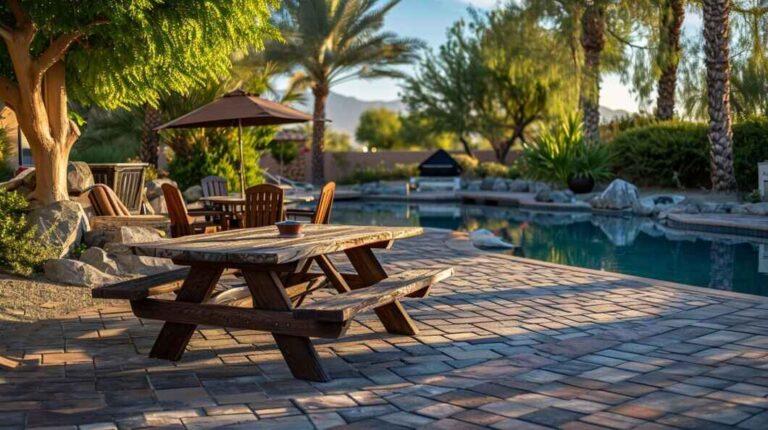


Walk through any established Dubai villa community and you will see the same truth from the street: no two pools are quite the same. One villa has a simple rectangular pool with a quiet waterline, built for children and weekend swimmers. Next door, a narrow lap pool runs along the boundary wall for a homeowner who swims before work. A few streets away, a compact plunge pool sits in a small garden, deep enough to cool off in and small enough to leave room for seating and planting. And on a corner plot with a view, an infinity edge appears to pour itself into the skyline. All of these are swimming pools, but they are different types of pool, built differently, maintained differently, and suited to different villas.
Choosing between the types of swimming pools in Dubai is therefore not a matter of picking the prettiest photograph. It is a matter of matching three separate decisions to your villa: how the water is handled at the edge, what the shell is made of, and how the pool will actually be used. Get those three decisions right and the pool fits your plot, your household and your appetite for maintenance. Get them wrong and you can end up with a showpiece nobody swims in, a family pool that is too deep for its youngest swimmers, or a compact garden swallowed by a pool that was sized for a different villa entirely. This guide explains each type in detail — skimmer, overflow and infinity edge pools; concrete and fiberglass shells; family, lap and plunge pools; indoor and outdoor pools; and the water systems that sit behind them all — so you can walk into a design conversation knowing what you are choosing between.
Three decisions that define a pool type
Most confusion about pool types comes from mixing up three different choices. The first is the edge system: how water leaves the pool, gets filtered and returns. A skimmer pool pulls surface water through boxes set into the wall. An overflow pool lets water spill evenly over the edges into a channel. An infinity edge pool lets water spill over one lowered edge into a hidden basin, creating the vanishing effect. The second choice is the shell: the structure that holds the water. In Dubai villa work this is typically a reinforced concrete shell sprayed on site, or a factory-made fiberglass shell delivered and set into a prepared excavation. The third choice is the use: a family pool, a lap pool, a plunge pool, or a pool with an integrated spa. These three choices combine freely. You can have a concrete family pool with a skimmer edge, a fiberglass plunge pool, or a concrete lap pool with an infinity edge, and each combination behaves differently. Keeping the three decisions separate matters because they answer different questions. The edge system decides the look of the waterline, the plant room equipment and how surface debris is handled. The shell decides the shapes available, the build programme and the long-term surface care. The use decides the size, the depth profile and the features worth paying attention to. A buyer who asks only “which type is best” will get a different answer from every contractor, because the honest answer is always “best for what, and for which villa”. Work through the three decisions in order, and the right combination usually becomes obvious.Skimmer pools: the standard Dubai villa pool
A skimmer pool is the conventional pool most Dubai villas have, and for good reason. Water sits a little below the coping, and surface water is drawn through skimmer boxes set into the pool wall near the waterline. Leaves, dust and surface oils are pulled into baskets, the water passes through filtration, and clean water returns through jets. It is a simple, proven system, and it suits the everyday family pool better than any other edge type. The practical advantages are real. A skimmer system needs no balance tank and no overflow channel, so the plant room is simpler and the pool occupies less underground space than an overflow design. That makes it the natural choice for a standard rectangular or freeform family pool on a typical villa plot, where the priority is swimming rather than spectacle. It is also forgiving: water level can vary a little without the system complaining, and a skimmer basket is a quick job to empty. The trade-offs are visible at the waterline. Because the water sits below the edge, you see a band of wall between the water and the coping, and that band collects the tide mark — the faint line of oils, dust and scale that Dubai’s heat and desert dust make more noticeable than in cooler climates. Regular brushing of the waterline is part of owning a skimmer pool, and skimmer throats themselves are a known leak point over time, since the plastic fitting and the concrete shell move slightly differently as they age. None of this is a reason to avoid a skimmer pool. It is the reason a skimmer pool suits owners who want a straightforward, dependable pool and are happy with ordinary weekly care.Overflow pools: the mirror-flat modern look
An overflow pool, sometimes called a deck-level pool, works on a different principle. Water is kept level with the surrounding deck and flows evenly over all the edges into a channel, from where it runs to a balance tank and is pumped back through filtration. The result is a perfectly flat, mirror-like surface with no visible waterline band at all. For a modern villa with clean lines, wide terraces and a minimalist garden, that still surface is the whole point of the design. The engineering behind the look is more demanding than a skimmer pool. Every edge must be levelled with precision, because water will only overflow evenly if the edges are truly even; a small error shows immediately as a dry patch or a heavier flow on one side. The balance tank, which holds the displaced water when swimmers enter the pool, needs its own space in or beside the plant room, and the system typically circulates more water than a skimmer arrangement. That is also why overflow pools are commonly praised for water quality: because surface water is constantly leaving over the edge, debris and oils are removed continuously rather than waiting to drift into a skimmer box, and temperature and chemicals tend to stay more even across the pool. The honest trade-off is care. The channel and the balance tank need regular inspection, the water level must be maintained more precisely, and evaporation in Dubai’s summer is more noticeable on a system that is always spilling. An overflow pool suits a villa where the design matters as much as the swimming, and where the owner accepts a more involved plant room in exchange for that calm, level surface.Infinity edge pools: the vanishing edge
An infinity edge pool is a variety of overflow pool, but it deserves its own section because the effect and the engineering are distinct. Instead of water spilling over all edges, one edge is built slightly lower than the water level, so water flows continuously over that single edge into a hidden trough, from where it is pumped back into the pool. Seen from the right angle, the water surface appears to continue past the edge and merge with the horizon, the sea, or the skyline. On an elevated villa plot or a garden with a genuine view, that vanishing edge is one of the most striking effects a pool can produce. The catch is that the effect only works with something to vanish into. An infinity edge facing a boundary wall, a neighbouring villa or a busy road looks like an ordinary pool with an expensive edge detail, and the premium paid for the engineering buys no visual reward. The site has to earn it: a raised terrace, a sloping plot, or a clear view beyond the garden. The engineering also has to be right. The lowered edge must be perfectly level along its length, the catch trough must be sized and detailed to handle the flow without noise or splashing, and the water level control must be reliable, because the effect collapses if the level drops and the edge runs dry. Infinity edges suit confident modern architecture on plots with a view, and they are wasted on flat inland plots where the horizon is another villa’s wall. If your garden has the outlook, it is a magnificent choice. If it does not, a standard overflow pool gives the same mirror surface for less.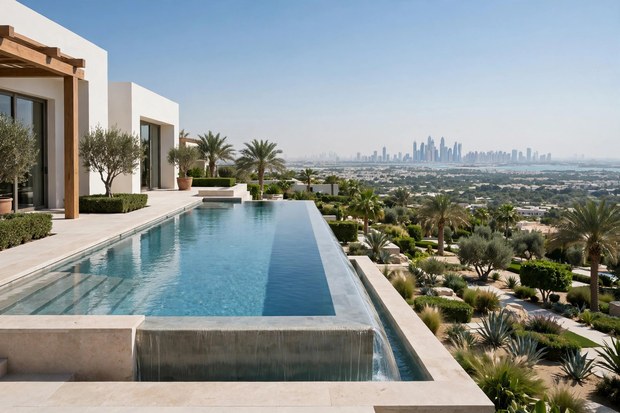
Concrete shells: built on site, shaped freely
A concrete pool shell, built by spraying concrete (gunite) over a steel framework or by pouring into formwork, is made entirely on your plot. That is its defining advantage: the shape is whatever the design calls for. Curves, freeform lagoons, integrated steps and benches, beach entries that slope gently into the water, swim-outs and attached spas are all shaped in the same process. For a villa where the pool is part of an architectural composition, or where the plot is an awkward shape that a catalogue of standard sizes cannot serve, concrete is the natural answer. The build is a proper construction project, and it should be treated as one. Excavation, steel fixing, spraying or pouring, curing, waterproofing, tiling and commissioning run over weeks, and each stage needs supervision by people who have done it before. The surface finish, usually tile in Dubai’s higher-end villas, decides much of the pool’s character and its maintenance: a well-tiled concrete pool is beautiful and durable, but the structure will need resurfacing or retiling after many years, and any structural movement can telegraph through as cracks. Concrete suits owners who want a fully bespoke pool and accept a longer, more involved build to get it. It is the shell behind most of Dubai’s striking villa pools, and when it is built well, it lasts for decades.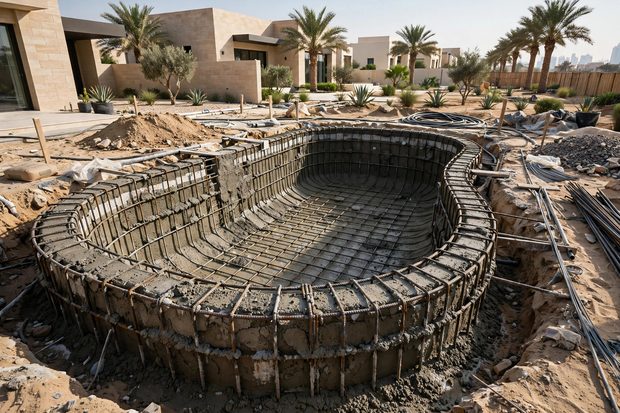
Fiberglass shells: factory-made and fast
A fiberglass pool arrives as a finished shell. It is moulded in a factory, transported on a truck, lifted by crane into a prepared excavation, and plumbed in. The surface is smooth gelcoat, which feels kind on feet and gives algae very little to grip, so day-to-day cleaning is often a little easier than on a tiled concrete pool. Because the shell is one piece, the build programme is dramatically shorter: the long stages of steel fixing, spraying and curing simply do not exist. The limitation is choice. You select from the shapes and sizes the factory makes, and while the range is broad, it is still a catalogue rather than a blank sheet. A complex freeform design, an unusual dimension forced by the plot, or an integrated beach entry may not be available. Fiberglass also has its own long-term considerations: the gelcoat surface can fade or craze after many years of Dubai sun, and while the shell itself is strong, poor installation, particularly inadequate backfill around the shell, causes more fiberglass pool problems than the shell material ever does. Fiberglass suits owners who want a quality pool quickly, who are happy to choose from established shapes, and whose priority is a fast, predictable build rather than a fully bespoke design.Family pools: shallow areas, steps and safety
A family pool is defined by how it is used, not by its shell or edge, and its design starts from the swimmers. Shallow areas where children can stand, wide easy steps rather than ladders, and a depth profile that deepens gradually are the features that make a pool genuinely family-friendly. A beach entry or a large shallow sun shelf gives toddlers a place to play and adults a place to sit in the water, while older children want enough depth to jump and swim properly. Designing for the youngest and oldest swimmers at the same time is the art of the family pool. Safety is inseparable from the design. In Dubai, where pools are used for much of the year and often by visiting grandchildren as well as resident children, the basics matter: a fence or barrier that a small child cannot open, a self-closing gate, no climbable furniture left beside the fence, and a pool cover or alarm as a second layer rather than a substitute. Inside the pool, slip-resistant surfaces on steps and the shallow floor, clear depth markings, and lighting that actually illuminates the water at night all reduce risk. None of this removes the need for supervision — there is no substitute for an adult watching — but a pool designed with safety in mind forgives the moments when attention lapses, and those are the moments that matter.Lap pools: fitness in a narrow strip
A lap pool is a simple idea executed well: long, narrow and straight, designed for swimming lengths rather than lounging. Because the width is modest, a lap pool fits along a boundary wall or down the side of a villa where a conventional pool would not, turning an awkward strip of garden into a serious fitness asset. The length matters more than the width; a pool too short to build a rhythm in is frustrating for a real swimmer, while a longer pool rewards the investment. The details that make a lap pool work are practical rather than glamorous. Steps at one or both ends rather than a ladder, because swimmers turn at the ends constantly and need easy entry and exit. A consistent depth, usually deep enough to swim comfortably without touching, rather than a graduated profile. Lane markings or a simple centre line on the floor, which help a swimmer hold a line without thinking. And a cover, because a long narrow pool loses heat quickly in winter and collects dust along its length in summer. A lap pool suits a homeowner who swims regularly and wants that routine at home rather than at a club. It is a focused, honest pool type, and it does its one job very well.Plunge pools and spa-pool combinations
A plunge pool is the answer to the small garden. Compact, usually deeper than it is wide, and designed for cooling off, floating and sitting in the water rather than swimming lengths, it gives a villa the essential pleasure of a pool without surrendering the whole garden to it. In Dubai’s dense villa communities, where plots are getting smaller and outdoor space has to work hard, the plunge pool has become one of the most sensible choices an owner can make. The spa-pool combination takes the idea further by adding heat and jets. A compact pool with an integrated spa, or a spa that overflows into the pool, gives warm-water relaxation on cooler evenings and a cool dip in summer, all in one footprint. The engineering is straightforward — the spa shares filtration with the pool but has its own heating and jet pump — and the result is a garden that works for wellness as well as for cooling off. Plunge and spa-pool combinations suit smaller plots, courtyards, and owners who want the pool experience without the pool maintenance of a full-size vessel. They are also easier to heat, easier to cover, and cheaper to run, which matters over years of ownership.Indoor versus outdoor pools in Dubai
Most Dubai villa pools are outdoors, and the reasons are obvious: the climate allows year-round outdoor swimming, the garden is part of the lifestyle, and an outdoor pool costs far less to build and run than an indoor one. But indoor pools have a devoted following, and for certain villas they are the better choice. An indoor pool is usable in any weather, including the dust storms that close outdoor pools for days, and it offers complete privacy, which matters for owners who want to swim without being overlooked. The price of going indoors is the building around the pool. Humidity is the enemy: warm pool water evaporates constantly, and without proper ventilation and dehumidification, that moisture condenses on walls, ceilings and windows, damaging the building and creating an unpleasant atmosphere. An indoor pool room needs to be designed as a pool room from the start, with the right air handling, the right surfaces, and heating that keeps the air a degree or two above the water temperature. Retrofitting a pool into an existing villa room rarely works well. Indoor pools suit owners who swim daily in all weathers, who value privacy above garden life, or whose plot cannot accommodate a good outdoor pool. For everyone else, the outdoor pool with a chiller for summer and a heat pump for winter is the more practical Dubai answer.Saltwater, chlorine, heating and chilling
Every pool, whatever its type, needs a water system, and the choices here matter as much as the shell. Saltwater chlorination, where a salt cell generates chlorine from dissolved salt, gives steadier dosing and softer-feeling water than manual chlorine dosing, and it suits busy households that want less chemical handling. Traditional chlorine dosing, via tablets, granules or liquid, is simpler to install and easier for any maintenance team to manage. Neither is automatically better; the right choice depends on how hands-on the owner wants to be and what the maintenance arrangement looks like. Heating and chilling are the other half of the system, and in Dubai they are not luxuries. A heat pump extends the swimming season through the cooler months and takes the edge off winter mornings, while a chiller keeps summer water refreshing rather than bath-warm. Both need to be planned into the plant room and the pipework from the start; adding them later is possible but always more expensive and more disruptive. The lesson for anyone choosing a pool type is to choose the water system at the same time as the shell and the edge, not as an afterthought. A beautiful pool with the wrong water system is a beautiful problem.Shapes, depths and matching the pool to your plot
With the edge, the shell and the use decided, shape is where the pool meets the plot. A rectangular pool is the easiest to cover, the easiest to clean with an automatic cleaner, and the most honest about how much swimming it offers for its footprint. A freeform pool with curves softens a villa’s architecture and sits happily in a planted garden, but every curve is a little more work for covers and cleaning, and a complicated shape can waste water area on corners nobody swims in. The right shape is the one that leaves the garden balanced: enough pool for the swimmers, enough terrace for loungers and shade, and enough planting that the garden still feels like a garden. Depth deserves the same honesty. A pool that is uniformly deep is simple to build but excludes small children and anyone who wants to stand. A graduated profile, shallow at one end and deeper at the other, serves the widest range of swimmers but needs more length to make the gradient gentle. For most Dubai family villas, a maximum depth that lets an adult stand comfortably at the deep end is the practical sweet spot; anything deeper adds water volume, chemical cost and heating cost for very little extra enjoyment. Diving needs genuine depth and clear space, and if nobody will dive, there is no reason to pay for it. Finally, walk the plot before committing to dimensions. Stand where the pool will go at different times of day and notice the sun, the shade, the overlooking windows and the prevailing wind, because a pool placed for the view from the majlis may be unusable at 4pm when the sun blasts the terrace. Check access for machinery, because a crane that cannot reach the garden changes what can be built. And leave room for the plant room, which is always larger than first imagined once filtration, heating, chilling and any water features are accounted for. A pool that fits its plot in all these senses is a pool that gets used, and a used pool is the only kind worth building.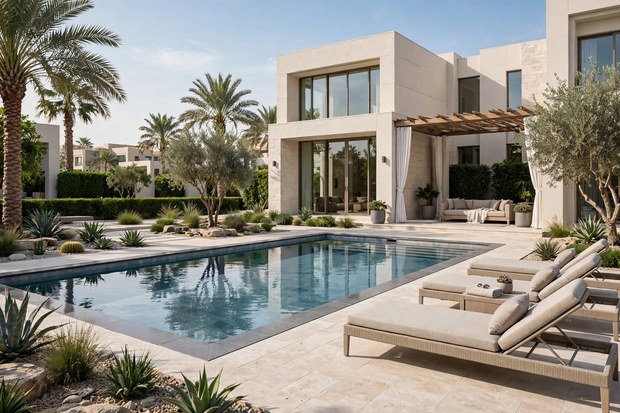
Related reading: our indoor pools guide covers design and humidity, our indoor versus outdoor comparison weighs both options, and our construction process guide shows how each type is built.