


A swimming pool in Dubai rarely breaks down without warning. Pumps grow noisier over a fortnight, tiles start sounding hollow underfoot, the water takes a little longer to clear after a dust storm — small signals that are easy to ignore when life is busy. Catch them early and most are quick, affordable fixes. Leave them, and Dubai’s heat, dust, and year-round swimming season will turn them into the kind of repair that keeps the pool closed for days.
This guide walks through the faults we see most often on villa pools across Dubai, what each one is telling you, and the honest line between a repair that makes sense and work that has gone past patching. If you’d rather skip straight to a diagnosis, our technicians carry out pool repairs across Dubai every day — call +971 50 866 5595 or message us on WhatsApp and we’ll take it from there.
Related reading: if leaks are your main worry, our guide on finding and fixing pool leaks in Dubai goes deeper; for the full strip-and-rebuild story, see swimming pool renovation in Dubai.
Read the early signs before they become a bigger job
Most pool failures announce themselves weeks before they become expensive. A pump that hums a fraction louder each evening, a faint white crust forming where the waterline meets the tile, grout that feels gritty rather than smooth under your fingertips — these are the pool’s early vocabulary. Learning to read it is the single most valuable maintenance skill a villa owner can develop, because nearly every major repair we carry out started as a minor symptom somebody noticed and filed away for later. Dubai’s climate compresses the timeline. In cooler countries a small fault might sit quietly for a season; here, 45-degree heat, fine dust, and water that never really cools down accelerate everything. A weeping seal becomes a failed bearing, a patch of black algae becomes a plaster stain, a hairline crack becomes a leak path. The sections below follow the order in which these problems usually surface, so you can match what you’re seeing to what’s actually going wrong.Tiles popping off and grout failing
Loose tiles are the fault owners notice first, usually as a hollow clack underfoot or a tile that rocks when pressed. The cause is rarely the tile itself. More often the expansion joint — the flexible channel that absorbs movement between the pool shell and the coping — has hardened or split, so thermal movement transfers straight into the tile bed. Once one tile debonds, water gets behind its neighbours, and a single loose tile becomes a drifting patch within a season. Grout tells the same story in a quieter voice. Cement grout softens and crumbles when water chemistry drifts acidic for long stretches, which happens easily in Dubai when evaporation concentrates everything in the water and top-ups lag behind. If the grout lines feel sandy or you can pick material out with a fingernail, the grout is failing and water is reaching the tile bed. Epoxy grout resists this far better, which is why we specify it for repairs in pools that have suffered repeat grout loss. One or two loose tiles with sound grout elsewhere is a tidy, honest repair: lift, clean back to a solid bed, re-bed, and regrout. Whole rows coming away, or tiles lifting over cracked render, is a different conversation — it usually means the substrate has failed and retiling properly is the only fix that lasts. A good technician will tap-test the surrounding tiles and tell you which situation you’re in before quoting anything.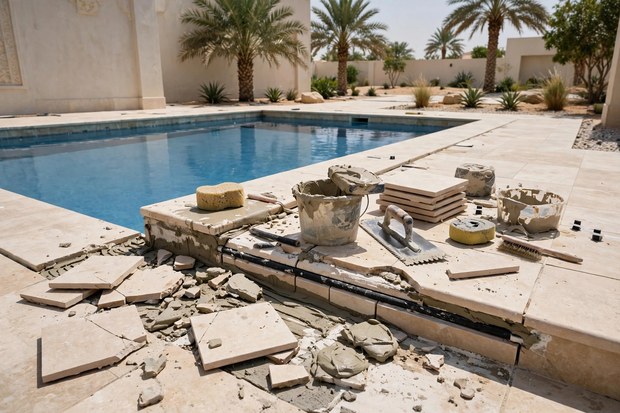
Rough, pitted plaster and stains that will not clean off
Run your hand along the pool wall below the waterline. It should feel smooth. If it feels like fine sandpaper, or you can see small pits and exposed aggregate, the plaster surface is deteriorating. The usual driver is chronically low pH or low calcium hardness — aggressive water that slowly dissolves the cement binder out of the plaster. Dubai’s high evaporation makes this easy to drift into: as pure water evaporates, everything dissolved in it concentrates, and without regular testing the chemistry slides. Stains fall into two families. Organic stains — leaves, berries, algae — are brownish-green and usually respond to brushing and shock treatment. Mineral stains are the stubborn ones: blue-green from copper (often from algaecides or heater corrosion), brown-red from iron in the fill water, grey-black from manganese. If a stain ignores brushing, chlorine, and acid spot-treatment, it’s mineral, and it has likely bonded into the plaster rather than sitting on it. Here’s the honest part: no repair fixes plaster that has deteriorated across large areas. Acid washing can buy time on mild roughness but thins the plaster further, and patch repairs on pitted surfaces rarely blend or bond well. When more than a small area is affected, replastering or resurfacing is the repair — everything else is postponing it. A technician who tells you this plainly is doing you a favour.Coping stones and deck cracks
Coping — the stones edging the pool — takes more punishment than any other part of the structure. It absorbs full sun, thermal expansion, splash-out chemicals, and foot traffic, all at once. Cracked or rocking coping stones usually trace back to a failed bed or a seized expansion joint, and once a stone moves, water finds its way underneath and starts working on the bond beam. Deck cracks need a calmer eye. Hairline shrinkage cracks in a concrete deck are common in Dubai’s heat and are usually cosmetic, especially if they haven’t changed in a year. What’s worth attention is a crack that is widening, one side sitting higher than the other, or cracking that runs from the deck straight into the coping and down the tile line — that pattern suggests ground movement, and ground movement near a pool shell deserves a professional assessment, not a tube of sealant. Small, stable cracks can be routed and filled with a flexible sealant as maintenance. Anything structural — displacement, water loss alongside the crack, or cracks that keep extending after repair — needs proper diagnosis first. Sealing over a moving crack just hides the evidence while the movement continues underneath.The pump: noise, lost power, and failure to prime
The pump is the heart of the system, and in Dubai it works harder than almost anywhere else — long daily run times through a summer that never really ends. A healthy pump hums steadily. Grinding or screeching points to failing bearings; a loud rattle often means a clogged or damaged impeller; a pump that hums but won’t start may have a failed capacitor. Each sound is diagnostic, which is why “it’s making a funny noise” is actually useful information for your technician. Failure to prime — the pump running but not moving water — is the most common pump call-out we attend. The causes run from the trivial to the serious: a pump basket choked with leaves, a skimmer weir stuck shut, an air leak on the suction side (often just a worn pump-lid O-ring), or a suction blockage. The O-ring deserves special mention — it’s a ten-minute part that mimics a dying pump perfectly, and we replace them constantly. Before calling, check the basket, the water level (low water starves the skimmer and lets the pump gulp air), and look for air bubbles streaming through the pump lid — bubbles mean a suction-side air leak. If the motor smells hot, trips the breaker, or the pump won’t prime with a clean basket and full water, stop and call a technician. Running a pump dry, even briefly, can destroy the seal and overheat the motor.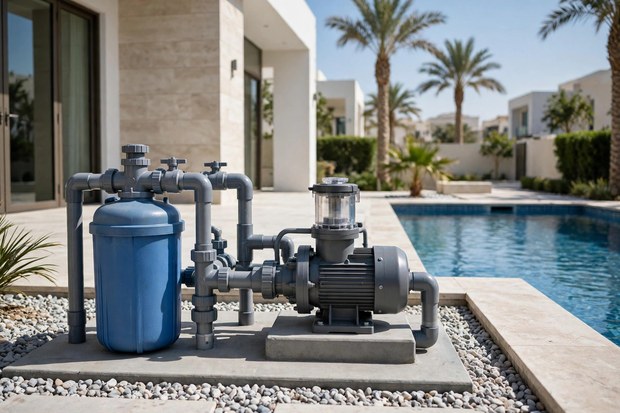
Cloudy water that will not clear
Cloudy water is a symptom, never a diagnosis, so resist the urge to tip in more chemicals before you know why it’s cloudy. Work the chain in order: is the filter clean, is circulation strong, and is the water balanced? In Dubai, the filter question comes first more often than owners expect — fine desert dust loads filters relentlessly, and a filter running at high pressure with reduced flow will leave water hazy no matter how perfect the chemistry is. Read the pressure gauge on the filter. A reading well above its clean baseline means the filter is choked and needs backwashing (sand) or rinsing (cartridge). If pressure is normal and flow is strong, test the water: low sanitiser, high pH, or combined chloramines all cloud water. And check circulation patterns — a pool with a dead corner where debris settles will stay dull in that corner until the return jets are re-aimed or the run time is extended. Cloudiness that survives a clean filter, good flow, and balanced water for more than a couple of days needs a technician’s eye. Persistent haze can signal channeling in a sand filter, a failing filter element, or phosphates feeding micro-algae that chlorine alone won’t clear. This is also the point where “add more shock” stops being a plan — repeated shocking without diagnosis just loads the water with dissolved solids.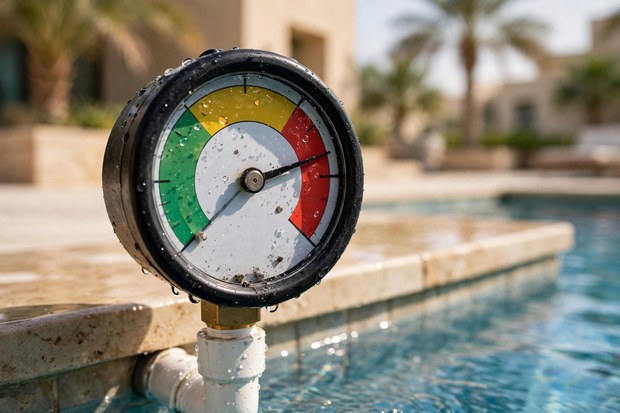
Heaters and chillers that stop doing their job
A heater or chiller that can’t hold temperature is often a flow problem wearing a disguise. Both units need strong, steady water flow across their heat exchangers, so weak circulation — a dirty filter, a tired pump, partially closed valves — makes them short-cycle, throw error codes, or simply underperform. Check flow before blaming the unit; we’d estimate a good share of “broken heater” call-outs resolve at the filter. Scale is the slow killer, especially for heaters. Dubai’s hard water lays mineral crust on heat exchangers, insulating them so the unit burns more energy for less heat, and the same scale attacks thermostats and sensors. Annual descaling is cheap maintenance against an expensive replacement. Chillers have their own version: dust-choked condenser coils that can’t shed heat, which in a Dubai summer means the unit runs constantly and cools barely at all. Call a technician when the unit shows error codes you can’t clear, leaks, makes new noises, or heats one day and not the next — intermittent faults are almost always electrical or control-board issues, not settings. And never open up a heater or chiller yourself beyond the owner’s-manual basics: gas connections, high-voltage electrics, and refrigerant circuits are strictly professional territory.Leaks: the slow damage owners miss
Leaks rarely announce themselves dramatically. More often it’s the water bill creeping up, the autofill running constantly, or a damp patch appearing near the equipment pad that wasn’t there last month. The bucket test is the classic first check: place a bucket of pool water on the steps, mark both levels, and compare after 24 hours with the pump running normally. If the pool drops noticeably more than the bucket, you’re losing water somewhere beyond evaporation — and in Dubai’s heat, “noticeably” means more than a few millimetres. Common leak points follow a pattern: pump-lid O-rings and drain plugs at the equipment pad, skimmer throats where plastic meets concrete, light niches, and return fittings. Underground plumbing leaks are the ones that need proper detection equipment — pressure testing and acoustic listening — because digging on a hunch gets expensive fast. We have a dedicated guide on how to find and fix a swimming pool leak in Dubai that walks through the full process; the short version is that leaks reward methodical testing and punish guessing.What you can safely check yourself — and what needs a technician
There’s a useful middle ground between “call someone for everything” and “fix it all yourself.” Safe owner checks include: skimmer and pump baskets, water level, the filter pressure gauge, visible O-rings and drain plugs, salt-cell crust (power off first), return-jet direction, and basic water testing. None of these require tools beyond a test kit, and together they resolve a surprising number of “faults” — we’d estimate a meaningful share of call-outs end at a choked basket or a stuck weir. The line sits where water meets electricity, gas, or sealed systems: opening a pump motor, touching heater internals, breaking into sealed plumbing, or handling anything refrigerant-related. Also call a professional for anything structural — shell cracks, moving coping, subsidence — and for faults that persist after the basic checks. A good rule: if the fix needs more than a screwdriver and a test kit, or if getting it wrong could flood something or hurt someone, it’s a technician’s job.When a repair is enough — and when renovation is the honest answer
The rule of thumb we give villa owners: if one thing has failed and everything else is sound, repair it. A worn seal, a scaled salt cell, a handful of loose tiles, a tired O-ring — these are repairs, and they’re usually quick. If faults are stacking up across systems — plaster rough everywhere, grout failing in every bay, equipment ageing out together — then serial repairs become the expensive option, and saying so is the honest advice even though it’s the bigger quote. Age is the quiet variable. Pool equipment in Dubai lives a hard life, and most pumps, filters, and heaters have a realistic service life that heat shortens. When a 12-year-old pump needs its third major repair, replacement is usually cheaper than another fix — not because anyone is upselling, but because the arithmetic favours it. Ask your technician for the expected remaining life of the equipment, not just the repair price; the comparison is what matters. Renovation doesn’t have to mean starting over. Often it means retiling and regrouting properly, refreshing the coping, and replacing equipment as a matched set — the kind of joined-up work our swimming pool renovation team in Dubai handles. The honest trigger for renovation is pattern, not price: when the same categories of fault keep returning, the pool is telling you the system is worn out, not that one part failed.How a good repair visit should run
Knowing what a proper visit looks like protects you from guesswork quotes. It should start with questions — when did the fault start, what changed, what have you already checked — because history narrows diagnosis enormously. Then a full walk-round: shell, tiles, grout, expansion joints, coping, deck, and the equipment pad, with the pump, filter, heater or chiller, and salt cell each checked in turn. Water testing comes early too, since chemistry explains or eliminates a whole class of faults. What you should hear is explanation before pricing: what the fault is, why it happened, what the fix involves, and what happens if you leave it. Be cautious of anyone who quotes a big number before inspecting, who can’t explain the cause in plain words, or who pressures for an on-the-spot decision. Itemised written quotes — parts and labour listed separately — are the norm for reputable firms, and ours always are. After the work, expect the technician to show you what was done, run the system with you watching, and tell you what to watch for next. Small, sensible aftercare advice — a pressure-gauge baseline to remember, a weir to keep an eye on — is the mark of someone who wants the fix to last. If you’d like that kind of visit, call +971 50 866 5595 or reach us on WhatsApp and we’ll arrange it.Frequently asked questions
What is the most common swimming pool repair in Dubai?
Pump and filter work tops the list — bearings, seals, impellers, and filter servicing — followed by tile and grout repairs. Heat, dust, and year-round use wear these parts faster than in cooler climates, which is why they dominate our call-outs.How do I know if my pool is leaking or just evaporating?
Run the bucket test: mark water levels in the pool and in a bucket of pool water on the steps, then compare after 24 hours. In Dubai’s heat some evaporation is normal, but if the pool drops noticeably more than the bucket, you have a leak worth investigating.Can I repair pool tiles myself?
A single loose tile can be re-bedded by a careful DIYer, but anything beyond that — rows of tiles, failed grout across bays, or tiles lifting over cracked render — needs a professional. Badly bonded tiles fail again quickly, and you’ll pay twice.Why does my pool pump keep losing prime?
Usually a suction-side air leak — most often the pump-lid O-ring — or a choked basket or skimmer. Check the basket, the water level, and look for air bubbles in the pump lid. If those are fine and it still won’t hold prime, call a technician before running it dry.How often should pool equipment be serviced in Dubai?
At least once a year for a full professional check of pump, filter, heater or chiller, and salt cell — more often for heavily used pools. Between visits, keep up the owner basics: baskets, pressure gauge, water testing, and brushing.Is cloudy pool water dangerous to swim in?
It can be. Cloudiness often means sanitiser isn’t reaching the whole pool, so bacteria and algae can thrive even if the water looks only mildly dull. Sort the cause — filter, circulation, or chemistry — before swimming, especially with children.My heater works sometimes and not others — what’s wrong?
Intermittent heating is usually a flow issue, a failing sensor, or a control-board fault rather than a settings problem. Check circulation first, but don’t keep resetting it — get a technician to diagnose it properly.When should I renovate instead of repairing?
When faults stack up across systems — widespread plaster deterioration, grout failing everywhere, equipment ageing out together — serial repairs stop making financial sense. One failed part in an otherwise sound pool is a repair; a pattern of failures is a renovation.How much does swimming pool repair cost in Dubai?
It depends entirely on the fault — an O-ring costs very little, a pump replacement or retiling considerably more. We don’t guess over the phone: book a free site visit and you’ll get an itemised written quote after inspection.Do you offer swimming pool repair across all of Dubai?
Yes — our technicians carry out pool repairs across Dubai, from villas in Arabian Ranches, Palm Jumeirah, Jumeirah, and Dubai Hills to communities across the city. Call +971 50 866 5595 or message us on WhatsApp to book.Related reading: our leak repair guide explains detection and diagnosis, our renovation cost guide explains when renovation beats repair, and our construction process guide walks through a new build stage by stage.