

Blog
An indoor pool is a room first and a pool second
The single most important idea in this guide is also the one most often missed: when you build an indoor pool, you are not just building a pool with a roof over it. You are building a specialised room that happens to contain a large body of heated water, and every part of that room — its walls, its ceiling, its glass, its air system, its drains — has to be designed for a warm, wet environment that never switches off. An outdoor pool releases its evaporated water into the open sky. An indoor pool releases it into a closed box, hour after hour, day and night, whether anyone is swimming or not. If the room has no answer for that moisture, the moisture will find its own answer, and it will usually choose the coldest surface it can reach: a window, a steel beam, the back of a ceiling panel, the inside of a wall. That is why the design conversation for an indoor pool starts with the building, not with the tile. Before anyone discusses finishes, a serious design team asks about the room’s structure, its insulation, its vapour protection, its air system and its drainage, and it sizes all of them for the pool that will sit inside. It also asks how the room connects to the rest of the house, because a pool room that leaks warm, chlorinated air into bedrooms and living spaces will make itself known quickly. Done properly, none of this is visible in the finished room. You see daylight, calm water and clean lines. The engineering is hidden, and that is exactly the point. An indoor pool should feel effortless to use, and effortlessness is engineered, not accidental.The benefits that make owners choose indoors
The first benefit is the one every owner mentions first: year-round swimming on your own schedule. Dubai’s outdoor pools are wonderful for much of the year, but peak summer midday heat, dust storms and winter evenings all interrupt the routine. An indoor pool removes those interruptions. The water stays at a comfortable temperature, the air stays controlled, and a morning swim before work or an evening swim after dinner becomes a habit rather than a weather-dependent treat. For owners who swim for exercise, for therapy, or simply to unwind every day, that reliability is the whole argument. A pool you can use daily is worth far more than a pool you admire from the window. The second benefit is privacy, and in Dubai’s closely built villa communities it matters more than many buyers expect. An outdoor pool, however beautiful, is overlooked by neighbouring windows, upper floors and garden walls unless it is carefully screened. An indoor pool is completely private by construction: a closed room, no sightlines, no audience. Families with children, owners who swim for health reasons, and anyone who simply values quiet will feel the difference every single day. The room becomes a personal wellness space rather than a display, and that changes how often it gets used. The third benefit is cleanliness and calm. An indoor pool never collects desert dust, leaves, insects or storm debris, so the water stays clearer with less daily skimming and the filtration system works less hard for the same result. The room is also sheltered from wind and glare, which makes it easier for children and older swimmers to enjoy, and it gives the household a sheltered place to gather that does not depend on the season. Add a seating area, a shower and a changing corner, and the pool room becomes a genuine part of the home rather than a separate attraction. For many owners, that is when the pool stops being a luxury and starts being a daily routine.Designing the room: size, height, light and layout
Room size is the first practical question, and it deserves more thought than the pool’s dimensions alone. A pool room needs deck space around the water for safe entry and exit, for loungers or seating, and for a technician to reach the plant and pipework. It needs a sensible ceiling height, because a low ceiling traps warm, moist air exactly where people breathe and where condensation forms most readily, while a generous ceiling gives the air system room to work and the room a sense of calm. It needs space for a plant room that a technician can actually enter and service, for drainage that carries backwash and splash water away properly, and for access routes that let equipment be delivered and, one day, replaced without dismantling the room. Light is what separates a beautiful indoor pool room from a gloomy one. Large windows, glass walls and skylights bring daylight in and keep the garden connection that owners fear losing when they move a pool indoors. But glass is also the surface where condensation appears first, because glass cools faster than a wall. That does not mean avoiding glass; it means designing for it, with warm air delivered across the glazing so its surface stays above the dew point, and with frames chosen for a wet environment rather than a dry one. Lighting deserves the same care: underwater lights, soft ceiling lights and dimmable settings turn the room from a daytime exercise space into an evening retreat, and all electrical work near water must be planned, protected and inspected by qualified hands. Layout details matter just as much. A shower and changing corner near the entrance keeps wet feet off the rest of the house. Non-slip deck finishes, clearly marked depths, comfortable steps and well-placed handrails make the room safe for every age. Sound deserves a thought too, because hard surfaces and water make a pool room echo; acoustic treatment in the ceiling keeps conversation pleasant rather than harsh. None of these details is glamorous, and all of them are what you will notice every day you use the room.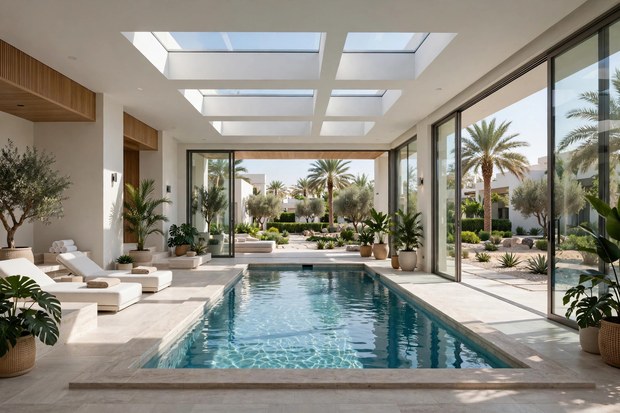
Humidity: the problem that decides everything
If there is one section of this guide to read twice, it is this one. Humidity is the problem that decides whether an indoor pool succeeds or fails, and it fails quietly. A heated pool surface evaporates continuously, and that vapour has to go somewhere. In a well-designed room it is captured by the air system and removed. In a poorly designed room it condenses on the coldest available surface, day after day, and the damage accumulates where nobody looks: behind ceiling panels, inside wall cavities, on steel structure, around window frames. Paint peels, metal corrodes, mould takes hold, and the room starts to smell damp even when the water itself is perfectly clean. The warning signs are worth knowing, because they appear long before structural damage does. Windows and skylights that stay misted or dripping, damp patches or staining on ceilings and upper walls, rust on door hardware or light fittings, a musty smell that returns after cleaning, and paint or plaster that softens near the pool room are all signals that moisture is winning. None of these means the pool is leaking. In most cases the pool is doing exactly what pools do — evaporating — and the room simply has no adequate answer for it. That distinction matters, because it tells you where to spend: on the air system and the building envelope, not on patching finishes that will fail again. Standard home air conditioning, on its own, is typically not the answer. A normal cooling system is sized for a dry living room, not for a room with a heated water surface evaporating around the clock, and it cannot hold humidity steady through every season on its own. Owners sometimes try opening windows or running exhaust fans, and in Dubai’s climate that approach has a further weakness: much of the year the outdoor air brought in is itself hot and humid, so it adds moisture rather than removing it, while throwing away the energy already spent heating the room. A proper indoor pool room needs a system designed for its actual moisture load, and that system needs to be part of the original design, not an afterthought bolted on when the windows start dripping.Dehumidification and ventilation, done properly
A proper indoor pool climate system does three jobs at once: it removes moisture from the air, it keeps the air at a comfortable temperature, and it delivers that air where it is needed. The heart of it is a dedicated dehumidification unit sized for the pool’s surface area, water temperature and expected use — not a generic unit chosen by guesswork. Sizing matters because an undersized unit will run constantly and still lose ground, while the room’s humidity creeps up and condensation returns. A qualified designer calculates the moisture load properly, including the extra evaporation caused by splashing, water features and heavy use, and then specifies equipment that can handle it with margin to spare. How the air is delivered matters as much as how much moisture is removed. Warm, dry supply air should wash across glazing and cold surfaces first, keeping them above the dew point so condensation never starts, and then move down into the breathing zone where swimmers actually are, so the air feels fresh rather than heavy. The pool room should also sit at slightly lower air pressure than the rest of the house — exhausting a little more air than it supplies — so that warm, chlorinated pool air is drawn out of the room rather than pushed into bedrooms and living spaces through every crack and doorway. An airlock or well-sealed vestibule at the entrance helps the same way, and it is a small detail that makes a large difference to the rest of the home. Two everyday habits complete the system. A pool cover, used whenever the pool is not in use, is the single most effective moisture and heat control an owner has: it seals the water surface, cuts evaporation dramatically, and lets the climate system rest instead of fighting a wide-open pool all night. And the dehumidification equipment itself needs regular professional servicing, because it is specialised machinery, not a household appliance. Filters, coils, drains and controls should be checked on a proper schedule by qualified technicians, and warning lights or unusual running patterns should be investigated promptly rather than ignored. A dehumidifier that has quietly stopped working will not announce itself; the windows will, a little too late.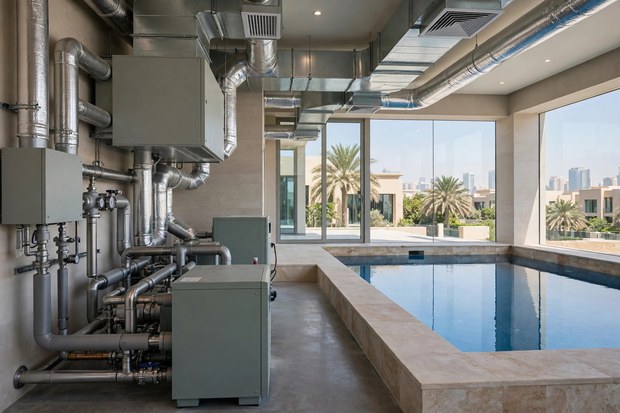
Protecting the building from its own pool
Alongside the air system, the building itself needs protection, and this protection has to be built into the walls, not painted on afterwards. A continuous vapour barrier behind the interior finishes stops moist air from reaching cold structure inside the walls, where it would condense unseen and rot timber, corrode steel and feed mould for years before anyone noticed. Insulation must be detailed with the same care, because a gap or a cold bridge in the insulation becomes a condensation point by default. Fixtures and fittings in the room — door hardware, light housings, fixings, exposed metal — should be chosen for corrosion resistance, since pool air carries chloramines, the compounds formed when chlorine meets organic matter, and chloramines are considerably more aggressive to metal and finishes than ordinary humidity. Finishes deserve the same thinking. Tiles, stone and plaster in a pool room live in warm, wet, chemically active air, so they should be selected for that environment rather than for a dry living room, and grouts and sealants should be specified accordingly. Glazing frames, skylight kerbs and any steel structure in the room need protection or a corrosion-resistant specification, and ceiling systems should allow access for inspection, because a ceiling nobody can look behind is a ceiling nobody can maintain. None of this is visible in a finished room, and none of it can be retrofitted cheaply once the room is tiled and furnished. It is the hidden half of the budget, and it is the half that decides whether the room still looks and smells good a decade later. Existing villas deserve a special note here. Converting a room, a basement or an extension into a pool room is commonly possible, but it starts with a structural and environmental review, not with a tile catalogue. The existing structure must carry the pool’s weight and water load, the drainage and plant routes must be workable, and the walls and roof must be able to receive a proper vapour barrier and insulation system. Where those conditions cannot be met honestly, a good designer will say so, and a retractable enclosure over a garden pool or a glass-walled pool room added to the villa may be the wiser answer. A conversion forced into an unsuitable room is how the worst indoor pool stories begin.Heating the water and the air in balance
Comfort in an indoor pool room comes from a balance, not from a single setting. The air is typically kept slightly warmer than the water, so swimmers stepping out do not feel chilled, and so evaporation from the surface is held in check — cooler air over warm water pulls more vapour off the surface, which is exactly what the dehumidification system is trying to prevent. A heat pump is a common choice for heating the water itself, because it moves heat efficiently rather than generating it from scratch, and it pairs well with a dehumidification system that can return recovered heat to the water. In Dubai, winter evenings are when heating earns its keep: the desert night cools quickly, and a pool room that cannot hold its temperature on a cold evening will sit unused through the very season its owners most want it. Summer brings the opposite question. An indoor pool room in a Dubai summer still needs cooling, because the building gains heat through its roof and glazing, and a room full of warm, moist air can feel heavy even when the water is perfect. The climate system should therefore handle both heating and cooling across the year, with controls that let the owner set water and air temperatures sensibly rather than fighting the system. A pool cover helps here too, holding heat in the water overnight instead of letting it escape into the room and then out through the ventilation. The goal throughout is steady, quiet comfort: water that invites you in, air that feels fresh when you step out, and energy use that reflects a system working with the pool rather than against it. For owners weighing heating and cooling choices in more depth, our pool chiller guide explains how cooling works for Dubai pools, and our saltwater versus chlorine comparison covers the water-treatment decision that shapes daily pool care.The pool itself: shell, finishes and water care indoors
The pool inside the room still has to be built to the same standards as any good villa pool. A properly engineered shell, a waterproofing membrane applied to a correctly prepared surface, and a witnessed water test before any tile is fixed remain non-negotiable, because an indoor leak is harder and more disruptive to repair than an outdoor one: the water has nowhere harmless to go, and the room around it is finished and furnished. Hydraulics and the plant room follow the same logic — pumps, filtration and pipework sized for the pool, laid out so a technician can reach every valve and connection, and a plant room with proper drainage and ventilation of its own. Cutting corners on the hidden structure of an indoor pool is never a saving; it is a future renovation inside a finished room. Finishes and water care, though, do change indoors, and mostly for the better. Without sun, wind and dust, the water stays cleaner and chemical consumption is typically lower, because sunlight is what breaks chlorine down fastest outdoors. That closed environment has its own demand, however: chloramines, the compounds behind the classic pool smell, build up more noticeably in an enclosed room, so ventilation and air distribution matter as much to water quality as dosing does. A salt chlorinator is a popular choice indoors for its steady, gentle chlorination, while traditional chlorine dosing works perfectly well when it is managed carefully and the room’s air system keeps chloramines moving out. Either way, regular water testing and balancing — the same discipline as any pool, applied consistently — is what keeps the water clear, the finishes healthy and the room smelling fresh rather than chemical. Deck finishes deserve a final word here, because they are a safety feature as much as a design choice. A wet indoor deck must grip reliably under bare feet, so non-slip tiles or stone, properly grouted and sealed for a wet environment, are essential rather than optional. Steps should be clearly visible, depths clearly marked, and handrails placed where swimmers of every age actually reach for them. These details cost little at design stage and prevent the most common indoor pool accident, which is not dramatic at all: a simple slip on a wet deck.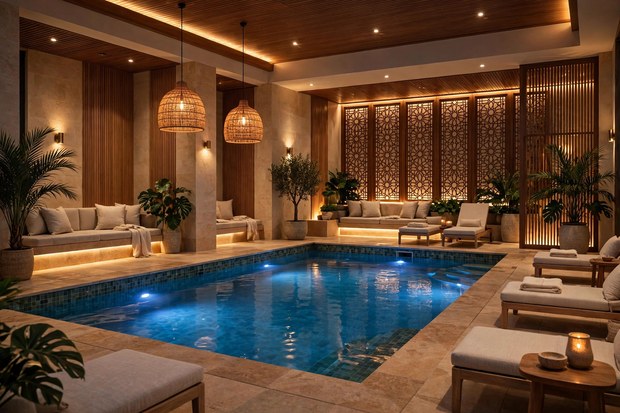
How maintenance differs from an outdoor pool
Owners often ask whether an indoor pool is more or less work than an outdoor one, and the honest answer is that the work moves rather than disappears. The daily debris battle largely ends: no leaves, no dust storms, no insects landing in the water, so skimming and vacuuming take less time and the filter loads more slowly. Water testing and balancing continue exactly as before, because chemistry does not care whether the pool has a roof, and pumps, filters and chlorinators need the same scheduled care. What changes is the addition of a second system to look after: the climate system. Dehumidifier servicing, air-filter changes, condensate drain checks and periodic inspection for condensation or corrosion become part of the routine, and they belong on the same schedule as the pool’s own servicing, not treated as an afterthought. The inspection habit is what separates indoor pools that age gracefully from those that do not. Once a month, walk the room slowly and look: at glazing and skylight frames for early condensation or staining, at ceiling edges and upper walls for damp marks, at metal fittings for the first signs of rust, at the dehumidifier’s drains and warning indicators, and at the pool cover’s condition and mechanism. Catching a small change early — a drain beginning to block, a seal beginning to fail, a fitting beginning to corrode — is a minor service visit. Missing it for a season is how small moisture problems become building repairs. An annual maintenance contract that covers both the pool and its climate system, with technicians who understand both, is the simplest way to make sure neither half is neglected, and it keeps one company accountable for the whole room rather than two companies blaming each other. For ongoing care, see our guides to swimming pool maintenance in Dubai and swimming pool cleaning in Dubai, and if you are weighing what shapes a quotation, our pool cost factors guide explains the elements honestly, without figures that cannot be quoted responsibly before a site visit.Safety in a closed room
An indoor pool room is a safer place to swim than an open garden in several ways — no glare, no wind, no sudden weather, warm water, clear sightlines — but it needs its own safety discipline, especially where children are concerned. Access control comes first: the room should be entered through a door that children cannot open unsupervised, ideally self-closing and self-latching, or kept locked when the pool is not in use. That single measure prevents the scenario every pool-owning parent fears, a small child wandering into the water alone, and it matters more indoors than outdoors because the pool sits inside the home itself, steps from bedrooms and play areas. Inside the room, the safety list is practical rather than dramatic. Non-slip deck finishes throughout, including the route from the door to the water. Clearly marked depths and a shallow area where children can stand comfortably. Steps and handrails that suit small hands as well as adult ones. Lighting bright enough that the whole pool, including its deepest point, is visible from the deck. Electrical safety treated seriously: all fittings near water properly protected, inspected and maintained, and no portable electrical equipment brought into the pool room casually. Pool covers, where fitted, must be fully removed before anyone enters the water, and must never be treated as a surface anyone can walk on. And the oldest rule of all still applies, indoors as out: nobody swims alone, and children are supervised by an adult who is watching the water, not a phone. A calm, enclosed room can make supervision feel unnecessary. It is not.Who an indoor pool suits — and who should think twice
An indoor pool suits owners who swim often and on a routine, who prize privacy above sunbathing, who have children learning to swim and want warm, calm, supervised water always ready, and who want a wellness room — for exercise, therapy or daily unwinding — more than a garden showpiece. It suits villas where a suitable room, basement or extension space exists, or where a new pool room can be designed properly from the start, with the structure, vapour protection and climate system all planned together. For those owners, the indoor pool becomes the most-used room in the house, and the investment is measured in daily use rather than in occasional display. It deserves a second thought where the space is tight, the ceiling is low, the existing structure cannot honestly carry the load or receive proper vapour protection, or where the climate system would have to be improvised rather than designed. In those cases, the honest alternatives are worth considering: a glass-walled pool room that keeps the garden view with indoor control, or a retractable enclosure over a garden pool that gives sunshine when open and shelter when closed. For a balanced side-by-side comparison, read our indoor versus outdoor pools guide. Whichever direction you choose, the decision should follow a proper site visit and an honest assessment of your villa, not a brochure. A good design team will tell you plainly when an indoor pool is right for your home — and when it is not. Hello Landscaping & Pools LLC designs, builds and maintains indoor pools across Dubai. If you are considering an indoor pool for your villa, start with that site visit. Walk the space with a designer who understands both the pool and the room around it, ask how the humidity, structure and climate system will be handled for your specific villa, and compare the answers carefully before committing. The right team will welcome every question in this guide, in specifics rather than slogans. For design and construction, see our swimming pool construction services and swimming pool renovation services, and if an older indoor pool room needs attention, our renovation team can assess both the pool and the room around it.Frequently asked questions
Can I swim in an indoor pool all year round in Dubai?
Yes, and that is the main reason owners choose one. Because the water and the air are both controlled, an indoor pool stays comfortable through peak summer heat, dust storms and cold winter evenings alike, so a daily swimming routine never depends on the weather. The key is a climate system sized for the room and a pool cover used whenever the pool is not in use, which together hold water and air temperatures steady through every season.Does an indoor pool need a dehumidifier, or is air conditioning enough?
It needs dedicated dehumidification. A heated pool surface evaporates around the clock, and a standard home cooling system is sized for a dry living room, not for that continuous moisture load, so it cannot hold humidity steady on its own. Without a properly sized dehumidification unit, moisture condenses on glazing, ceilings and structure, and the damage accumulates unseen. Opening windows or running exhaust fans is not a reliable substitute either, because much of the year Dubai’s outdoor air is itself hot and humid and adds moisture rather than removing it.Why do indoor pool rooms get condensation on the windows?
Condensation appears when warm, moist pool air meets a surface colder than the air’s dew point, and glass cools faster than a wall, so windows and skylights show it first. It is a sign that warm, dry air is not being delivered across the glazing, or that humidity in the room is running too high for the system to handle. The fix is in the air design: supply air washed across the glass to keep its surface warm, humidity held in a comfortable band by the dehumidification unit, and a pool cover used when the pool is idle to cut evaporation at its source.Can an indoor pool be built in an existing villa?
Commonly yes, but it starts with a structural and environmental review rather than a tile choice. The existing structure must carry the pool’s weight and water load, drainage and plant routes must be workable, and the walls and roof must be able to receive proper vapour protection and insulation. Where those conditions cannot be met honestly, a glass-walled pool room or a retractable enclosure over a garden pool may be the wiser answer, and a good designer will say so plainly rather than forcing a conversion into an unsuitable room.Is an indoor pool harder or easier to maintain than an outdoor pool?
The work moves rather than disappears. Daily debris largely ends, since no dust, leaves or insects reach the water, and chemical use is typically lower without sunlight breaking chlorine down. But the climate system joins the routine: dehumidifier servicing, air-filter changes, condensate drain checks and regular inspection for condensation or corrosion all become part of scheduled care. An annual maintenance contract covering both the pool and its climate system is the simplest way to make sure neither half is neglected.How do you heat an indoor pool in Dubai’s winter?
With a heat pump for the water, paired with a climate system that keeps the room air slightly warmer than the water so swimmers do not feel chilled when they step out. Dubai’s winter evenings cool quickly, and that is when heating earns its keep. A pool cover used overnight holds heat in the water instead of letting it escape into the room, which keeps temperatures steady and reduces the work the heating system has to do.Saltwater or chlorine for an indoor pool?
Both work well indoors when managed properly. A salt chlorinator is popular for its steady, gentle chlorination and softer feel to the water. Traditional chlorine dosing works equally well with careful testing and balancing. The indoor difference is chloramines, the compounds behind the classic pool smell, which build up more noticeably in an enclosed room — so ventilation and air distribution matter as much to the choice as dosing does, and the room should sit at slightly lower air pressure than the rest of the house so pool air does not drift into living spaces.Is an indoor pool safe for small children?
Yes, when the room is designed for them. Access control matters most: a self-closing, self-latching or locked door so children cannot enter the water unsupervised. Inside the room, non-slip decks, a shallow standing area, clearly marked depths, comfortable steps and handrails, and bright lighting so the whole pool is visible from the deck all contribute. And the oldest rule still applies: children are supervised by an adult watching the water, and nobody swims alone.What room size and ceiling height does an indoor pool need?
There is no single answer, because it depends on the pool’s size and the villa’s structure, but the principles are consistent. The room needs deck space around the water for safe entry and exit, room for seating and for a technician to reach the plant, and a ceiling high enough that warm, moist air does not sit trapped where people breathe. A proper design visit measures the space, checks the structure and drainage routes, and confirms what is genuinely workable before any design is drawn.Does an indoor pool always smell of chlorine?
No — a strong pool smell is a sign of poor air management, not of a healthy pool. The smell comes from chloramines, which form when chlorine meets organic matter, and in a closed room they linger when ventilation is inadequate. A well-designed room, with dedicated dehumidification, air delivered properly across the space, slightly lower pressure than the rest of the house, and consistent water balancing, smells fresh rather than chemical. If a pool room smells strongly, the air system and water balance should be checked before anything else.Related reading: our pool types guide compares shapes and systems, and our construction process guide walks through a build stage by stage.