

Choosing between an indoor and an outdoor pool in Dubai is not really a choice between two products. It is a choice between two ways of living with water in a climate that is extreme at both ends of the year. An outdoor pool gives you sun, sky and garden life, and asks you to accept dust, summer heat and a cleaning routine that never quite stops. An indoor pool gives you calm, privacy and a swim whenever you want one, and asks you to accept a room that must be engineered as carefully as the pool itself. Both can be wonderful. Both can disappoint. The difference is almost always whether the pool matches how you actually live, rather than how a brochure imagines you living.
This guide lays the two options side by side for Dubai villa owners: swimming through the year, summer heat and winter mildness, dust and cleaning, humidity and ventilation, heating and cooling, light and privacy, space and approvals, and the maintenance each one really demands. It answers the questions owners actually ask — in community groups, on forums and on site visits — in detail, and it ends with a simple way to decide which pool suits your household, your plot and your swimming habits. For pricing on either option, message us on WhatsApp and we will arrange a free site visit and an exact quote for your villa.
Start with how you actually swim, not with a brochure
The single most useful question in this whole decision has nothing to do with construction. It is: how do you actually swim? A person who swims most mornings before work needs something completely different from a family that swims socially on weekends, and both need something different again from a household that mostly lounges by the water and swims a few times a month. Be honest about your routine, because the pool that suits your real routine is the one you will still love in year three, while the pool that suits an imagined routine is the one that quietly stops being used. A daily swimmer, someone training for fitness or swimming for a bad back or stiff joints, lives by consistency. They want the water at the same comfortable temperature every morning, no wind, no dust, no waiting for the sun to move off the deck. For them, an indoor pool’s steady, controlled water is hard to beat, because the swim happens whether it is dusty outside, blazing hot, or a rare grey morning. A weekend family, by contrast, often gets more joy from an outdoor pool: children playing in the open air, friends around the deck, evening swims under the sky, the pool as part of the garden rather than a room apart from it. And a household that mostly entertains will value space, sunshine and atmosphere over precision — the outdoor pool as the centre of garden living. None of these routines is wrong. But each one points clearly at one side of this decision, and naming yours first makes every section that follows much easier to weigh.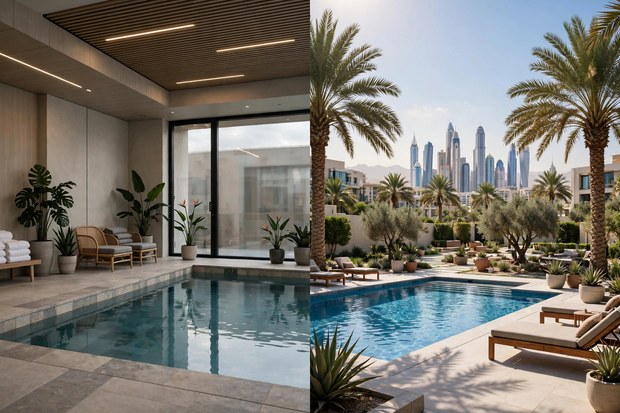
Swimming through Dubai’s year: what each season does to each pool
Dubai does not have one swimming season; it has several, and each one treats the two pool types differently. In the cooler months, roughly from late autumn through early spring, an outdoor pool is genuinely hard to beat. The air is mild, the evenings are beautiful, and a garden pool under open sky is exactly what most owners pictured when they decided to build. Many owners say winter is when their outdoor pool earns its keep, and they are right — those months are the outdoor pool’s golden season, when swimming feels effortless and the garden is at its best. Summer reverses the picture. Through the hottest months, an outdoor pool at midday can sit empty for hours, not because the water is unusable but because the deck is fierce, the sun is relentless, and the water itself can turn bath-warm without cooling. Swimming shifts to early mornings and evenings, which suits some households perfectly and frustrates others. An indoor pool, meanwhile, barely notices the season. The room holds its temperature, the water stays controlled, and the swimmer’s routine continues unchanged from January to August. That steadiness is the indoor pool’s great gift — and its great cost, because holding that steadiness takes a properly designed room and plant, which we come to below. The honest summary is this: outdoors wins the winter, indoors wins the summer, and the shoulder months in between are pleasant in either. Your decision turns on which season matters more to your swimming.Summer outdoors: heat, sun and the case for chilling
Outdoor pool owners in Dubai ask one summer question more than any other: why is the water so warm, and what can be done about it? The answer is simple physics. A garden pool sits under intense sun for most of the day, and the water absorbs that heat hour after hour. By the peak of summer, an uncooled outdoor pool commonly feels more like a warm bath than a refreshing swim, which is the opposite of what most people want on a hot day. Warm water is also harder on chemistry: sanitiser burns off faster, algae finds conditions it likes, and the water needs more attention just to stay clear. The practical answer is cooling, and the usual route is a dedicated pool chiller or a reversible heat pump that cools in summer and heats in winter. A chiller actively removes heat from the water and releases it into the air, holding the pool at a comfortable swimming temperature even through the hottest weeks. Shade helps too — pergolas, shade sails and planting all reduce direct sun on the water — and features that move the water, such as fountains and aerators, cool it slightly through evaporation, though they are a supplement rather than a solution on their own. The point for this decision is that an outdoor pool in Dubai is not a “no equipment” option: to swim comfortably all summer outdoors, you budget for cooling just as an indoor pool budgets for dehumidification. Our pool chiller guide covers how cooling works and what to consider when choosing a system.Winter flips the contest: mild months and the outdoor pool’s best season
If summer is the indoor pool’s argument, winter is the outdoor pool’s reply. Through Dubai’s cooler months, an outdoor pool needs little help to be delightful: the water is naturally comfortable with modest heating, the air is pleasant, and the whole garden becomes usable living space again. Evening swims, weekend gatherings and children playing outside all happen naturally, without any machinery working hard in the background. For households whose swimming peaks in winter — and many Dubai families find it does, because the garden is simply more inviting then — the outdoor pool delivers its best value exactly when they use it most. An indoor pool in winter is comfortable too, of course, but the contrast narrows. The room still needs its heating and ventilation running, and the swimmer gains less over the outdoor alternative than they do in August. This is worth weighing honestly: if your household swims mainly from the cooler months onward and rarely swims at midday in peak summer, you may be paying for year-round climate control you barely use. Conversely, if you swim daily through summer, winter’s outdoor pleasures do not compensate for months of empty midday water. Match the pool to the season you actually swim in, not to the season you photograph best.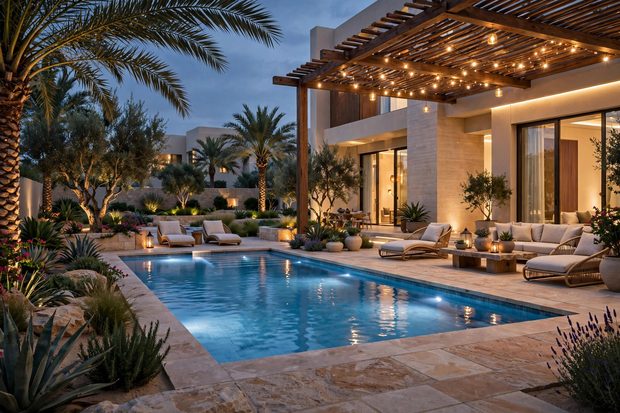
Dust, leaves and debris: the daily cleaning difference
Ask any outdoor pool owner in Dubai what the daily work looks like, and the answer starts with dust. Fine desert dust is the defining cleaning fact of a garden pool here: it settles on the water after every windy day, it drifts in during sandstorms, and it finds its way into skimmers, filters and corners no matter how sheltered the garden seems. After a sandstorm, an outdoor pool can need a full recovery sequence — skimming, brushing, vacuuming and a filter clean — before it looks inviting again. Day to day, the routine is heavier on skimming and vacuuming, and chemical adjustments come more often, because heat, sun and dust all push the water chemistry around. An indoor pool’s cleaning load is lighter in exactly this respect. With no wind and no dust storms reaching the water, skimming and vacuuming drop to a fraction of the outdoor routine, and the water chemistry stays steadier because sun and heat are no longer driving it. What replaces that work is a different kind of attention: regular checks of the ventilation and dehumidification systems, keeping the room’s surfaces dry and clean, and watching for condensation in corners and on glazing. So the trade is not “work versus no work” — it is visible, physical cleaning outdoors against quiet, technical checks indoors. Households that enjoy a hands-on garden routine often mind the outdoor work less than they expect; households that want swimming with minimal daily chores usually prefer the indoor balance. Either way, a proper swimming pool maintenance routine in Dubai matters for both types, and the differences are in what the visits focus on, not in whether visits are needed.The indoor pool’s hidden system: humidity, ventilation and dehumidification
An indoor pool’s most important system is the one you never swim in. Warm water evaporates continuously, and every litre that leaves the pool enters the room’s air. Without a way to remove it, that moisture condenses on the coldest surfaces it can find: glazing, external walls, ceilings, steelwork. Over time, persistent condensation damages finishes, feeds mould, corrodes metal and makes the room feel dank rather than calm. A well-designed indoor pool room therefore treats humidity as a first-order design problem, not as an afterthought to be solved with an open window. The standard answer has three parts. Ventilation brings in fresh air and exhausts humid air, with air change rates sized for the pool’s evaporation, not for an ordinary room. A dehumidifier, usually a ducted unit in the plant room, actively pulls moisture from the air and returns the recovered heat to the room or the water. And a vapour barrier, a continuous sealed layer in the room’s construction, stops moisture migrating into the building fabric where it would condense unseen. The three work together: the barrier keeps moisture out of the structure, the dehumidifier keeps the air dry, and the ventilation keeps the air fresh. Miss any one of them and the room tells you within a year. Get them right and the indoor pool feels exactly as it should: warm, dry-aired, calm and odour-free.Heating and cooling: what each pool asks of its plant room
Every Dubai pool needs its water temperature managed; the two types just ask for different equipment. An indoor pool needs heating that works in step with the room. The water is typically held a degree or two below the air temperature, because warm air over slightly cooler water limits evaporation, while cool air over warm water drives it up and fogs the glazing. A heat pump or boiler heats the water, the room’s heating holds the air, and the two are controlled together rather than left to fight each other. Get the balance wrong and the room either feels clammy or the windows weep. An outdoor pool’s plant room is simpler in concept but has its own demands. Heating for the cooler months, usually a heat pump, extends the season and keeps winter mornings comfortable. Cooling for summer, usually a chiller or a reversible heat pump, stops the water turning bath-warm. Both need space, power and pipework planned from the start, and both need to be sized for the pool’s volume and the exposure of the site. The practical lesson is the same for both pool types: decide the water system when you decide the pool, not after the shell is built. Retrofitting heating, cooling or dehumidification into a finished pool room or a finished garden is always more expensive and more disruptive than planning it in.Light, air and the feel of the space
Swimming is a sensory experience, and the two pool types feel profoundly different. An outdoor pool gives you the full register: sun on your skin, breeze on the water, the sound of leaves and birds, night skies and sunsets. For many owners, that sensory richness is the entire reason to have a pool. An indoor pool trades the sky for control: steady light, still air, warm water and a quiet that can feel meditative. Neither feeling is better in the abstract; they are different pleasures, and the right one is the one you actually want more of. Daylight matters more indoors than most owners expect. A dark pool room feels oppressive no matter how well the water is kept, so skylights, glass walls and good artificial lighting are not luxuries but necessities. The best indoor pool rooms borrow as much daylight as the structure allows, and use lighting — underwater lights, wall washers, subtle ceiling spots — to keep the room feeling alive in the evening. Outdoors, the design question is the opposite: how much sun do you want, and where? Too little shade and the deck is unusable at midday; too much and the pool feels gloomy. The feel of the space is worth designing deliberately either way, because you will live with it every day.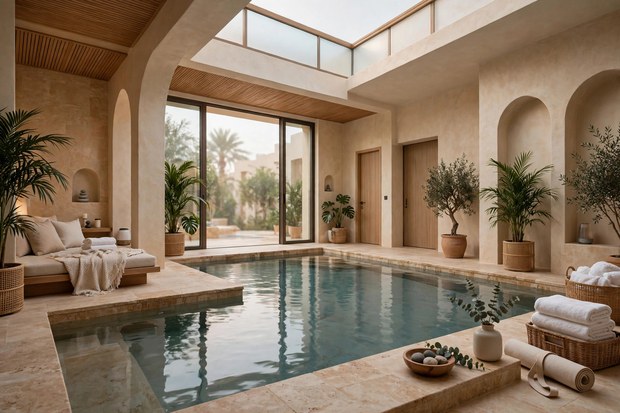
Privacy, noise and neighbours
Privacy cuts differently for the two pools. An indoor pool is private by construction: a closed room with controlled access, no overlooking windows, no need to think about who can see in. For owners who swim for exercise or therapy and want no audience, or for households where cultural privacy matters, that absoluteness is decisive. An outdoor pool’s privacy is a design problem to be solved with boundary walls, screening planting, pergolas and the orientation of the pool itself. It can be solved well — high walls and mature planting make many Dubai garden pools feel completely secluded — but it takes deliberate design, and it is worth checking the reality from upstairs windows before assuming the garden is private. Noise runs the other way. An indoor pool room contains sound, which is a blessing for neighbours but can make the room itself echoey; acoustic treatment of the ceiling and walls is worth specifying. An outdoor pool broadcasts: children’s play, evening gatherings, the hum of equipment all carry, especially in the still evening air. Good neighbour relations and sensible hours matter more with a garden pool, and equipment should be sited and screened to minimise its voice. Neither is a deal-breaker, but each asks for a different kind of consideration.Space, structure and approvals: what each option demands from your home
An indoor pool asks for a room, and the room asks for structure. The pool’s weight, full of water, is enormous, so the floor beneath it must be designed to carry it — a ground-bearing slab is straightforward, while an upper floor or a basement needs a structural engineer’s design and approval. The room needs height for comfortable swimming and for the ventilation ductwork, drainage falls to waste, and access for the plant equipment. In a new-build villa, all of this can be drawn in from the start. In an existing villa, it means finding a space — a large basement, a ground-floor extension, a repurposed majlis block — that can take the load and the services without compromising the house. An outdoor pool asks for garden rather than structure, but the garden has its own demands. Access for excavation machinery, space for the plant room, and the setbacks and approvals your community requires all shape what can be built. Most Dubai communities have rules about pool placement, fencing and equipment noise, and getting those confirmed before design saves expensive rework. The approvals for an outdoor pool are usually simpler than for structural work inside the house, but they still need to be checked. Either way, the site visit is where these questions get answered honestly — which is why we insist on seeing the villa before quoting. For a closer look at how the design process works, see our swimming pool design process in Dubai.Maintenance side by side: daily, weekly and seasonal work
Put the two maintenance routines next to each other and the difference is one of rhythm. An outdoor pool asks for attention in small, frequent doses: skimming after wind, brushing the waterline where dust settles, checking chlorine and pH more often in summer, cleaning the filter after dust storms. It is visible work, and owners who do a little of it themselves often feel more connected to their pool. A service contract covers the technical side — the filter cleans, the equipment checks, the seasonal deep cleans — but the daily skimming is the part that keeps an outdoor pool inviting between visits. An indoor pool’s routine is quieter day to day but more technical. Skimming and vacuuming take minutes rather than tens of minutes, and the chemistry moves slowly enough that weekly checks usually suffice. What the owner — or the service contract — must not neglect is the room’s systems: the dehumidifier’s filters and drains, the ventilation grilles, the seals around glazing, the first signs of condensation or mould. Seasonal work exists for both: an outdoor pool benefits from a thorough pre-summer service of the chiller and a post-summer filter overhaul, while an indoor pool wants its air-handling serviced before the humid months. Neither is maintenance-free, and honestly neither should be — a pool is a living system, and the owners who accept that enjoy theirs far more than the ones who resent it.Which suits whom: families, fitness swimmers, small plots and entertainers
For families with children, the split often comes down to age and energy. Young children and daily swimmers thrive in an indoor pool’s warm, calm, predictable water — lessons happen on schedule, play happens without sunburn, and supervision is simpler in one contained room. Older children and teenagers often prefer the outdoor pool’s freedom: space to play, friends over, the garden as an extension of the house. There is no universal answer, but there is a useful test: picture your family’s busiest pool day, then picture it indoors and outdoors, and notice which picture feels more like your life. Fitness swimmers, the daily-lap kind, are the indoor pool’s most natural constituency. Consistency of temperature, water and timing matters more to them than sunshine, and a pool that is always ready removes every excuse. Small plots push the other way or toward the middle ground below: a compact garden may not fit a good outdoor pool plus terrace plus planting, while a basement or ground-floor room might. Entertainers, finally, usually choose outdoors — a pool that anchors garden parties, evening gatherings and weekend lunches is doing a different job from a training pool, and the garden setting is the point. Match the pool to the life, and the decision makes itself.The middle ground: retractable roofs and enclosures
For owners who want the best of both, there is a middle path: a retractable roof or enclosure over a garden pool. Open, it is an outdoor pool under the sky. Closed, it becomes a sheltered space protected from dust, wind and the fiercest sun, with some of the indoor pool’s steadiness. Modern retractable systems — sliding roofs, telescopic enclosures — have become reliable and attractive, and they suit villas where the garden is precious but the owner wants more swimming days per year. The honest caveats are cost and complexity. A retractable enclosure is a significant structure in its own right, with motors, tracks and seals that need maintenance, and it changes the garden’s look whether open or closed. It also creates a semi-indoor environment that still needs ventilation thought through, though nothing like a fully indoor pool room. For the right villa — a compact garden, an owner who swims daily, a household split between sun-lovers and shade-seekers — it can be the perfect compromise. For others, it is an expensive way to avoid choosing. Discuss it as an option, not as a default, and only with a contractor who has built them before.Frequently asked questions
Can I build an indoor pool in an existing Dubai villa?
Sometimes, but it depends on structure. The floor must carry the pool’s enormous weight when full, the room needs height for swimming and ventilation, and drainage, waterproofing and plant access must all be workable. A ground-floor extension or a large basement is more promising than an upper floor. A structural engineer and a site visit are essential before committing — this is not a decision to make from photographs.Do I need a chiller for an outdoor pool in Dubai?
Most owners benefit from one. Without cooling, summer water can turn bath-warm and lose its appeal, while chemistry becomes harder to hold. A chiller or reversible heat pump, planned into the plant room from the start, keeps the water refreshing through the hottest weeks. Shade and water features help, but they are supplements rather than solutions on their own.Which is cheaper to run: an indoor or an outdoor pool?
It depends on the season and the systems. An outdoor pool’s running costs spike in summer with cooling and heavier chemical use, while an indoor pool has steadier year-round costs for heating, ventilation and dehumidification. Over a full year, a well-designed example of either can be reasonable; a poorly designed one of either becomes expensive. Good design matters more than the category.How do I stop an indoor pool room going mouldy?
Design the humidity system properly from the start: ventilation sized for the pool’s evaporation, a ducted dehumidifier that returns recovered heat, and a continuous vapour barrier in the room’s construction. Then maintain it — clean the dehumidifier’s filters and drains, keep ventilation grilles clear, and act on the first signs of condensation. Mould in a pool room is almost always a design or maintenance failure, not bad luck.Can I swim outdoors in Dubai all year?
Yes, with heating in the cooler months. Winter outdoor swimming is superb — mild air, beautiful evenings, comfortable water with modest heating. It is peak summer, with its fierce midday sun and warm water, that tests the outdoor pool. A chiller solves the water temperature; shade and timing solve the rest.Is an indoor pool safer for children?
An indoor pool is easier to secure — a closed room with a lockable door is a strong barrier — and the calm, warm water suits lessons and daily supervised swimming. But no pool is safe without supervision and proper barriers. Outdoor pools need fencing, self-closing gates and covers. Safety comes from layers: barriers, supervision and teaching children to swim, whatever the pool type.What is a retractable pool enclosure, and is it worth it?
A retractable roof or telescopic enclosure slides open for open-air swimming and closed for protection from dust, wind and fierce sun. It suits compact gardens and daily swimmers who want more swimming days per year. The caveats are significant cost, mechanical complexity that needs maintenance, and a changed garden look. Discuss it as an option with a contractor who has built them before, not as a default.Does an indoor pool add value to a Dubai villa?
Both types add appeal, to different buyers. Indoor pools attract luxury, privacy-focused buyers and those who swim daily; outdoor pools appeal to families and entertainers who value garden living. The quality of the design and construction matters more than the category — a well-built pool of either type is an asset, a poorly built one is a liability.How much space does an indoor pool need?
Beyond the pool itself, allow room for the pool hall around it, the plant room for filtration, heating, ventilation and dehumidification, and access for construction and maintenance. A compact plunge-style indoor pool needs far less than a full-length training pool. An architect or pool designer should test-fit the arrangement on your villa’s plans before you commit.Can I convert my outdoor pool to indoor later?
Sometimes, by adding an enclosure or structure over it — subject to structural capacity, ventilation, and community approvals. It is a significant project, not a simple cover, because the new room must handle humidity properly. It is almost always cheaper and better to decide at the design stage than to retrofit.Related reading: our indoor pools guide goes deep on design and maintenance, our pool types guide compares shapes and systems, and our construction process guide walks through a build stage by stage.
Whichever way you lean, the next step is the same: walk the plot, name your swimming routine honestly, and talk it through with people who have built both. Contact Hello Landscaping & Pools LLC for a free site visit, and we will help you decide which pool your villa — and your life — actually wants.