

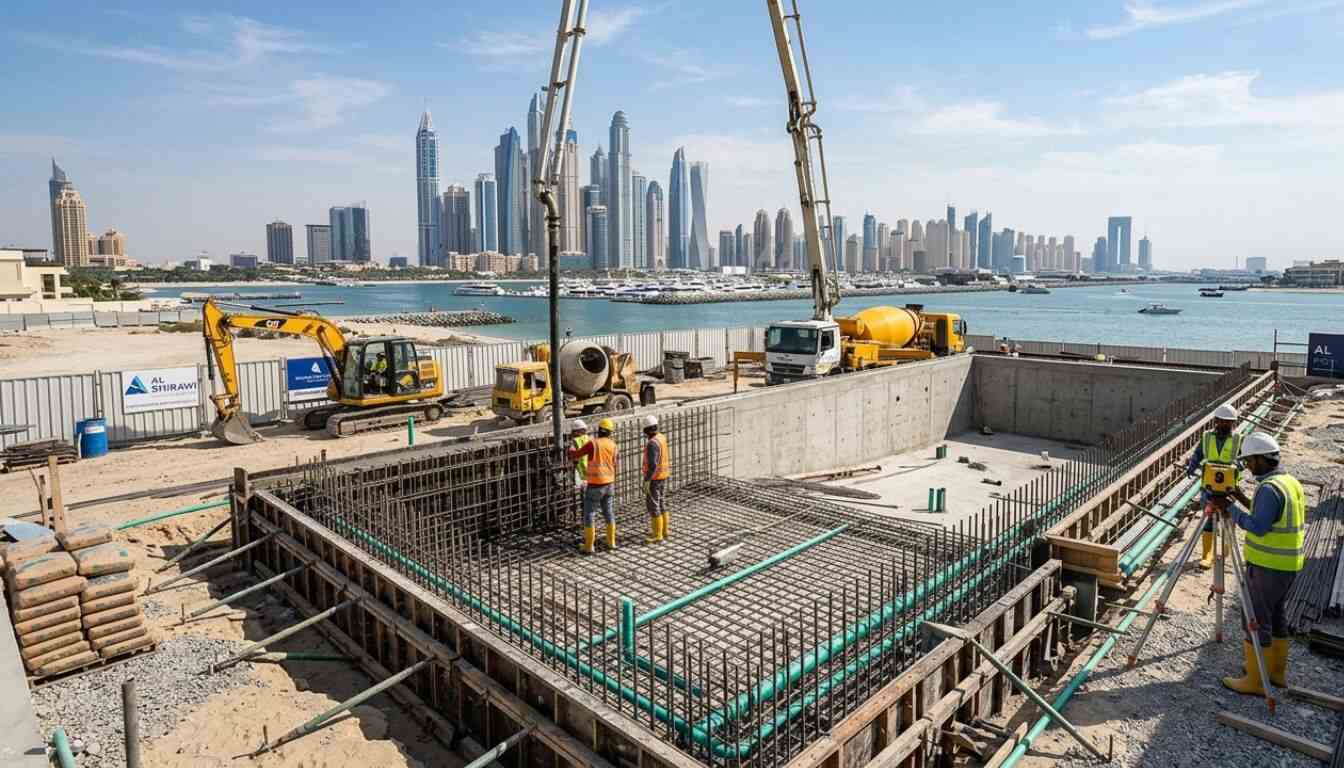

Building a swimming pool in Dubai is not like building one almost anywhere else. The pool is a permanent structure in your garden, plumbed into your villa, wired into your electrical system, and governed by approvals from Dubai Municipality and your community developer — and it has to survive desert dust, intense summer heat, sandy soils and, in some areas, groundwater pushing up from below. A pool built in the right order, with the right paperwork and the right testing at each stage, will give you decades of clear water and quiet weekends. A pool built in the wrong order usually looks fine on handover day and starts to show its problems later, as a slow leak, tiles lifting at the waterline, or equipment that was never sized for the pool it serves.
This guide walks through the swimming pool construction process in Dubai stage by stage, in the order a serious contractor actually works: approvals first, then survey and design, then excavation, shell, waterproofing, finishes, plant and handover. It answers the questions villa owners really ask — on community forums, in Quora threads and on site visits — in detail: which approvals you need and who files them, what your plot decides before any design is drawn, what happens underground that you will never see again, why waterproofing is tested before tiling, how long the whole job honestly takes, and the red flags that should make you pause before signing. Read it before you choose a contractor, and use it as a checklist at every stage of your own build.
Approvals first: nothing is dug before the permit
Every private pool in Dubai needs approval before excavation starts, and this is the stage that most often catches first-time buyers by surprise — not because it is difficult, but because more than one authority is usually involved. The main track is Dubai Municipality, through the Building Permits System: structural, architectural and MEP drawings are submitted covering the site plan, the pool structure, the plant room, pipework and electrical layout, and the pool is registered on the property’s approved record. If your villa sits in a master community such as Emirates Hills, Dubai Hills or Arabian Ranches, you will also need a No Objection Certificate (NOC) from the developer — Emaar, Nakheel or whoever manages your community — and that community review often takes longer than the municipality permit, so it should start early and run in parallel. DEWA sign-off covers the electrical load, bonding and plumbing connections, Dubai Civil Defence clearance applies where fire and life safety systems are involved, and properties in PCFC zones such as Palm Jumeirah are approved by Trakhees instead of Dubai Municipality, while some master-community zones fall under the Dubai Development Authority. At the end of the job, final inspections lead to a completion certificate, which is what makes the pool a properly approved part of your property.
The practical question for any contractor is simple: who files each of these, who chases them, and what happens to the programme when a submission comes back with comments? A contractor that handles approvals routinely will answer in specifics and will have secured permits in your community before. A contractor that dismisses approvals as unnecessary, or suggests you handle them yourself, is waving away the legal foundation of the whole job. An unpermitted pool can mean fines, forced rework and serious problems when you eventually sell the villa, because the pool will not appear correctly on the property’s record. Nothing — not the excavator, not a deposit on tile — should move before the permit is in hand.
The site survey: what your plot decides before any design is drawn
One of the most useful things a serious contractor does happens before anyone talks about tile colours: a proper site survey. A good team spends time on your plot with a tape measure, a copy of the affection plan and a list of questions, then goes away and prepares a considered proposal. A weak one measures the garden, sends a price the same evening, and discovers the problems after your deposit has cleared. That second approach is exactly why so many Dubai pool builds end in variation orders — extra charges for things that were predictable from day one.
The affection plan, the official plot drawing, sets what you can build and where. Setbacks from boundaries are not negotiable at permit stage, so a design that ignores them gets sent back and costs you weeks. Soil matters just as much: much of Dubai sits on sand over caprock, and inland areas can hide solid rock under a thin layer of sand, while coastal and reclaimed areas can have groundwater close to the surface that pushes up under an empty shell. Each condition changes the engineering, the excavation method and the waterproofing system, which is why soil and groundwater conditions should be understood before the design is fixed, not discovered by the excavator. Access matters too — excavation machinery, concrete pumps and delivery trucks have to reach the garden, and a tight side passage, a landscaped frontage or a villa wall close to the dig all change the method. Then there is the practical geography of the finished pool: a deck around the pool that drains properly, a plant room sited where a technician can actually reach everything for servicing, a drainage proposal for backwash water that stays inside your plot, and safety provisions such as a barrier with self-closing, self-latching gates where children are present. A contractor that walks your plot through all of this before you sign has really surveyed your job.
Design: shape, depth and the decisions to make early
With the survey done, design is where your daily life with the pool gets decided. Shape and size follow the garden and the household: a lap lane for swimmers, a generous shallow shelf for children, a raised spa, a beach entry, or a simple family rectangle — each choice changes the structure, the hydraulics and the finishes. Depth matters beyond swimming: deeper water needs more structure and more plant capacity, while a consistent shallow-to-deep profile with clear steps and depth markings is safer and easier to maintain. This is also the stage to settle the two big system choices. The first is the waterline system: a skimmer pool, where water is drawn through skimmer openings in the wall, or an overflow-edge pool, where water spills over a level edge into a channel and balance tank — the overflow edge gives a still, mirror-like surface and a more luxurious look, but it needs a balance tank, more plant capacity and more careful levelling. The second is sanitation and comfort: a salt chlorinator versus traditional chlorine dosing, automated dosing and testing versus manual checks, and a heat pump or pool chiller for year-round swimming, which our pool chiller guide and saltwater versus chlorine comparison cover in depth.
Three design decisions are cheap now and expensive later, so make them before the shell is drawn. Lighting positions must be planned before concrete is sprayed, not improvised afterwards, because light niches and conduits are cast into the shell. Water features, jets and automation points need pipework and cable routes fixed at the same stage. And finishes should be chosen with Dubai’s heat in mind: mosaic tiles, porcelain tiles and plaster interiors each behave differently under sun, heat and heavy chemical use, and imported tile carries lead times that can hold up the finishing stage if it is ordered late. A good design package ends with a full drawing set — plans, sections, structural details and MEP layouts — that the authorities can approve and the site team can build from without guessing. If your design is still changing after excavation starts, every change becomes a variation order, so settle the design while changes are still free.
Excavation: access, shoring and what the ground hides
Once the permit is issued, excavation is the first physical step, and your garden goes from flat lawn to a large hole very quickly. The hole is always dug a little larger than the finished pool, because room is needed around the outside for the structural shell work, the waterproofing membrane and formwork. Before digging, the site is set out from the approved drawings, existing services are located, boundary screening and dust control go up, and the access route for machinery is agreed — community rules commonly govern working hours, noise and spoil removal, and a good contractor confirms all of that with community management before the first truck arrives.
What the ground hides is what separates an honest programme from an optimistic one. In sandy areas the excavation walls need careful handling and, commonly, temporary shoring while the hole is open, because loose sand will not stand on its own. Where rock is found under the sand, breaking it is slow work that extends the dig. Where the water table is high, dewatering — pumping water out as the hole is dug — keeps the excavation workable and protects the shell that follows, and for deeper pools or sites close to villa foundations, shoring also protects neighbouring structures. Spoil — the dug-out earth — has to be removed from site, and the volume is larger than most owners expect. None of these conditions is a reason to panic; all of them are reasons to have surveyed the ground properly and to have a contractor who prices the method for your plot rather than assuming the easiest dig.
Steel and the shell: shotcrete, curing and why it cannot be rushed
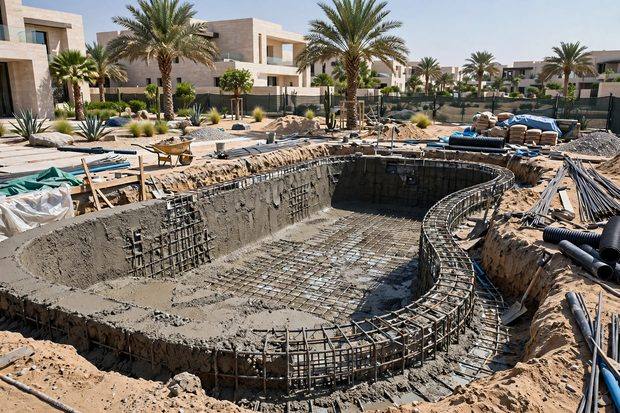
The shell is the heart of the pool, and it is the part you will never see again once tiling starts — which is exactly why it deserves the most attention. Steel reinforcement is fixed to the structural engineer’s design, with denser reinforcement typically at corners and stress points, and the shape of the pool is formed around it. Plumbing and electrical conduits for returns, drains, lights and water features are positioned at this stage too, because they are cast into the shell and cannot be moved afterwards without cutting concrete. Then the concrete itself is applied, most commonly by spraying: shotcrete, where wet concrete is pumped and sprayed onto the steel, or gunite, where a dry mix is sprayed and water is added at the nozzle. Both methods produce a dense, strong shell when applied by an experienced crew, and both are standard for custom villa pools in Dubai because the shell can be shaped freely and engineered for local soil and groundwater conditions. A fiberglass shell is the factory-made alternative — faster to install and smooth to the touch, but limited in shape and size, and still dependent on correct ground preparation and backfill.
After spraying, curing is the stage that impatient programmes try to shorten and good contractors refuse to. Concrete gains its strength as it cures, and in Dubai’s heat that means protected curing — keeping the shell moist and shielded while it hardens — rather than letting it bake dry. Cube testing is commonly used to confirm the concrete has reached its specified strength, and the shell is checked for honeycombing, the air pockets that weaken concrete and give water a path through. A shell that is rushed through curing, or tiled over before it has properly hardened, can crack, move or leak years later, and by then the repair means stripping finishes to reach the structure. The curing stage costs days. Skipping it can cost the pool.
Pipework and electrics: the work buried before the shell is sealed
While the shell is still open, the pool’s hidden systems go in: suction lines, return lines, main drains, skimmer or overflow connections, light conduits and any feature pipework, all laid to the approved drawings and fixed so they cannot move when concrete is sprayed around them. Every run is pressure tested before it is covered, because a leak under the deck costs far more to find than to fix — a buried joint that fails after tiling means cutting through finishes and deck to reach it. The plant room pipework is roughed in at the same stage, with runs kept as short and direct as the layout allows, because long, convoluted pipework wastes pump energy for the life of the pool.
Two details in this stage deserve a specific question in your site meetings. The first is the hydrostatic valve, a small fitting in the shell floor that relieves upward groundwater pressure when the pool is empty — in areas with a high water table, an empty pool without that protection can literally lift, so ask whether your plot needs one and whether it is in the design. The second is the electrical installation: DEWA requirements cover load approval, residual-current protection and bonding of all metalwork, and inspections confirm the installation before the pool is filled. A contractor that treats pipework and electrics as an afterthought — untested runs, unlabelled valves, a plant room that a technician cannot move around in — is building maintenance problems into a brand-new pool. For a sense of what good ongoing care looks like, see our guide to swimming pool maintenance in Dubai.
Waterproofing and the witnessed water test
If there is one stage that decides whether your pool leaks, it is this one. A waterproofing membrane system is applied to the inside of the correctly prepared shell, in the specified number of coats, with full coverage of joints, corners and every penetration where a pipe or fitting passes through the shell, and each coat is allowed to cure before the next goes on. In coastal and reclaimed areas, where groundwater can be brackish and mineral-rich, the system should be one suited to saline conditions, because salt-laden moisture behind the shell attacks concrete and finishes over time. The applicator’s skill matters as much as the product: a membrane is only as good as its weakest detail, and the details are all in corners and around fittings that nobody sees once tiling starts.
Then comes the test that separates careful builders from careless ones. Before any tile is fixed, the shell is filled and left standing with the water level marked, so that any drop is caught while it is still cheap to fix — this is the witnessed water test, and it should be exactly that: witnessed, with the level recorded, not waved through. A contractor that wants to tile over an untested shell to save a few days is telling you something about its priorities, because a leak found after tiling means stripping finishes, re-waterproofing and re-tiling, at a cost and disruption nobody wants. Waterproofing and the water test are also where the cheapest quotes quietly save their money — thinner membranes, fewer coats, a skipped test — all invisible on handover day and all expensive later. When you compare contractors, ask each one to name its waterproofing system, its applicator and its testing procedure in writing. The answers will tell you more than any brochure.
Tiling, coping and the deck
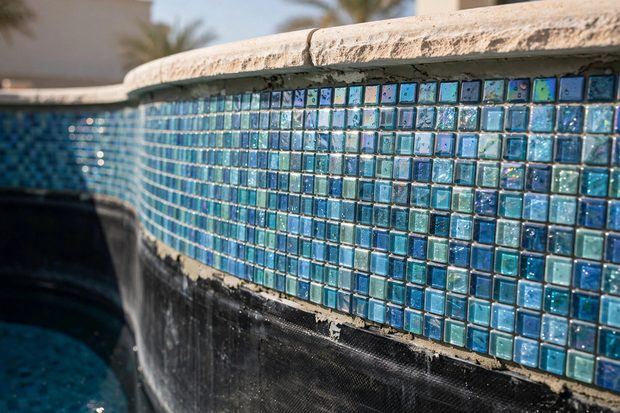
Only after the water test has passed does the pool start to look like a pool. Tiles or interior finish go onto the waterproofed shell, with the waterline detailing given particular care — the waterline is where chemistry, sunlight and constant wetting meet, so grout and tile adhesion there take the hardest punishment in the whole pool. Coping stones are set level around the edge, shedding water away from the pool rather than into it, and the deck is laid to fall towards its drains so that it never puddles after rain or splashing. Steps, ledges and depth markings go in at this stage, and lighting is fitted into the niches that were cast into the shell months earlier. Expansion joints, where the pool structure meets the deck, are detailed to absorb movement rather than transfer it into cracked tiles.
Finish choices made at design stage now show their consequences. Mosaic tiles give a classic, easily repaired surface and a huge range of colours; porcelain tiles offer a clean, contemporary look with a hard-wearing face; plaster interiors give a smooth, uniform finish at a different maintenance profile. Each behaves differently under Dubai heat, sun and heavy chemical use, and each needs the right adhesive, grout and curing to last. Imported finishes deserve one specific question at this stage: are they already on site, or still on a boat? A finishing stage held up by a tile shipment is one of the most common avoidable delays in a Dubai build, and it is entirely predictable if ordering is tied to the shell programme rather than left until tiling week.
The plant room: the engine room of the pool
A pool is only as good as its plant room, and this is the room buyers almost never inspect — which is why it repays a visit during construction. The pump and filter are sized to the pool’s volume, with permit drawings commonly checked against a water turnover of four hours or less, meaning the whole volume of the pool passes through filtration within that time. A variable-speed pump, which can run gently for most of the day and harder when needed, is the usual choice for a villa pool because it cuts running costs and noise; a correctly sized sand or cartridge filter, matched to that pump, keeps the water genuinely clear rather than merely moving. Around them sit the treatment and comfort systems: a salt chlorinator or dosing system, a heat pump or pool chiller for year-round swimming, automation and controls, and the valves, unions and electrical connections that tie them together.
Judge a plant room the way a technician will. Can a person reach every valve, union and electrical connection without dismantling half the room? Are pipes labelled and runs kept direct? Is there drainage for filter backwash water, ventilation for heat, and light to work by? A plant room crammed into a corner with no access is a maintenance bill waiting to happen, because every future service visit takes longer and costs more patience. Ask the contractor to walk you through the plant room before handover and to show you each item: pump, filter, chlorinator, heater or chiller, and the settings each one runs at. That ten-minute walkthrough is the difference between owning a pool you understand and owning a mysterious room you are afraid to touch. And if your existing pool’s plant is ageing or failing, our swimming pool renovation services cover plant replacement as part of a wider refurbishment.
Filling, balancing and commissioning
With finishes complete and plant installed, the pool is filled — slowly, so the structure and finishes are not shocked, and with the level watched against the marks from the water test. Once full, the plant is run up properly for the first time: circulation checked at every return, skimmers or overflow edge confirmed to be drawing evenly, lights and features tested, heating or chilling run through its range, and the whole system checked for leaks at every valve and union. Then the water itself is balanced — pH, chlorine and alkalinity brought into their correct ranges — because unbalanced water damages new finishes and irritates swimmers, and new plaster and grout in particular need careful chemistry in their first weeks.
Commissioning ends with two formal steps that should never be skipped. The first is snagging: a walkthrough of the finished pool with the contractor, noting every defect — a tile edge, a coping joint, a deck fall, a light that flickers — and agreeing in writing what will be fixed before handover is accepted. The second is the authority side: final inspections and the completion certificate that close the permit properly and put the pool on the property’s approved record. A contractor that rushes you past snagging, or treats the completion certificate as optional paperwork, is asking you to accept a pool that is not yet finished. Take the walkthrough slowly, in daylight, with the plant running, and do not sign off a snag list that has not actually been cleared.
Handover, warranties and the first year
A proper handover gives you more than a set of keys. You should receive as-built drawings showing what was actually built — pipe runs, cable routes, plant settings — equipment manuals, warranty documents, water-chemistry guidance and a schedule for the first months of maintenance. That package is what makes the pool maintainable by anyone, including a different company years later, and its absence is one of the quietest ways a cheap build keeps costing you: without drawings, every future repair starts with guesswork.
Warranties deserve the same written clarity. The structural warranty covers the shell and waterproofing — the parts hardest and most expensive to fix — and on a well-built pool it runs for several years. Equipment warranties on pumps, filtration, heating and chlorination are usually the manufacturers’ warranties passed through by the contractor, each with its own period. Workmanship cover deals with tiling, finishes and plumbing. Each should state its length, its exact coverage, and what voids it: unauthorised alterations, poor water chemistry left uncorrected, or servicing by unqualified hands are common exclusions, and you should know them before you sign, not after a claim is refused. Also confirm who services the warranty — the company that built the pool, or a third party — and ask to see a sample warranty document before committing. The first year is when small things settle: water chemistry needs regular attention, the filter needs its first services, and any snag that appears should be reported promptly rather than lived with. An annual maintenance contract with a named schedule keeps that first year orderly, and it keeps the same technician visiting your pool, which is how small problems get caught early.
Timelines, honestly stated
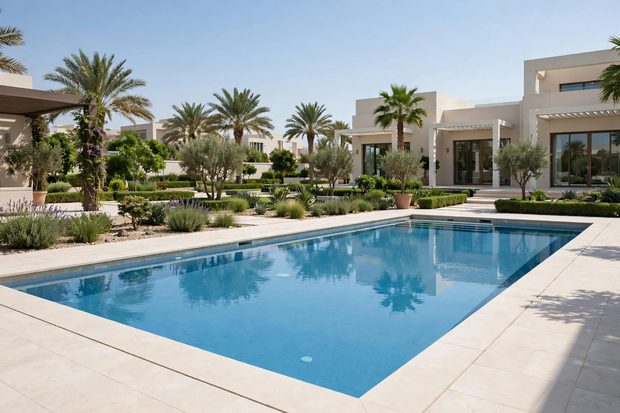
Ask for a written programme before work begins, and judge it by its honesty rather than its optimism. A realistic Dubai villa pool runs in two phases. First, design and approvals: drawings prepared, developer NOC obtained, municipality permit issued — a process that commonly takes several weeks, and longer when a submission returns with comments or when the developer’s review track runs separately from the municipality’s. Second, the build itself: excavation, steel and shotcrete, curing, waterproofing and water testing, tiling and finishes, plant installation, commissioning and handover — a standard villa pool commonly takes a few months on site once the permit is in hand, with larger or more complex designs, infinity edges with balance tanks, and imported finishes all extending the programme.
Three things most often knock that programme off course, and all three are predictable. Incomplete or non-compliant permit submissions send the job back to the start of the approvals queue, which is why approvals come first in this guide and not last. Ground conditions — rock under the sand, a high water table, a tight access route — extend excavation and shell work in ways a proper survey would have foreseen. And imported finishes with long lead times hold up the finishing stage if they were ordered late. Fragmented teams add a fourth risk: when design, approvals and execution sit with different companies, each handoff is a delay waiting to happen and nobody owns the gap between them. Judge a contractor by its communication as much as its dates: the complaint Dubai homeowners repeat most is not that a project slipped, but that nobody told them it had slipped. A contractor that reports progress against milestones, and flags a delay the week it appears rather than the month after, is worth more than one that merely promises the earliest date.
Red flags in a pool contractor
Most bad pool experiences announce themselves early, if you know what to listen for. Be cautious when a contractor dismisses approvals as unnecessary or offers them as something you should handle yourself, because in Dubai approvals are the contractor’s job. Be cautious when the scope is vague — no named waterproofing system, no equipment specified by type, no payment stages, no written programme — because vagueness at quotation stage becomes dispute at construction stage. Be cautious when the portfolio is renders rather than real finished pools, or when no past client can be produced who is willing to speak to you. Be cautious when the price is dramatically lower than every other quote without a clear explanation of what is different: on a pool, the saving is normally taken out of the two things you cannot see, waterproofing and plant, and neither shows on handover day. Be cautious when full payment is demanded before excavation, when you are pressed to sign quickly, and when curing or the water test is offered as a stage that can be skipped to save time — those stages are what make the pool last, and a builder who promises to omit them is leaving out the quality, not saving you time. None of these signs alone proves a contractor is bad. Together, they are a pattern worth respecting.
If you have read this far, you are already doing the single most useful thing a buyer can do: slowing the decision down long enough to compare properly. Shortlist two or three licensed contractors, put the same questions from this guide to each of them, compare their itemised scopes line by line, visit one finished pool from each, and only then decide. The right contractor will welcome every question in this guide. That reaction, more than any brochure, is the signal to trust.
Frequently asked questions
Do I need approval before building a pool in Dubai?
Yes, and more than one approval is commonly involved. Every private pool must be registered with Dubai Municipality through the Building Permits System before any digging starts, with drawings covering the site plan, pool structure, plant room, pipework and electrical layout. If your villa is in a master community, you will also need a No Objection Certificate from the developer, and that review often takes longer than the municipality permit, so it should start early. DEWA sign-off covers electrical and plumbing connections, Dubai Civil Defence clearance applies where safety systems are involved, and properties in PCFC zones such as Palm Jumeirah are approved by Trakhees instead of Dubai Municipality. Your contractor should file, chase and close all of these as part of the build, and final inspections at the end lead to a completion certificate that puts the pool properly on your property’s record.
How long does building a pool in Dubai take?
Think in two phases. Approvals — drawings, developer NOC and municipality permit — commonly take several weeks, and longer when a submission returns with comments or when the developer’s review runs separately. The build itself, from excavation through steel and shotcrete, curing, waterproofing and water testing, tiling and finishes, plant installation and commissioning, commonly runs into a few months for a standard villa pool once the permit is in hand. Larger or more complex designs, infinity edges with balance tanks, and imported finishes all extend the programme. Be wary of any timeline that skips the curing and water-testing stages to sound faster — those stages are what make the pool last.
What happens if the excavation hits rock or groundwater?
It is handled, but it changes the method and the programme, which is why a proper survey matters before the price is fixed. Rock under the sand is broken out, which is slow work that extends the dig. A high water table is managed with dewatering while the hole is open, and with engineering that accounts for upward pressure on the shell — including, where the plot needs it, a hydrostatic valve that relieves pressure when the pool is empty. Sandy walls may need temporary shoring while the excavation is open, and deeper pools or sites close to villa foundations may need shoring to protect neighbouring structures. None of this is unusual in Dubai; what matters is that your contractor foresaw it, explained it and priced the method for your plot rather than discovering it after work started.
Shotcrete or gunite — what is the difference?
Both are sprayed concrete, and both are standard for custom villa pools in Dubai. In shotcrete, wet concrete is pumped through a hose and sprayed onto the steel reinforcement. In gunite, a dry mix is sprayed and water is added at the nozzle, so the crew controls the mix at the point of application. Either method, applied by an experienced crew to an engineer’s design, produces a dense, strong shell that can be shaped freely and engineered for local soil and groundwater conditions. What matters more than the choice between them is what surrounds the method: correct steel fixing, proper curing in Dubai’s heat, testing that confirms the concrete reached its specified strength, and a waterproofing system applied to a correctly prepared shell afterwards.
Why is waterproofing tested before tiling?
Because a leak found before tiling is a small repair, and a leak found after tiling is a stripped finish, a re-waterproofing job and a re-tile. The test is simple and non-negotiable: once the membrane system has cured, the shell is filled and left standing with the water level marked, so any drop is caught while it is still cheap to fix. That test should be witnessed, with the level recorded. Any contractor that wants to tile over an untested shell to save a few days is cutting the one corner that protects everything underneath the tile. When you compare contractors, ask each one to name its waterproofing system, its applicator and its testing procedure in writing.
Skimmer or overflow edge — which should I choose?
It depends on the look you want and the plant you are willing to run. A skimmer pool draws water through openings in the pool wall; it is simpler, needs less plant capacity and suits most family villas well. An overflow-edge pool spills water over a level edge into a channel and balance tank, giving a still, mirror-like surface that suits modern and luxury designs — but it needs a balance tank, more plant capacity and very careful levelling, and it costs more to build and run. Either system needs correct hydraulics to keep the water genuinely clear, with the whole volume commonly turning over through filtration within four hours. Your contractor should explain both options against your design and your budget, not sell one system to every buyer.
Can a pool be built if access to my garden is tight?
Commonly yes, but the method changes and the programme may extend. Tight side passages, landscaped frontages and villa walls close to the dig all affect how excavation machinery, concrete pumps and deliveries reach the garden. Smaller plant, crane lifts over the villa, manual handling for parts of the dig, and staged deliveries are all normal solutions, and a good contractor will have used them before in communities like yours. What matters is that access is assessed during the site survey, not discovered by the excavator on day one, because access problems found late become delays and variation orders. Raise access explicitly in your first site meeting, and ask the contractor to describe the exact method it would use for your garden.
What should handover include?
More than a set of keys. A proper handover gives you as-built drawings showing what was actually built — pipe runs, cable routes and plant settings — equipment manuals, warranty documents, water-chemistry guidance and a schedule for the first months of maintenance. It should also include a walkthrough of the finished pool with the plant running, a snag list that has actually been cleared, and the completion certificate that closes the permit properly. Without as-built drawings, every future repair starts with guesswork, so treat the handover package as part of the build, not as paperwork. If a contractor cannot show you a sample handover checklist before you sign, it has not finished designing its own aftercare.
What warranty should I get in writing?
Expect it in writing, with its parts distinguished. The structural warranty covers the pool shell and waterproofing and, on a well-built pool, runs for several years. Equipment warranties on pumps, filtration, heating and chlorination are usually the manufacturers’ warranties passed through by the contractor, each with its own period. Workmanship cover deals with tiling, finishes and plumbing. Read the exclusions as carefully as the coverage: unauthorised alterations, poor water chemistry left uncorrected, or servicing by unqualified hands commonly void a warranty, and you should know that before you sign. Also confirm who services the warranty — the company that built the pool, or a third party — and ask to see a sample warranty document before committing.
What are the red flags in a pool contractor?
Be cautious when approvals are dismissed as unnecessary or offered as something you should handle yourself, when the scope is vague with no named waterproofing system or equipment, and when the portfolio is renders rather than real finished pools. Be cautious when the price is dramatically lower than every other quote without a clear explanation of what is different, because on a pool the saving is normally taken out of waterproofing and plant. Be cautious when full payment is demanded before excavation, when you are pressed to sign quickly, and when curing or the water test is offered as a stage that can be skipped to save time. None of these signs alone proves a contractor is bad, but together they are a pattern worth respecting — and the right contractor will welcome every question in this guide. If you want a professional opinion on your own plot, Hello Landscaping & Pools LLC offers a free site visit, after which you receive an exact quote for your villa — ask on WhatsApp and we will arrange it.
Related reading: our guide to choosing swimming pool contractors in Dubai covers licences, quotes and warranties in depth, our pool cost factors guide explains what shapes a quotation, and our renovation guide covers what to check when an older pool needs work.
Related reading: our types of swimming pools guide compares shapes and systems, our indoor pools guide covers design and humidity control, and our repair tips guide explains what to check on an older pool.