


A green pool in Dubai rarely appears out of nowhere, even when it seems to. One morning the water looks a little dull, the next it is cloudy, and by the weekend it is a shade of green that makes swimming unthinkable. Owners usually blame one thing — a missed cleaning visit, a hot week, a sandstorm — but a green pool is almost always the result of several small slips lining up at once: sanitiser drifting low, the sun burning off what is left, dust feeding the water, and a filter that quietly stopped keeping up. This guide explains the whole picture in detail: why Dubai pools turn green so fast, how to tell what kind of green you are dealing with, the clearing sequence in the order that actually works, why shocking alone so often fails, and the habits that keep the water clear afterwards.
It is written for villa pool owners across Dubai who want to understand what they are treating, not just which product to pour in. Clearing a green pool is a process, not a single dose, and the owners who get their water back fastest are usually the ones who follow the sequence properly: test first, brush, shock in the evening, run the filter without stopping, vacuum the dead algae out, and retest before declaring victory. Follow that order and most green pools recover. Skip steps, and the green commonly comes back within days — which is why so many owners end up convinced their pool is somehow cursed, when in fact one link in the chain was never fixed.
Why Dubai pools turn green so fast
Algae are microscopic plants, and like any plant they need light, warmth and food. A Dubai pool gives them all three in abundance. Summer water temperatures climb high, the sun is intense for most of the day, and fine desert dust blows in constantly, carrying organic material that feeds growth. Algae spores arrive on the wind, in rain and on anything that falls into the water, so a pool never has to be “infected” from somewhere exotic — the spores are already there, waiting for conditions that let them multiply. In warm, still water with low sanitiser, a bloom can take hold within days, and once it starts it commonly accelerates, because the growing algae themselves consume sanitiser and shade the water, which makes the next dose less effective. Heat also works against you in a second way: it burns off free chlorine faster than most owners expect. Chlorine is the sanitiser that keeps algae in check, and in a Dubai summer it is consumed by sunlight, by bathers, by dust and debris, and by the algae themselves, while evaporation concentrates everything dissolved in the water. Add a pump timer still set for winter hours, a filter that has not been cleaned in weeks, and a few still corners where water barely moves — behind steps, around ladders, in shaded corners — and you have the classic recipe. None of this means the pool is badly built. It means Dubai conditions punish small lapses faster than a cooler climate would, and the routine has to match the climate.First, work out what kind of green you have
Before adding anything, take a proper look at the water, because not every green pool is an algae problem, and the wrong treatment wastes time and chemicals. The most common case is algae: cloudy, opaque green water, often with walls and steps that feel slippery to the touch, and sometimes visible green film or speckles on surfaces. If the water is green but you can still see the floor fairly clearly, and the walls do not feel slimy, dissolved metals are a strong possibility — copper or iron that has been oxidised by chlorine, which typically turns the water a clear blue-green or brownish-green. A useful clue is timing: if the water turned green immediately after a shock dose, metals are more likely than algae, because the shock oxidised metals that were previously dissolved and invisible. A simple glass test helps separate the two. Fill a clean white bucket or glass with pool water and add a small amount of liquid chlorine, then stir. If the sample clears, the problem is organic material that chlorine can kill — algae or similar contamination. If the sample turns a darker green or brown, the chlorine has reacted with dissolved metals, and pouring more shock into the whole pool will not fix it; that job needs a metal sequestering treatment and a plan to find where the metals are coming from, such as corroding equipment, source water, or a copper-based product used previously. Pale, cloudy green water with no slippery surfaces can also come from fine organic debris, such as pollen or dust, that is simply too fine for the filter to trap. Naming the problem first matters because each version has a different fix, and treating metals as algae — or algae as metals — is one of the most common reasons a green pool drags on for weeks.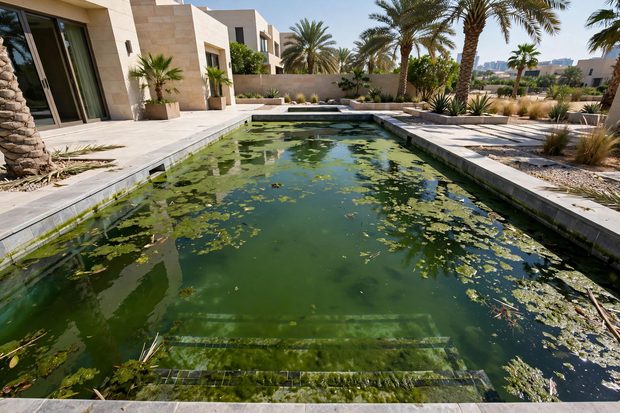
Test the water before you add anything
Every successful green-pool recovery starts with a test, not a purchase. A reliable test kit or digital meter should tell you free chlorine, pH, total alkalinity, calcium hardness and cyanuric acid, which is the stabiliser that protects chlorine from sunlight. Each of these readings changes what you do next. Free chlorine near zero strongly suggests an algae bloom that has consumed the sanitiser. A high pH reading warns you that chlorine will work weakly until the pH is corrected, because chlorine exists in a highly effective form and a much weaker form, and as pH rises, more of it converts to the weaker form. A very high stabiliser reading warns you of a different trap entirely, covered below, where chlorine is present but locked up and unable to act. Test properly: take the sample from elbow depth away from return jets, test at the same time of day when comparing readings, and write the numbers down. Guessing from memory after three rounds of treatment is how owners lose track of what has actually changed. If you do not own a full test kit, a professional visit earns its keep here — a technician tests everything, including stabiliser and metals, and builds the treatment around readings rather than assumptions. For ongoing care, see our guide to swimming pool maintenance in Dubai, which explains what a proper visit tests and why testing frequency matters more in summer than in winter.Brush first: the step owners skip
Brushing is the least glamorous part of clearing a green pool and the one most often skipped, which is exactly why it matters so much. Algae do not just float in the water; they cling to walls, steps, corners, grout lines and the floor in a slimy biofilm that shields the cells underneath from sanitiser. Shock poured into a pool whose walls have not been brushed kills the free-floating algae and leaves the attached colonies largely intact, so the water clears for a few days and then turns green again as the survivors regrow. Brushing breaks that protective layer open and exposes the cells to the chlorine that follows. Brush the whole pool — walls from the waterline down, steps, benches, corners, behind ladders, and the floor — before shocking, and brush again the following day after the shock has worked. Use a brush suited to your finish: a nylon brush for vinyl or fiberglass surfaces, a stiffer brush for plaster or tile, and take care around mosaic and grout. Pay special attention to the dead spots where water barely moves, because those are where algae hide and where circulation alone will never reach them. If the walls feel slippery, that slipperiness is the biofilm itself, and no chemical dose substitutes for physically removing it. Owners who brush thoroughly commonly find the rest of the treatment works noticeably faster, and owners who skip it commonly find themselves shocking the same pool twice.Shock in the evening, and keep the level up
Shocking means adding a high dose of chlorine to overwhelm the bloom, and timing matters. Shock in the evening, after the sun has lost its strength, so the chlorine works through the night instead of being burned off by ultraviolet light within hours. Daytime shocking in a Dubai summer wastes much of the dose before it has finished its work, which is one reason owners report that they “shocked and nothing happened”. The dose itself depends on the severity of the bloom and on your stabiliser level, so follow the product’s guidance for a green pool rather than a maintenance dose, and remember that a single evening’s dose is often not the end of it. The key discipline is holding the shock level until the job is done, not just reaching it once. Test the free chlorine the next morning and top it back up if it has fallen, because a large bloom consumes chlorine quickly, and letting the level crash between doses lets surviving algae recover. Keep the water’s colour shift in mind as your progress signal: as the algae die, the water typically shifts from green to a cloudy grey or blue, which means the kill has worked and the remaining job is filtration, not more killing. Do not add algaecide at the same moment as shock and expect it to do the killing — algaecide prevents regrowth, it does not eradicate an established bloom. While the shock level is high, nobody should swim; wait until the water is clear and the free chlorine has returned to its normal range.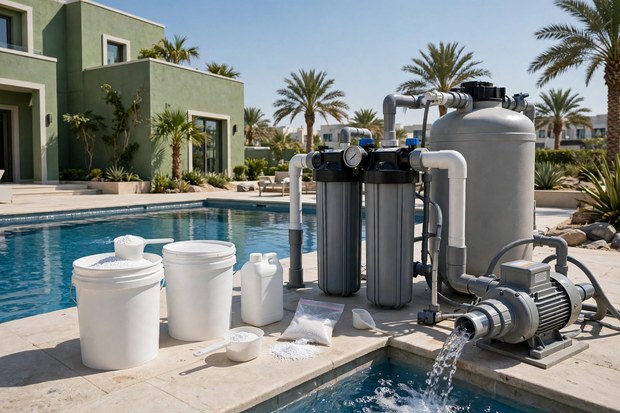
Run the filter without stopping, then clean it
Dead algae have to go somewhere, and the filter is where they go. While you are clearing a green pool, run the pump and filter continuously — twenty-four hours a day — until the water is clear. Stopping the filter for its normal timer cycle lets dead algae settle back onto the floor and gives surviving cells a quiet period to recover, which is why owners who run the pump “as usual” during treatment often find the process takes twice as long. Continuous filtration is not wasteful here; it is the mechanism that actually removes what the chlorine has killed. Watch the filter’s pressure gauge, because a filter capturing a heavy load of dead algae clogs faster than normal. When the pressure rises noticeably above its clean reading, clean or backwash the filter, then resume. A sand filter gets backwashed, a cartridge filter gets hosed down, and a DE filter gets backwashed and recharged — whichever type you have, the principle is the same: a clogged filter cannot capture, and water simply bypasses it. If the pressure never rises and the water never clears, the filter may be channelling, damaged or simply too small for the pool, which is one of the equipment problems covered below. Do not add clarifier or flocculant as a substitute for proper filtration; they can help in specific situations, but they do not replace a clean filter running without stopping.Vacuum the dead algae out
Once the water has shifted from green to cloudy grey or blue, the kill phase is over and the removal phase begins. The dead algae settle as a fine grey dust on the floor, and vacuuming is how they leave the pool for good. Vacuum slowly and methodically, because rushing stirs the fine dust back into suspension and you end up filtering what you could have removed directly. If your system allows vacuuming to waste — sending the vacuumed water straight to the drain rather than through the filter — use it for the heaviest loads, because it removes the debris without loading the filter at all. Top up the water afterwards and rebalance. The spots that need the most attention are the ones circulation reaches least: behind steps, around ladders, in corners and along the floor-wall junction. If your vacuum head cannot reach somewhere, brush the debris toward somewhere it can. After vacuuming, run the filter continuously until the water is completely clear, backwashing or cleaning as the pressure gauge dictates. A pool that is vacuumed properly after shocking clears noticeably faster than one left for the filter to handle alone, because the filter is no longer trying to capture what you have already removed by hand.Why shocking alone so often fails
This is the complaint behind half the green-pool calls a professional receives: “we shocked it and it went green again”. Shocking fails on its own for a handful of predictable reasons, and recognising which one applies is the difference between a second failed attempt and a recovery that works. The most common is skipping the brush: anchored algae under their biofilm survive the shock and regrow within days. Next is the filter: a dirty, channelling or undersized filter cannot capture what the shock kills, so the dead algae stay in circulation and the water never clears. Then there is timing: shocking in daylight wastes the dose to UV, and letting the free chlorine crash between doses lets survivors recover. Two chemical traps complete the list. The first is pH: if the water is well above its healthy range, chlorine converts mostly to its weak form, and even a heavy shock dose underperforms — which is why the test-and-correct-pH step comes before shocking, not after. The second is stabiliser: if cyanuric acid is very high, chlorine becomes locked and sluggish, and no reasonable shock dose overcomes it; the fix is diluting the stabiliser with fresh water, not adding more chlorine. And if the green is from metals rather than algae, shocking was never the right treatment at all. When a pool resists repeated shocking, stop repeating the same step and diagnose instead: brush, test pH and stabiliser, check the filter, and confirm the green is actually algae. The answer is almost always in that list.Cloudy water after the green clears
Owners often expect the water to go from green to sparkling in one step, and worry when it stalls at cloudy grey or pale blue. That cloudiness is normal and expected: it is the fine dust of dead algae suspended in the water, too fine to settle quickly and too fine for a tired filter to capture immediately. It means the killing worked and the removal is still in progress. The answer is patience and filtration, not more chemicals. Keep the pump running continuously, keep the filter clean, and let the system do the slow work of capturing what the chlorine killed. If the cloudiness persists for more than a couple of days of continuous filtration, two things are worth checking. First, the filter: a filter that has not been cleaned since the treatment started is likely clogged and bypassing, so clean or backwash it and watch whether the water starts clearing. Second, the particle size: very fine dead algae can pass through some filters, and this is the one situation where a clarifier — a product that binds fine particles into larger clumps the filter can catch — earns its place. Use it as a finishing aid after the heavy work is done, not as a substitute for it, and follow the product’s dosing carefully. A pool that was properly brushed, shocked and vacuumed rarely needs much help at this stage.How long clearing takes, honestly
The honest answer depends on how bad the bloom was and how completely the sequence is followed. A light green haze in a pool that is brushed, shocked in the evening and filtered continuously often clears within two to three days. A solid green pool with an established bloom typically needs four to seven days of the full sequence: brushing, evening shocks held at level, continuous filtration with regular filter cleans, and vacuuming. A deep green or murky pool, especially one with heavy settled debris or an underlying equipment problem, can take a week or more, and may need a second round of treatment if the first round stalls. What stretches the timeline is almost always a skipped step or a hidden problem: no brushing, a filter that was never cleaned, shock added in daylight, the free chlorine allowed to crash between doses, or a stabiliser level so high that the chlorine cannot work. Each of these adds days. The owners who clear fastest are not the ones who buy the most products; they are the ones who follow the sequence completely and keep the filter running. If your pool is not clearly improving after several days of proper treatment, stop and diagnose rather than repeating the same dose — the answer is usually in the test readings, the filter or the brushing, not in a stronger chemical.Sandstorm and rain blooms: the Dubai pattern
Dubai has a specific green-pool pattern that owners in other climates never see: the post-sandstorm bloom. A sandstorm dumps fine dust across the whole garden, and much of it ends up in the pool, carrying organic material that feeds algae. At the same time, the storm often disrupts the routine — the power may trip, the pump timer may be off, the owner may be away — so the pool sits still and unchlorinated for a day or two while dust settles into it. The result is a bloom that seems to come from nowhere but actually had two full days of perfect conditions. After any sandstorm, the recovery sequence starts with debris removal and a filter clean, not with chemicals, because treating water still full of dust wastes the dose. Heavy rain does something similar through a different mechanism. Rain dilutes the chemicals, washes dust and organic matter from the garden and the deck into the pool, and often arrives with wind that drops leaves and debris. A pool that was balanced before a storm can test completely differently afterwards, which is why retesting after heavy weather matters more than treating on a schedule. The Dubai pattern, then, is not just “pools go green in summer”. It is that specific weather events — sandstorms, heavy rain, the shamal winds — create bloom conditions, and the owners who recover fastest are the ones who respond to the event rather than waiting for the next scheduled visit.When green water signals an equipment problem
Sometimes a green pool is not a chemistry failure but an equipment failure wearing a chemistry disguise. The classic case is the pump that is not actually running its full cycle: a tripped breaker, a failed timer, a pump that has lost prime and is running dry, or a variable-speed pump accidentally set to a trickle. Without circulation, chlorine cannot reach the whole pool, dead spots grow algae undisturbed, and no amount of shock compensates, because the treated water never travels. If a pool turns green while the owner insists the chemistry was fine, the first question is always whether the water was actually moving. The filter is the second suspect. A sand filter with channelling — water carving paths through the sand rather than filtering through it — passes debris straight back to the pool. A cartridge filter left uncleaned for months clogs and bypasses. A filter that is simply too small for the pool never had a chance. And the salt chlorinator, for salt pools, can fail quietly: the cell scales up, the output drops, and the owner does not notice until the water turns. When green water resists proper chemical treatment, or returns within days of a full recovery, stop treating the water and inspect the equipment. The fix for a failed pump, a channelled filter or a scaled cell is a repair, not a chemical.Prevention habits that keep it clear
A pool that has been cleared stays clear when the routine behind it changes, because the same routine that let it turn green will let it turn green again. The habits are not complicated. Test the water a few times a week in summer and weekly in winter, and act on the readings rather than filing them away. Keep the sanitiser in range continuously — a floating dispenser or salt chlorinator helps, but only if it is checked and refilled. Brush the waterline and steps weekly, even when the water looks perfect, because the biofilm that seeds the next bloom is invisible long before it is green. Clean the filter on its pressure gauge, not on a calendar, and run the pump long enough each day to turn the water over properly. Seasonal habits matter in Dubai more than in cooler climates. Before summer, service the equipment, check the stabiliser level, and make sure the pump timer is set for summer hours. After sandstorms and heavy rain, clear debris, clean the filter and retest rather than waiting for the next scheduled visit. Before holidays, balance the water, clean the filter, set the pump to run reliably, and arrange for someone to check chlorine and skim the surface while you are away — a week of neglect in August undoes months of good care. None of this is onerous once it becomes routine, and a swimming pool maintenance plan in Dubai takes the whole routine off your hands if you would rather not think about it.When to call a professional
There is no shame in calling for help, and there are clear situations where it is the faster and cheaper option. Call a professional if the water does not clearly improve after several days of proper treatment, because something in the diagnosis is wrong — the green may be metals, the filter may be failing, or the stabiliser may be locking the chlorine. Call if you suspect an equipment problem: a pump that will not prime, a filter that never builds pressure, a salt cell that may have failed, or any electrical issue around the pool. Call if the pool has heavy settled debris, black or mustard algae that resists normal treatment, or stains that suggest the surface itself needs attention. A professional visit for a green pool should follow the same sequence in this guide — diagnosis, test, brush, shock, filter, vacuum, rebalance — not just a stronger chemical. Ask what the visit includes before booking, and be wary of anyone who promises to fix a deep green pool with a single dose of something poured in and a quick departure. The honest professionals stay with the process, retest, and tell you when it is safe to swim again. For a one-time recovery or ongoing care, our pool cleaning team in Dubai covers villas across the city.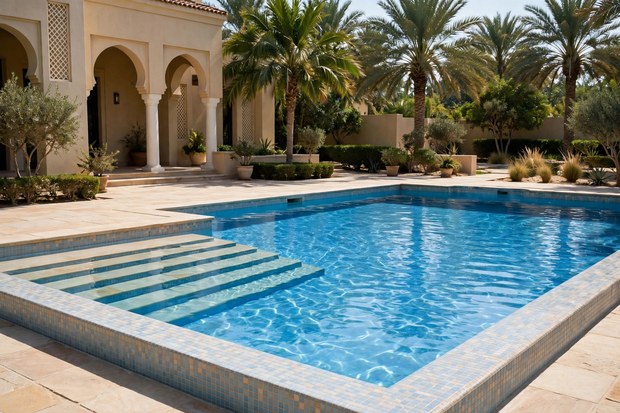
Related reading: our villa pool cleaning guide covers the routine that prevents green water, and our pool maintenance guide covers testing, balancing and filter care.