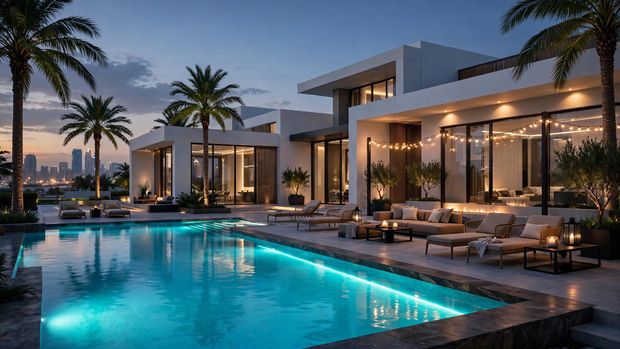


There is a particular disappointment in stepping out into 45-degree heat, looking forward to a cold plunge, and finding the pool water warmer than the air in your living room. If you own a villa pool in Dubai, you have lived this moment. From June to September, unshaded pool water routinely climbs into the low-to-mid 30s — pleasant for about ten seconds, then just warm. Children stop wanting to swim, evening dips lose their appeal, and the pool you pay to maintain becomes ornamental.
This guide explains how pool chillers actually work, how to size one for your pool, what installation involves, what they cost to run, and when you might not need one at all. It is written for Dubai conditions — the heat, the dust, the hard water — not for a generic climate. By the end, you will know whether a chiller is right for your pool, and what to ask before you buy one.
Why Dubai pool water gets too warm
Three things conspire against your pool from June to September. First, the air itself: when daytime highs sit above 40°C for weeks, the water has nowhere to dump its heat, especially overnight when temperatures barely dip below 30°C. Second, the sun: direct solar radiation pours energy into the water all day, and most villa pools are unshaded through the worst of the afternoon. Third, the pool’s own thermal mass works against it — a large body of water that warms up slowly also cools down slowly, so once it is warm, it stays warm.
Depth and finish make it worse. Shallow pools heat faster than deep ones. Dark tiles and finishes absorb more solar energy than light ones. A pool with poor circulation develops warm surface layers that never mix down. None of this is a fault in your pool — it is physics, and every villa pool in Dubai faces it.
The result is water in the low-to-mid 30s: too warm to be refreshing, warm enough to accelerate chlorine burn-off and algae growth, and uncomfortable for the long, lazy swims that are the whole point of having a pool. This is the problem a chiller solves.
How a pool chiller actually works
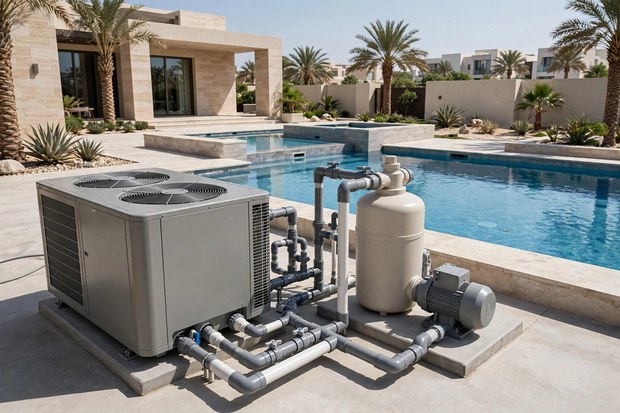
A pool chiller is a refrigeration machine, the same principle as your air conditioner or refrigerator, applied to pool water. Pool water is pumped through the unit, where a refrigerant cycle extracts heat from the water and rejects it to the outside air via a fan and condenser coil. The cooled water returns to the pool. A thermostat monitors the pool temperature and cycles the unit to hold your set point.
Two components matter most in Dubai conditions. The heat exchanger — the part the pool water flows through — should be titanium, which resists corrosion from salt and Dubai’s mineral-heavy water far better than standard cupronickel. The condenser coil and fan need to handle 45°C+ ambient air and dust; a unit designed for temperate climates will struggle here.
One efficiency term you will hear is COP, the coefficient of performance. It describes how much cooling you get per unit of electricity. Higher is better, but treat brochure figures sceptically — they are measured in mild conditions, not a Dubai August. Ask for performance data at high ambient temperatures, which is when you actually need the cooling.
Chiller, heat pump, or a reversible heat-and-cool unit?
The terminology confuses people, so let us clarify. A dedicated chiller cools only — it is the simplest machine for the job if summer overheating is your only problem. A heat pump in pool terminology usually means a reversible unit: it cools in summer and heats in winter by running the refrigeration cycle in reverse. An evaporative or fan-assisted cooler is a simpler, cheaper device that drops the temperature a few degrees using airflow and evaporation — helpful, but not precise, and limited in peak summer humidity.
For most Dubai villa owners, the real choice is between a dedicated chiller and a reversible heat-cool pump. If you also want comfortable winter swimming (pool water in January can drop to the high teens, too cold for most people), the reversible unit covers the whole year in one machine and is often the smarter buy. If you only care about summer, the dedicated chiller is simpler and sometimes cheaper.
Be wary of anyone who sells you a standard air-source heat pump designed for European winters and calls it a pool chiller. The machine needs to be specified for high-ambient cooling duty. Ask what the unit is rated to cool at 43°C ambient — if the salesperson cannot answer, find another salesperson.
Sizing a chiller for your pool
Sizing starts with volume, not surface area: length times width times average depth. Two pools with the same surface can have very different volumes, and it is the volume of water that needs cooling. A supplier who sizes from surface area — or worse, from “it worked for your neighbour” — is guessing.
Cooling capacity is rated in kilowatts (sometimes BTU). The right size depends on volume, sun exposure, target temperature, and how fast you want to pull the temperature down. As a rule, it is better to have headroom than to run a small unit flat-out: an undersized chiller runs continuously, never reaches the set point, wears out faster, and costs more in electricity than a correctly sized unit cycling normally.
Getting it wrong hurts both ways. Too small and you have an expensive machine that cannot do the job. Too large and you have paid for capacity you never use (though oversizing is the less painful error — the unit just cycles less). A proper site assessment measures the pool, checks exposure, and sizes from data, not rules of thumb.
Installation: plant room, plumbing, airflow and power
Most chiller installations we do are retrofits to existing pools, and they are straightforward provided three things are right. First, plumbing: the unit is plumbed into the circulation loop after the filter, with a bypass loop and isolation valves so it can be serviced without draining the system. Second, airflow: the condenser needs clear air — not boxed into a tiny plant room corner behind the chlorine drums. Third, power: the unit needs a dedicated electrical circuit of the right capacity, which an electrician confirms during the site visit.
Placement matters. The unit rejects heat to the air, so it should sit where hot exhaust air does not recirculate straight back into the intake, and where the fan noise does not bother bedrooms. Vibration-isolating feet and sensible siting keep it unobtrusive. Installation itself usually takes a day or two, followed by commissioning: balancing the water, setting the target temperature, and walking you through the controller.
What is not covered in a standard installation: major electrical panel upgrades or long new cable runs beyond the standard connection (flagged at survey), structural pool changes, and shade structures. These are quoted separately if needed, so there are no surprises.
Running it well: hours, night cooling and the thermostat
A chiller does not need to run 24 hours a day. The most efficient pattern in Dubai is night cooling: run the unit overnight when the air is coolest (so the refrigeration cycle works most efficiently) and electricity may be cheaper, then let the pool coast through the day. A well-insulated pool — and a thermal cover at night — holds the temperature remarkably well.
Set a realistic target. Holding water at 26–28°C through August is achievable and comfortable; trying to hold 22°C will run the unit constantly and double the bill for little extra comfort. Every degree lower costs disproportionately more energy — the laws of thermodynamics do not negotiate.
Keep the controller accessible and learn its basic settings: target temperature, timer schedules, and any eco or night mode. The fanciest controller in the world is useless if nobody in the house knows how to change the schedule when the seasons turn.
Chiller versus shade, covers and ice: what actually works
Before you commit, these are worth trying — and they are worth doing even with a chiller, because they cut the load it has to handle:
A shade sail or pergola over the west end. This blocks the harsh afternoon sun, the single biggest heat source. A well-placed sail can drop peak water temperature by a couple of degrees on its own, and it makes the pool area usable in the afternoon.
Night circulation plus a thermal cover. Run your pump overnight when the air is coolest, and use a thermal (bubble) cover to cut daytime heat gain and overnight heat loss. Covers are unglamorous and effective.
Lighter finishes and deeper water. If you are building new, these design choices reduce cooling needs for the life of the pool. Dark tiles look dramatic and absorb heat dramatically.
Fountains, deck jets and aeration. Water features increase evaporation, which cools the surface slightly. The effect is small in humid August air but noticeable in drier months — and they look good regardless.
What does not work: bags of ice (they melt in minutes in a 60,000-litre pool — do the maths), and running the waterfall all day in the hope it cools (it aerates, which helps chemistry, but the cooling effect is minimal). If shade and circulation cannot get you there, that is when a chiller earns its place.
Maintenance: coils, airflow, filters and dust
A chiller is low-maintenance, but not no-maintenance. The enemies are dust and restricted airflow. Keep the area around the unit clear — do not let plants grow into it, do not stack pool toys against the condenser, and hose the coil down periodically to clear dust buildup. In Dubai, a dusty coil can quietly cut efficiency by a noticeable margin.
The pool’s own filtration matters too. A dirty filter restricts flow through the heat exchanger, which reduces cooling and strains the unit. Keep the filter clean, the skimmer baskets empty, and the water balanced — scale forming inside the heat exchanger is the expensive consequence of neglected chemistry.
An annual service — checking refrigerant pressures, electrical connections, the fan and the controller — is cheap insurance. Our maintenance plans include chiller checks alongside routine water care, so the unit is looked at by someone who knows what a healthy one sounds like.
Common faults: not cooling, noisy fan, error codes
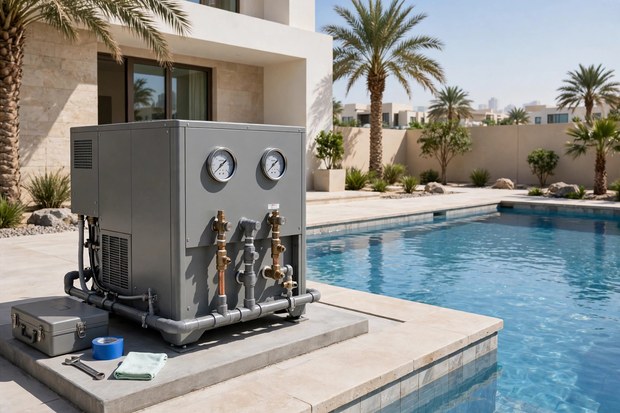
Most chiller problems announce themselves clearly. Not cooling usually traces to one of four things: the thermostat set point is wrong (check it first — it is the commonest “fault”), airflow to the condenser is blocked, the pool filter is dirty and flow is restricted, or refrigerant has leaked. The first three are homeowner-fixable; the fourth needs a technician.
Noisy fan often means debris in the fan housing, a failing bearing, or the unit vibrating against its pad. Error codes on the controller are actually helpful — they point to specific issues (flow switches, high pressure, sensor faults). Note the code and call your installer; do not just reset and hope.
The faults to take seriously: any refrigerant leak (the unit will ice up or stop cooling, and running it low on refrigerant damages the compressor), and any electrical burning smell. Both mean switch it off and call a professional. Everything else is usually straightforward.
Chiller plus heater: swimming all year
Dubai’s winter is short but real — pool water in January and February can sit in the high teens, which most people find too cold for comfortable swimming. A reversible heat-cool pump solves both seasons in one unit: cooling through the long summer, heating through the brief winter. If you are buying a machine anyway, the reversible option is worth pricing.
For dedicated-chiller owners, a separate heat pump or solar heating can extend the season. Solar pool heating works well in Dubai’s winter sun and costs little to run, though it needs roof space for the collectors. The combination — chiller for summer, solar or heat pump for winter — gives genuinely year-round swimming.
Whatever the setup, the control strategy matters: heat and cool set points should have a sensible dead band between them, or the units will fight each other in the shoulder seasons. Your installer should set this up at commissioning, not leave you to discover it.
When cooling alone is not enough
Sometimes the honest advice is that a chiller will not fix the real problem. If the pool has chronic algae because the filtration is undersized, cooling the water will not fix the filtration. If the water chemistry is wildly out of balance, a chiller just gives you cool, badly balanced water. And if the pool is fundamentally unpleasant — poor circulation, dead spots, constant debris — the money may be better spent on renovation first.
Similarly, if the pool is barely used — a holiday home occupied two months a year — the economics of a chiller are harder to justify. A good cover, shade, and accepting warm water for a few weeks may be the rational choice. We will tell you if that is the case; selling chillers to people who do not need them is a short-term business model.
The site visit is where this gets settled. We measure the pool, check the equipment, talk about how you actually use it, and give you a straight recommendation — chiller, heat-cool pump, shade and circulation improvements, or a combination. Sometimes the answer is “you do not need us,” and we are fine with that.
Related reading: our saltwater versus chlorine comparison helps you choose a sanitation system, our chlorine guide explains water chemistry in plain terms, and our pool maintenance guide covers the routine that keeps a chiller running well.
Frequently asked questions
How do I know if my pool needs a chiller?
If your pool is unshaded, shallow or west-facing, your family swims in the afternoon, and the water sits above 30°C through summer, a chiller will transform it. If the pool is shaded, deep, or mainly used in the morning, try shade and night circulation first. A site visit with actual measurements settles it.
Can one unit both cool in summer and heat in winter?
Yes — that is a reversible heat-cool pump. It cools through the long summer and reverses its cycle to heat in winter. For Dubai, where both seasons matter, it is often the smarter buy than a cooling-only chiller. Ask for it by name; not every “pool chiller” quote includes the heating function.
How is a chiller sized — and why does volume matter more than surface area?
Sizing starts with volume: length times width times average depth. Two pools with the same surface can hold very different volumes of water, and it is the water that needs cooling. Add sun exposure, target temperature and pull-down speed. A supplier who sizes from surface area is guessing — get a measured assessment.
What is the difference between an inverter chiller and a standard one?
An inverter chiller uses a variable-speed compressor that ramps up and down to match demand, so it runs quieter, uses less electricity, and holds temperature more steadily. A standard (fixed-speed) unit is either fully on or off — cheaper to buy, more expensive to run, and harder on the compressor. In Dubai’s long cooling season, the inverter usually pays back.
Why does a titanium heat exchanger matter?
The heat exchanger is the part your pool water flows through, so it lives in constant contact with your water chemistry — including salt if you have a saltwater pool, and Dubai’s mineral-heavy tap water. Titanium resists this corrosion far better than standard cupronickel. It is the specification to insist on, especially for saltwater pools.
Can a chiller be added to an existing pool, and how long does it take?
Yes, in most cases — it is plumbed into the existing circulation loop after the filter, with a bypass loop and isolation valves. Most retrofits take a day or two, plus commissioning. The site visit confirms plant-room space, airflow and electrical supply before anything is ordered.
How much does it cost to run a chiller in Dubai?
It depends on pool volume, target temperature, electricity tariff and running hours — which is why honest suppliers quote from a site visit, not a price list. Night cooling, a thermal cover and a realistic set point (26–28°C) keep costs sensible. Every degree lower costs disproportionately more.
Will a chiller make my pool too cold?
No — the thermostat holds your set point. It cools to the temperature you choose and then cycles to maintain it. If anything, the risk is setting it too low and running up the bill, not over-cooling. Start at 28°C and adjust to taste.
Do I still need shade or a cover if I have a chiller?
They help enormously. Shade cuts the heat load the chiller must remove; a thermal cover at night holds the temperature the chiller worked to achieve. A chiller plus shade plus a cover is the efficient trio — the chiller alone does the job, but the helpers cut its workload and your bill.
What maintenance does a chiller need?
Keep airflow clear and the condenser coil free of dust, keep the pool filter clean so flow through the heat exchanger is unrestricted, and keep the water chemistry balanced to prevent internal scaling. An annual professional service — refrigerant, electrics, fan, controller — is cheap insurance. It is low-maintenance, not no-maintenance.