
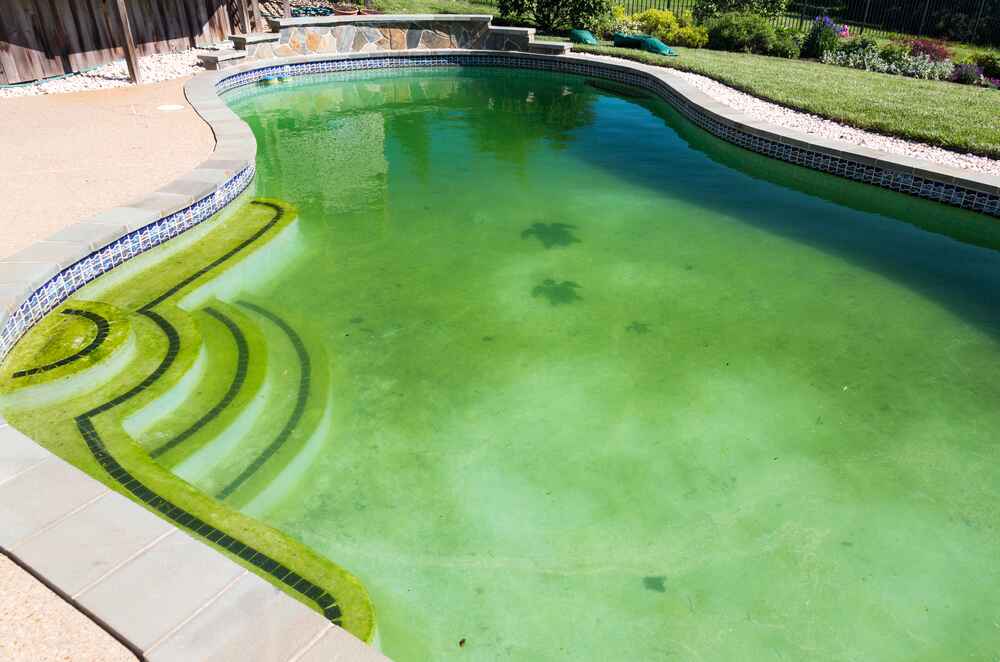

A green pool is the most common complaint Dubai villa owners have about their water, and it is also one of the most misunderstood. The water does not turn green because the pool is old, or because Dubai’s climate makes clear water impossible. It turns green because algae — microscopic organisms whose spores are always drifting in the air, the dust and the rain — found a window where the sanitiser fell behind, the water stopped moving properly, or the chemistry drifted out of balance. Dubai’s heat, fierce sun and fine desert dust simply make that window open wider and more often than it does in a cooler climate. Once you understand which type of algae you are looking at and why it showed up, the fix stops being guesswork, and keeping it away becomes a routine rather than a rescue.
This guide explains algae in Dubai pools in full: the three types owners actually meet, the causes hiding underneath every bloom, the recovery sequence that clears green water properly, why a single shock dose so often fails, and the habits that keep algae from returning. It answers the questions owners really ask — in community groups, on forums and on site visits — including whether green water is safe to swim in, why mustard algae keeps coming back after treatment, whether a saltwater pool can still go green, and when algae is really a sign of an equipment problem rather than a chemical one.

Why algae loves a Dubai pool
Algae needs three things to thrive: warmth, sunlight and nutrients, with weak sanitiser levels giving it the opening it needs. A Dubai pool offers all four in abundance for much of the year. Water temperatures climb through the summer, sunlight is intense and long-lasting, and fine desert dust settles on the surface daily, carrying organic matter and phosphates — the nutrients algae feeds on — straight into the water. Evaporation concentrates everything dissolved in the pool, so the chemistry drifts faster here than owners expect, and heat burns off sanitiser more quickly, which means the chlorine level that was fine on Monday can be too low by Thursday without anyone noticing. That is why a pool that looked perfect before a holiday so often turns green while the owners are away. A week without testing, brushing and topping up the sanitiser is a long time in July. A power cut that stops the pump, a salt cell that scales over, a filter that clogs, or a sandstorm that dumps a layer of dust across the surface can each open the same window. None of these are unusual events in Dubai, and none of them means the pool is ruined. They mean the routine slipped, and the routine is what keeps algae out. Understanding that is the first step, because it changes the question from “which chemical kills this?” to “what let it grow in the first place?” — and the second question is the one that keeps it from coming back.How algae takes hold: the window, not the invasion
It helps to know that algae spores are always present. They arrive on the wind, in rain, on leaves, on swimwear and on pool toys. In a healthy pool they are killed on contact by the sanitiser and never get the chance to settle. A bloom is therefore not an invasion from nowhere; it is a sign that the sanitiser fell behind the rate at which algae could grow. That happens most often when free chlorine drops too low, when the pH rises high enough to weaken chlorine’s killing power, when stabiliser levels climb so high that much of the chlorine is bound up and slow to act, or when circulation leaves corners, steps and the area behind ladders untouched so treated water never reaches the spores settling there. This is also why algae so often appears in the same spots first. The shaded side of the pool, the steps, the corners and the waterline are where water moves slowest and where sunlight and warmth still reach. A pool can look clear in the middle while a film is quietly establishing itself on a shaded wall, and by the time the water itself turns cloudy or green, the growth is already well established. Regular brushing matters precisely because of this: brushing breaks up the early film and exposes it to sanitiser before it can anchor itself. A pool that is dosed but never brushed, or brushed but never tested, will eventually go green — the two halves of the routine depend on each other.Green algae: the fast one, and the easiest to clear
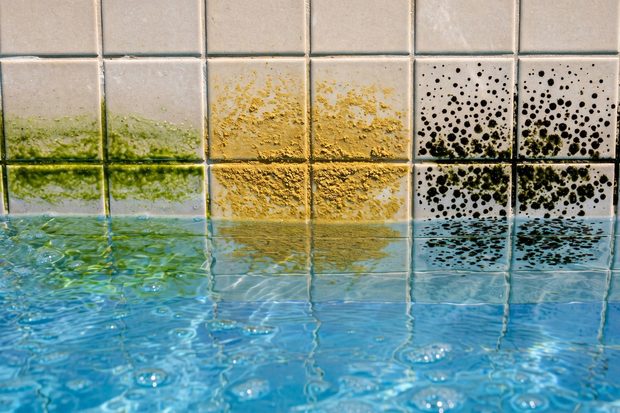
Green algae is the type most Dubai owners meet, and it is the most straightforward to deal with. It turns the water cloudy green, sometimes almost overnight in peak summer, and leaves a slippery film on walls, floors and steps. It floats freely in the water as well as clinging to surfaces, which is why the whole pool changes colour rather than just a patch. The good news is that green algae is the least stubborn of the three types: it has no deep roots and no tough protective shell, so once the sanitiser level is properly restored, the water is balanced, the surfaces are brushed and the filter runs long enough to remove the dead growth, it typically clears within a few days. The mistake owners make with green algae is usually impatience rather than the wrong product. A single shock dose, added to unbalanced water, with the pump running on its normal short schedule, will kill some algae and leave the rest to regrow. The water may look slightly better for a day and then turn green again, which feels like the treatment failed when in fact it was never completed. Green water needs the full sequence — testing, balancing, brushing, shocking in the evening, continuous filtration and vacuuming — and it needs the sanitiser held at an effective level until the water is genuinely clear, not just less green. Done properly, green algae is a few days of work, not a season of trouble.Mustard algae: the yellow dust that keeps coming back
Mustard algae, also called yellow algae, is the frustrating one. It looks like a fine yellow or sandy dust clinging to walls and steps, usually on the shaded side of the pool, and it is constantly mistaken for sand, pollen or dirt that has settled. That mistake is exactly why it returns: an owner vacuums it away, the pool looks clean, and a few days later the yellow dust is back on the same wall. Unlike green algae, mustard algae tolerates normal chlorine levels, clings hard to surfaces, and — critically — survives on everything that has touched the water, including brushes, vacuum hoses, nets, toys and swimwear. Treat the pool and ignore the equipment, and the equipment re-seeds the pool. Clearing mustard algae therefore takes a different discipline from clearing green water. The affected surfaces need aggressive brushing, the chlorine level needs to be held higher than a normal shock for longer, and every piece of equipment that has been in the water should be in the pool during treatment or disinfected separately, with swimwear laundered as well. Dead mustard algae is fine and light, so vacuuming it through the filter can send a share of it straight back into the pool through the returns, which reads as a return when it never actually left — vacuuming to waste, where the pool’s plumbing allows it, avoids that trap. If a yellow dust keeps returning despite all of this, it is worth checking whether it is pollen rather than algae at all: pollen settles on the floor, appears everywhere rather than on walls, and keeps accumulating even at shock level, while true mustard algae stops returning once a properly held shock level is maintained.Black algae: small spots, deep roots, real patience required
Black algae looks nothing like the other two. It appears as small, dark, raised spots — black or blue-green — that feel rough to the touch and sit most often on plaster and concrete surfaces, in grout lines, and in rough or pitted areas where it can anchor itself. Technically it is a form of cyanobacteria rather than true algae, and it protects itself with a tough outer layer that chlorine struggles to penetrate. Its roots sit below the surface of the plaster, which is why a light brush barely touches it and why a single shock dose does almost nothing: the chemical cannot reach the cells until the protective layer is broken. Black algae is the slowest type to clear and the one where brushing matters most. The spots need vigorous brushing — with a stiff brush suited to plaster, never a wire brush on a delicate surface — to break the layer open, followed by shock treatment and a targeted algaecide applied directly to the spots, and then repeated brushing over several days while the chlorine level is held up. Miss a day and the roots regrow underneath. This is also the type where honesty matters: very old, deeply pitted plaster can harbour black algae so thoroughly that repeated treatment only holds it back, and at that point the real fix is resurfacing rather than another round of chemicals. A reputable company will say so plainly instead of selling endless treatments, because the plaster itself has become the problem.Pink slime and white water mould: not algae, but easily confused
Two growths commonly get called algae but are not. Pink slime is a pinkish, slimy film that typically appears in corners, around fittings, in the skimmer and inside pipework, while white water mould looks like pale, tissue-like strands floating in the water or clinging to surfaces. Both thrive in the same conditions as algae — poor circulation, low sanitiser, undisturbed corners — and both hide in plumbing and filters where brushing the pool walls never reaches them. That hiding habit is why they return after a pool-only treatment: the growth inside a pipe or a filter is untouched and re-seeds the water. The practical point for owners is simple. If a pink or white growth keeps returning after the pool itself has been thoroughly brushed and shocked, the circulation system needs attention: the filter cleaned or serviced, the skimmer and pump basket scrubbed, water features and any rarely used lines run and flushed, and the sanitiser held up while all of it is done. It is a circulation and cleaning job as much as a chemical one, and it is a common reason a professional visit helps — because the growth is in places an owner cannot easily reach or see.The causes underneath every bloom
Whatever the type, almost every bloom traces back to a short list of causes, and working through them in order is how you stop the next one. The first is sanitiser level: free chlorine that has drifted too low, whether from heat, heavy use, rain dilution, a holiday gap or a salt cell that has stopped producing properly. The second is water balance: pH that has crept high enough to weaken chlorine, and stabiliser that has built up so high that the chlorine present is slow to act. In Dubai’s sun, stabiliser matters more than many owners realise — it protects chlorine from ultraviolet light, but too much of it binds the chlorine up, so the test shows chlorine present while the water is effectively unprotected. The third cause is circulation. Pumps run for too few hours, return jets pointed the wrong way, and dead spots behind steps and ladders all leave corners of the pool effectively untreated. A variable-speed pump running longer at lower speed commonly circulates the whole volume more thoroughly than a short, violent burst, and it is worth checking that the water is genuinely turning over rather than just moving near the skimmer. The fourth cause is filtration: a sand bed that is clogged, a cartridge that has never been cleaned, or a filter pressure reading that has crept well above its clean level all mean dead algae and spores pass straight back into the pool instead of being removed. And the fifth is nutrients: phosphates and organic debris from dust, leaves, rain and heavy bathing loads, which feed algae even when chlorine looks acceptable. A bloom after a sandstorm or a busy weekend is rarely a mystery — it is the nutrient load arriving all at once while the sanitiser was already stretched.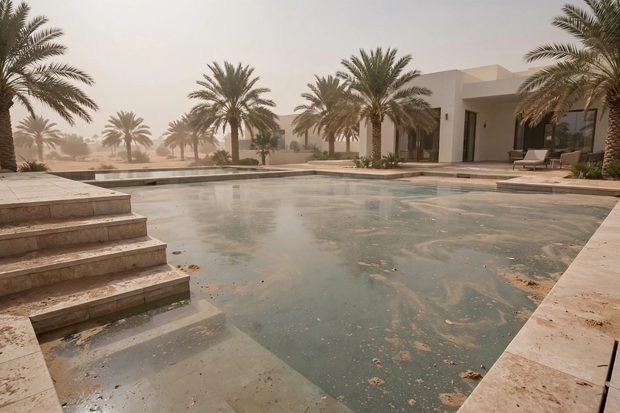
The recovery sequence that actually clears green water
Clearing a green pool is a sequence, and the order matters. Start by testing the water properly — free chlorine, pH, alkalinity and stabiliser — because treating blind is how owners waste chemicals and time. Correct the pH first, toward the low end of its healthy range, since chlorine works far better there; shocking into high-pH water is one of the most common reasons a treatment appears to fail. Then brush every surface thoroughly: walls, floor, steps, corners and the waterline, breaking up films and exposing growth to the sanitiser. Skim and empty the baskets so debris does not keep feeding the bloom. Next, shock the pool in the evening, when the sun cannot burn off the dose before it works, and run the filter continuously — not on its normal schedule — until the water clears. Backwash or clean the filter whenever the pressure rises noticeably above its clean reading, because a loaded filter stops removing dead algae and starts returning it. Vacuum the dead growth slowly, to waste where the plumbing allows, so it leaves the system entirely rather than passing through the filter. Then retest, and repeat the shock if the water is still green or cloudy after a full day, rather than assuming one dose was enough. The water typically moves from green to cloudy to clear over a few days, and that cloudy middle stage is normal — it is dead algae suspended in the water waiting for the filter to remove it. Only when the water is genuinely clear, the surfaces are clean, and the sanitiser has returned to its healthy range is the pool ready to swim in again.Why shocking alone so often fails
Owners often ask why a shock dose that worked last year did nothing this time, and the answer is usually one of four things. The pH was too high, so the chlorine was weakened before it could work. The stabiliser was too high, so the chlorine was bound up and slow. The filter was clogged or the pump schedule too short, so dead algae was never removed and the water stayed cloudy. Or the type was wrong for the treatment: mustard algae needs a higher level held longer plus equipment disinfection, and black algae needs its protective layer broken by brushing before any chemical can reach it. In each case the shock itself was not faulty — the conditions around it were. There is a second, subtler failure worth knowing about. Repeating the same shock dose without fixing the cause, and watching the pool green up again each time, trains owners to believe their pool “just goes green” and needs constant shocking. In reality the pool is telling them something specific — a circulation dead spot, a tired filter, a salt cell that needs cleaning, a stabiliser level that has crept up over seasons of tablet use — and until that cause is found, every treatment is temporary. If a pool turns cloudy again shortly after treatment, the order of checks is filter first, then circulation, then chemistry. That order saves more chemicals than any product choice.Saltwater pools can go green too
A common surprise for Dubai owners is a saltwater pool turning green. The salt cell generates chlorine automatically, so the assumption is that sanitiser takes care of itself — but a cell can only maintain a healthy pool, not rescue a blooming one. When algae is already established, the cell’s normal output is not enough to overcome it, and the pool needs the same manual shock treatment as any other pool first, with the cell supporting the recovery rather than leading it. After that, the cell’s own weaknesses need checking: scale building up on the cell plates, which reduces output quietly over weeks; pH drifting upward, which salt systems tend to do and which weakens the chlorine produced; and salt levels dropping after rain or top-ups, which can trip the system into a low-output or error state without the owner noticing. That is why a salt pool that keeps going green usually has a maintenance story behind it — a cell that has not been inspected or cleaned, a pH that has drifted high, or a pump schedule that leaves the cell running too few hours to keep up with summer demand. Regular cell inspection, pH control and a realistic pump schedule are what make a salt system genuinely low-maintenance; without them, it is simply a chlorine pool with a more expensive way of making chlorine. For a fuller comparison of salt and traditional systems, see our guide to saltwater versus chlorine pools in Dubai.When algae is really an equipment problem
Sometimes the honest diagnosis is not chemical at all. A pump that has lost power, a filter that is undersized for the pool or whose media is exhausted, return jets that short-circuit water straight back to the skimmer, or a circulation design that leaves half the pool unmoved will all produce recurring algae no matter how carefully the water is dosed. The clue is the pattern: algae that always returns in the same corner, water that stays hazy even with correct chemistry, a filter pressure reading that never returns to its clean level after backwashing, or a pump that struggles to prime. These are equipment and hydraulics problems wearing an algae disguise. This is the point where a professional assessment earns its keep, because the fix may be a filter service, a pump repair, a re-aimed return jet or a circulation change rather than another chemical. It is also the point where renovation enters the conversation honestly: rough, pitted plaster that harbours black algae, grout that has failed across the waterline, or a plant room whose equipment has reached the end of its working life are all problems that chemicals can only hold back. Treating those as chemical problems wastes money; recognising them as physical problems fixes the algae permanently. If your pool’s algae always returns to the same place, or if treatment has failed twice in a row, have the equipment and the surfaces checked before buying anything else.Prevention: the routine that keeps algae away
Prevention is less dramatic than recovery and far cheaper, and it rests on the same routine every clear pool in Dubai shares. Test the water regularly — more often in summer, after sandstorms and after heavy use — and act on small drifts before they become blooms. Keep the sanitiser in its healthy range and the pH at the low end of its range, so chlorine stays effective. Brush the walls, steps and waterline every week, including the shaded side and the corners, because brushing is what stops a film becoming a bloom. Skim daily in dusty weather, empty baskets before they clog, and keep the filter clean so pressure stays near its clean reading. Run the pump long enough for the whole volume to turn over properly, and longer in peak summer rather than shorter — circulation is the delivery system for everything else, and a sanitiser that never reaches a corner cannot protect it. Keep phosphates and debris down by skimming promptly after dust and rain, and use a preventative algaecide only as a support for that routine, matched to your pool and used as its label directs, never as a substitute for brushing and testing. Cover the pool when it will sit unused, and before a holiday arrange for someone to test, dose and run the system — a week of neglect in July is the single most reliable way to come home to green water. A regular swimming pool maintenance plan in Dubai, with seasonal adjustments for summer heat and dust, catches all of this before it becomes a green pool, and it is the difference between a pool that is always inviting and one that is always being rescued. If algae has already damaged the surfaces, or if recurring blooms have exposed deeper problems — failing grout, rough plaster, tired equipment — the honest next step may be repair rather than another treatment. Our guides to swimming pool renovation in Dubai and swimming pool construction explain what that involves, and our swimming pool cost guide for Dubai and pool chiller guide cover the wider decisions owners weigh when a pool needs more than a chemical fix. Algae in a Dubai pool is not a mystery and it is not a disaster — it is a sign that something in the balance has slipped, and once the type is identified and the cause is fixed, clear water is a routine, not a rescue.
Frequently asked questions
Why does my Dubai pool keep turning green even though I add chlorine?
Because the chlorine is not reaching the algae effectively, or not for long enough. The most common reasons are pH that has crept high enough to weaken chlorine, stabiliser that has built up so much of the chlorine is bound up and slow to act, circulation that leaves corners and steps untreated, or a filter too clogged to remove dead growth. Test the water properly — sanitiser, pH, alkalinity and stabiliser — and check the filter pressure and pump schedule before adding more chemicals. A green pool is usually a sign that one of these has slipped, and fixing that cause is what keeps the water clear after treatment.Is it safe to swim in a pool with algae?
No, it is best not to. Algae makes surfaces slippery, which is a fall risk, and its presence means the water is not properly sanitised, so bacteria can be present too. Wait until the water is clear, the surfaces are clean, and the sanitiser has returned to its healthy range before swimming again. After shock treatment, that also means waiting until the sanitiser level has come back down from its treatment high to its normal range, since swimming in heavily shocked water irritates skin and eyes.How do I tell green, mustard and black algae apart?
Green algae turns the whole water cloudy green and leaves a slippery film everywhere. Mustard algae looks like fine yellow or sandy dust clinging to walls and steps, usually on the shaded side, and is easily mistaken for sand or pollen. Black algae appears as small, dark, raised spots that feel rough, most often on plaster, in grout lines and in rough or pitted areas. The distinction matters because the treatments differ: green algae responds to the standard sequence, mustard algae needs a higher level held longer plus disinfection of everything that touched the water, and black algae needs vigorous brushing to break its protective layer before chemicals can reach it.Why does mustard algae keep coming back after treatment?
Because it survives on everything that touched the water, not just in the pool. Brushes, vacuum hoses, nets, toys and swimwear can all re-seed the pool after a successful treatment, so they need to be in the pool during treatment or disinfected separately, with swimwear laundered. Mustard algae also needs a higher chlorine level held longer than green algae, and dead mustard algae vacuumed through the filter can pass straight back into the pool — vacuuming to waste, where the plumbing allows, avoids that. If a yellow dust keeps returning despite all of this, check whether it is pollen instead: pollen settles on the floor, appears everywhere, and keeps accumulating even at shock level.Does shock treatment alone kill black algae?
Not on its own. Black algae protects itself with a tough outer layer and roots that sit below the surface of the plaster, so shock cannot reach the cells until that layer is broken by vigorous brushing. The working method is to brush the spots hard with a brush suited to plaster, apply shock and a targeted algaecide directly to the spots, and keep brushing over several days while the chlorine level is held up. Miss a day and the roots regrow. If the plaster is very old and deeply pitted, treatment may only hold black algae back, and resurfacing becomes the honest fix.How long does it take to clear a green pool?
Typically a few days for green algae, if the full sequence is followed: test, correct the pH, brush thoroughly, shock in the evening, run the filter continuously, vacuum the dead growth, and retest. The water usually moves from green to cloudy to clear, and the cloudy middle stage is normal — it is dead algae waiting for the filter to remove it. Mustard and black algae take longer, because they need higher levels held for days and repeated brushing. If the water is still green after a full day of proper treatment, repeat the shock and check the filter and circulation before assuming the chemical failed.Can a saltwater pool get algae?
Yes. A salt cell maintains a healthy pool but cannot rescue a blooming one on its own — an established bloom needs manual shock treatment first, with the cell supporting the recovery. Salt pools go green most often when the cell has scaled over and its output has quietly dropped, when pH has drifted high and weakened the chlorine produced, when salt levels have fallen after rain or top-ups, or when the pump schedule leaves the cell running too few hours in summer. Regular cell inspection and cleaning, pH control and a realistic pump schedule are what keep a salt system genuinely low-maintenance.What causes algae after a sandstorm or heavy rain?
A sudden load of nutrients and debris arriving while the sanitiser is already stretched. Dust carries phosphates and organic matter into the water, rain dilutes the sanitiser and washes more debris in, and both can clog baskets and filters at exactly the wrong moment. Skim promptly, empty baskets, clean or backwash the filter, test the water and top up the sanitiser after dust and rain rather than waiting for the next scheduled visit. In dusty weather, daily skimming and a prompt test after a storm prevent most post-storm blooms.When is algae a sign of an equipment problem?
When it always returns to the same place, when treatment fails twice in a row, or when the water stays hazy despite correct chemistry. Those patterns point to a pump that has lost power, a filter that is undersized or whose media is exhausted, return jets that short-circuit water back to the skimmer, or circulation that leaves part of the pool unmoved. A filter pressure reading that never returns to its clean level after backwashing is another strong clue. In those cases the fix is a service, a repair or a circulation change — not another chemical — and a professional assessment will find it faster than repeated treatments.How do I keep algae from coming back for good?
By making the routine non-negotiable: test regularly and act on small drifts, keep the sanitiser in range and the pH at the low end of its range, brush walls, steps and the waterline every week including shaded corners, skim in dusty weather, keep the filter clean, and run the pump long enough for full turnover — longer in peak summer, not shorter. Arrange cover and care before a holiday rather than leaving the pool for a week in July. A regular maintenance plan with seasonal adjustments for Dubai’s heat and dust catches all of this before it becomes a green pool. If you want that routine handled professionally, Hello Landscaping & Pools LLC covers cleaning and maintenance across Dubai — message us on WhatsApp and we will arrange a visit.Related reading: our green water fix guide gives the step-by-step clearing sequence, our chlorine guide explains dosing and testing, and our villa pool cleaning guide covers the routine that prevents algae returning.