


Blog
So, how do you actually keep a swimming pool clean in Dubai? Short answer: you skim often, brush every week, vacuum the floor properly, and test the water before it turns on you. That’s it, really — but Dubai’s climate makes each of those jobs harder than it looks on a YouTube video filmed somewhere cool and green. Dust lands daily, the sun eats your chlorine, and water evaporates fast enough that the level drops while you’re not looking. This guide walks you through a cleaning visit done right, whether you do it yourself or hand it over to a team. And if you’d rather skip the work entirely, we’ll show you exactly what a professional visit covers, what it doesn’t, and how to get an exact quote for your own pool.
A quick note on who this is for: villa owners across Dubai — from Arabian Ranches and Palm Jumeirah to Mirdif and Dubailand — who want a pool that’s genuinely clean, not just clear-looking. If you manage a commercial pool, the same principles apply, only the schedule gets tighter.
Get an exact quote for your pool — free site visit, no guesswork.
Tell us your villa location and pool size; we’ll confirm a visit time on WhatsApp within minutes.
Why Dubai villa pools get dirty faster than you expect
A pool in Dubai doesn’t get dirty the way a pool in London or Toronto does, and pretending otherwise is how most villa owners end up with green water in August. Here’s what you’re really up against.
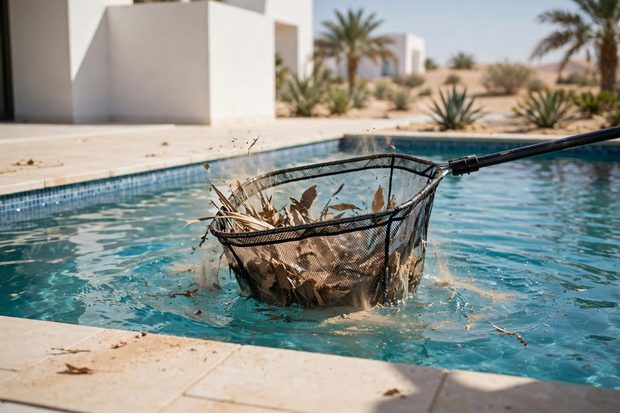
First, there’s the dust. Fine desert dust settles on the surface every single day, and after a shamal wind it arrives by the bucket-load. Leave it floating and it sinks, stains the finish, and clogs the filter. Skimming isn’t a chore here — it’s the daily price of a clean pool.
Then there’s the heat. Strong sun burns off free chlorine — the sanitiser that keeps water safe to swim in — far faster than in milder climates. A pool that’s perfectly balanced on Monday can be under-sanitised by Thursday if nobody checks it. Algae loves exactly those conditions: warm, under-chlorinated water with a fine layer of dust to feed on.
Add year-round swimming to the mix — sunscreen, body oils, and far more bather load than a seasonal pool ever sees — plus rapid evaporation that concentrates whatever’s dissolved in the water. The result: Dubai pools need more frequent attention, not less, than pools in cooler countries.
What a proper clean actually includes
Not every cleaning method does the same job, and mixing them up is a common mistake. Skimming won’t fix chemistry, and shocking the water won’t remove the dust sitting on the floor. Here’s what each part actually does.
- Skimming the surface — removes leaves, insects, dust and pollen before they sink and stain.
- Brushing walls, steps and the waterline — dislodges algae film and biofilm so the sanitiser can reach it.
- Vacuuming the floor — lifts settled dust and sand that brushing pushes down.
- Emptying skimmer and pump baskets — keeps water flowing properly through the filter.
- Testing and balancing the water — pH, free chlorine and total alkalinity, adjusted to safe ranges.
- Checking the filter — pressure read against its clean baseline; backwashed or cleaned as needed.
Miss any one of these regularly and the others have to work harder. A pool with perfect chemistry but a full skimmer basket still circulates poorly; a beautifully vacuumed pool with no chlorine still turns green.
Skimming and vacuuming: the daily and weekly backbone
If you only do two things, do these. Skim the surface every day — it takes five minutes with a leaf net, and it stops debris sinking, staining and clogging. In dusty weeks or after a windy day, skim twice. Pay attention to corners and the waterline, where dust collects in a visible film.
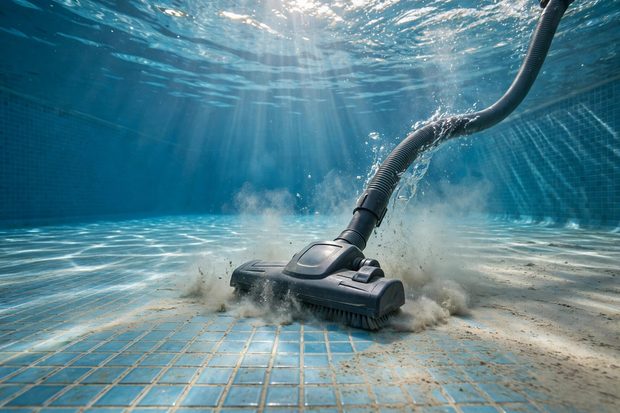
Vacuum the floor weekly, slowly, in overlapping passes. Rushing stirs dust into a cloud instead of lifting it — the classic beginner mistake is a pool that looks worse after vacuuming than before. If your system allows vacuuming to waste, use it after dust storms so fine particles bypass the filter entirely instead of loading it up.
A robotic cleaner is a brilliant helper for the floor, but it’s not a replacement for the routine. It won’t empty your skimmer basket, brush the tile band, or test your water — and it can’t tell you the pump sounds wrong. Think of it as the assistant, not the supervisor.
Brushing the walls, steps and waterline
Algae doesn’t start as green water — it starts as an invisible slippery film on walls, steps, benches and the shady spots behind ladders. Brush every surface weekly, and you’ll never give it a foothold. Start at the waterline tile band, where body oils and dust form a scum line, then work down the walls, steps and benches.
Use the right brush for your finish: nylon for vinyl and fibreglass, stainless steel only for concrete and plaster — the wrong brush scratches the surface, and scratched surfaces grow algae faster. It’s a small detail that saves real money over the years.
Testing and balancing the water
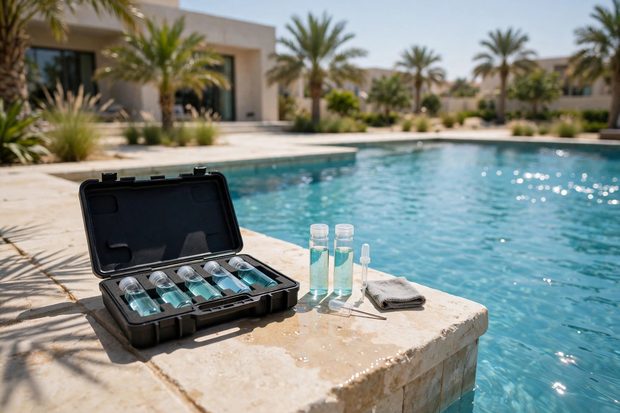
You don’t need a chemistry degree to keep pool water safe — you need three numbers checked regularly, and the discipline to act on them.
pH balance tells you whether the water leans acidic or alkaline. The comfortable range for swimmers is roughly 7.2 to 7.6. Too low and the water stings eyes and corrodes fittings; too high and chlorine stops working properly while scale forms on surfaces.
Free chlorine is the sanitiser still available to kill germs, usually aimed at 1 to 3 parts per million. Dubai’s sun burns it off fast, so test more often in summer — twice a week isn’t overkill in July and August.
Total alkalinity is the buffer that holds pH steady, usually aimed at 80 to 120 parts per million. Think of it as the shock absorber: get alkalinity right and pH stops swinging wildly.
One more term you’ll hear: cyanuric acid, often called stabiliser. It shields chlorine from sunlight, a bit like sunscreen for your sanitiser — genuinely useful in Dubai, but too much of it locks chlorine up so it can’t sanitise. If you’ve been using stabilised chlorine tablets for years without draining, get this tested.
Cloudy water: find the cause before treating it
Cloudy water is a symptom, not a diagnosis — and treating the wrong cause wastes chemicals and time. Work through the likely culprits in order.
- Filtration problems. A clogged filter, a pump running too few hours, or a full skimmer basket means particles never get removed. Check the pressure gauge against its clean baseline first.
- Chemistry imbalance. High pH, low sanitiser or combined chlorine (chloramines) all cloud water. Test before you dose — guessing is how pools end up over-shocked and still cloudy.
- Fine dust bypass. After a sandstorm, particles can be too fine for the filter to catch in one pass. A clarifier helps them clump together so the filter can grab them — but only after the basics check out.
- Early algae. If the cloudiness has a green tint, treat it as the start of an algae bloom and follow the recovery sequence below.
The golden rule: test, then treat. Dumping shock into a pool with a clogged filter just gives you expensive cloudy water.
Green water and algae: the recovery sequence
Green water is almost always algae, helped along by heat burning off chlorine and by missed brushing in corners, steps and behind fittings. The rescue follows the same sequence every time — order matters.
- Brush everything. Walls, floor, steps, benches — break the algae’s hold so chemicals can reach it.
- Test and adjust pH first. Shock works poorly if pH is high; bring it to around 7.2 before shocking.
- Shock the pool. A proper chlorine shock, dosed for your pool volume, in the evening so the sun doesn’t burn it off.
- Run the filter continuously until the water clears — 24 to 48 hours, backwashing or cleaning the filter as pressure rises.
- Vacuum the dead algae once the water clears, preferably to waste.
- Re-test and rebalance before swimming — chlorine must be back in the safe 1–3 ppm range.
If the pool keeps turning green within days of clearing, something is feeding the cycle: phosphates in the water, hidden biofilm in pipework, or a filter that isn’t actually filtering. That’s the point to call in a professional rather than buying more shock.
Filters, the pump basket and the plant room
Your filter does the quiet heavy lifting, and it tells you when it needs help — if you know how to listen. The pressure gauge is the instrument: note the reading when the filter is clean, and backwash or clean the cartridge when pressure rises about 8–10 psi above that baseline.
Empty the skimmer and pump baskets weekly, more often in dusty or leafy periods. A full basket chokes water flow, strains the pump, and makes the whole system work harder for worse results. Five minutes, once a week, saves pump repairs.
Give the plant room a regular once-over: the pump should sound steady (grinding or screeching means worn bearings), seals and O-rings should be drip-free, and there should be no musty smell of hidden leaks. Catching a weeping seal early is a cheap O-ring; catching it late is a new pump.
After a sandstorm: the recovery sequence
Sandstorms are Dubai’s special pool challenge. When the dust settles — literally — work through this sequence rather than just shocking and hoping.
- Skim the surface thoroughly before anything sinks. This is the highest-value ten minutes of the whole recovery.
- Empty all baskets — they’ll be full of dust and debris.
- Brush the walls and steps to push settled dust toward the floor drains and the vacuum’s path.
- Vacuum slowly, to waste if possible, so fine dust bypasses the filter.
- Run the pump longer than usual — give the filter extra hours to clear suspended particles, then check the gauge.
- Test and rebalance — dust shifts pH and consumes sanitiser.
One Dubai-specific note: unlike colder countries, you don’t winterise a pool here — but sandstorm season (roughly spring and the windy weeks of the year) is your equivalent of a seasonal deep-clean trigger. Plan a thorough recovery after every major storm, not just a quick skim.
How often should each job be done in Dubai’s heat
Frequency is where Dubai differs most from temperate-climate advice. Use this as your baseline, then adjust for your pool’s dust exposure and bather load.
- Skimming: daily in summer, every other day in the cooler months — and always after windy weather.
- Brushing: weekly, every surface including steps, benches and behind fittings.
- Vacuuming: weekly, plus after every sandstorm or dusty spell.
- Baskets: weekly at minimum; check after storms.
- Water testing: twice a week in summer, weekly in the cooler months.
- Filter check: monthly gauge reading against baseline; backwash or clean as pressure dictates.
- Professional visit: weekly or fortnightly for most villas, depending on dust exposure and use.
No two villa pools need exactly the same schedule. A pool near open desert or a construction site collects far more dust than a sheltered courtyard pool; a pool used daily by a big family needs more sanitiser attention than one swum in at weekends. Treat the list above as a starting point and tune it over a month of observation.
Want the whole routine handled? Weekly and fortnightly plans.
Skimming, brushing, vacuuming, water testing and filter checks — done properly, every visit.
When cleaning is not enough: the signs of repair
Being straight about this saves everyone a misunderstanding later. Cleaning keeps a healthy pool healthy; it doesn’t fix a sick one. Call for a repair assessment — not another clean — if you notice:
- Water level dropping faster than evaporation explains. In Dubai’s heat some loss is normal, but a daily drop of more than a centimetre or so suggests a leak.
- Cracks, hollow tiles or rough patches on the pool finish that brushing doesn’t improve.
- The pump struggling — grinding noises, air in the pump basket, or weak return jets despite clean baskets and filter.
- Stains that survive brushing and balanced water — especially rusty or copper-coloured marks, which usually mean metals in the water.
- Algae that returns within days of a proper shock-and-vacuum recovery, pointing to biofilm, phosphates or filter failure.
If a cleaning visit turns up something bigger, a good crew tells you plainly instead of selling you another clean. Cleaning and repair are different jobs with different quotes — anyone who blurs them is doing you no favours.
What a professional cleaning visit should include
When our team comes for a swimming pool cleaning Dubai visit, this is what “cleaned” actually means:
- Surface skimming — every leaf, insect and dust film lifted off the water, corners included.
- Skimmer and pump baskets emptied and rinsed — because a full basket chokes water flow and makes the whole system work harder for worse results.
- Brushing — waterline tile band first, then walls, steps, benches, and the shady spots behind ladders and around fittings.
- Vacuuming the floor — slow, overlapping passes that pick dust up instead of pushing it around.
- Water testing and balancing — pH, free chlorine and total alkalinity brought into their proper ranges, with stabiliser checked on request.
- Filter check — the pressure gauge read against its clean baseline, with backwashing for sand filters or a cartridge rinse as needed.
- Equipment once-over — pump, seals, O-rings, lights and fittings given a visual check, so small wear gets spotted before it becomes a repair.
- Water level topped up — brought back to mid-skimmer height, so the skimmer can do its job properly.
That last point matters more than people think. If your level keeps dropping far faster than evaporation explains, say so — a leak quietly wrecks water chemistry as well as your water bill. Here’s how to find and fix a swimming pool leak before it costs you more.
Related reading: if green water is your recurring problem, see our step-by-step green pool water fix for Dubai; for the ongoing routine, our guide to swimming pool maintenance in Dubai covers what a proper plan looks like month to month.
Ready for a pool you don’t have to think about?
Book a free site visit — we’ll look at your pool properly and give you an exact, itemised quote.
Related reading: our pool maintenance guide covers the full routine, our algae guide explains causes and fixes, and our chlorine guide explains water chemistry in plain terms.