

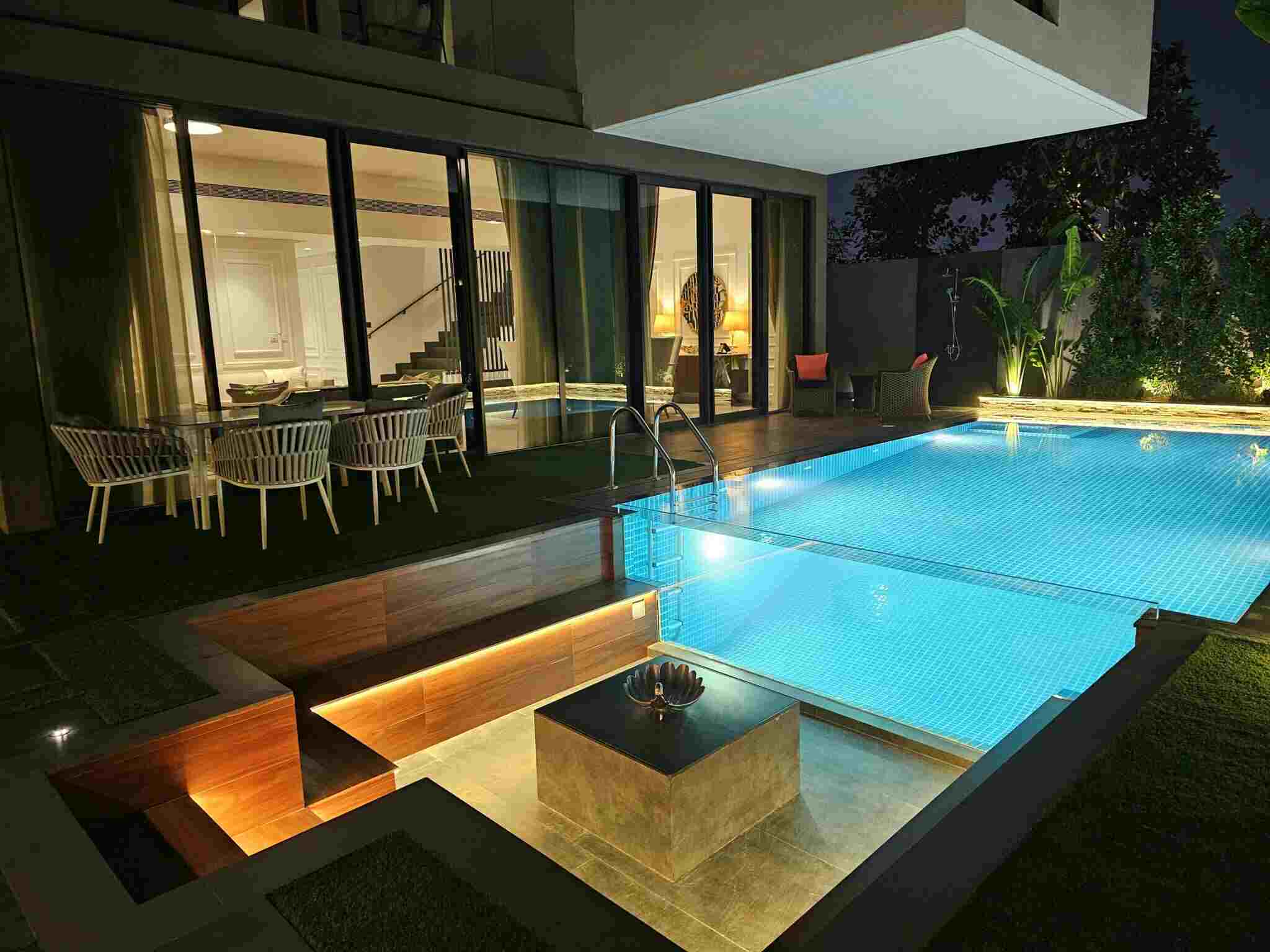

Building a swimming pool in Dubai is one of the biggest decisions a villa owner makes. The pool becomes a permanent part of your home, plumbed into your villa, wired into your electrical system and governed by approvals from Dubai Municipality and your community developer. Choose the right swimming pool contractor and the whole project feels orderly: clear drawings, honest communication, a build that runs to its programme and a pool that still looks good years later. Choose badly and the problems usually arrive late, as a leak behind the tiles, a pump that never quite copes, a deck that moves, or a contractor who stops answering the phone once the final payment has cleared.
This guide explains how to choose well. It is written for villa owners comparing swimming pool contractors in Dubai who want to know what to check, what to ask and what to watch out for — before signing anything. It covers the questions buyers actually ask in community groups and on site visits: how to verify a licence, who handles approvals, how to compare quotes fairly, how payment should be staged, what a realistic timeline looks like, what warranties are worth, and the warning signs that should make you pause. Use it as a checklist in every contractor meeting, and shortlist the companies that welcome these questions rather than dodging them.

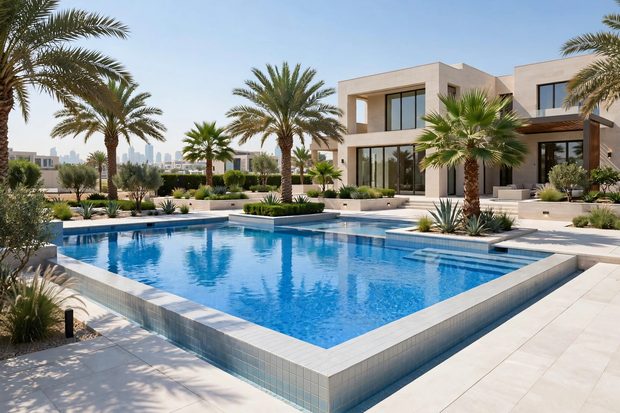
Start by defining what “best” means for your villa
There is no single best swimming pool contractor in Dubai, only the best one for your particular job. A company that builds large commercial pools may not be the right fit for a compact townhouse garden, and a firm that specialises in simple rectangular family pools may not be the right choice for an infinity edge with a balance tank. Before you contact anyone, get clear on your own project: are you building a brand new pool, renovating an older one, or adding features to a pool you already have? Do you want a design-build service where one company handles everything, or are you prepared to coordinate a designer, a builder and a maintenance team yourself? What kind of pool suits your garden — a classic rectangle, a freeform shape, an overflow edge — and how will your family actually use it? That clarity changes the questions you ask. A buyer who wants a full-service contractor should be asking about in-house engineering, site teams and aftercare. A buyer renovating an older pool should be asking about leak detection, structural assessment and waterproofing renewal. A buyer with a tight garden should be asking about access for machinery and how excavation spoil leaves the plot. Contractors respect buyers who know what they want, and the good ones will tell you honestly when a request does not suit your plot or your soil. The ones who agree to everything without a single question are rarely the ones who deliver.Check the licence and insurance before anything else
The first document to ask for is the trade licence. Every swimming pool contractor in Dubai works under a trade licence with listed activities, issued through the Department of Economic Development, and the activity lines should match the work you are buying — swimming pool construction or building contracting, not a generic trading activity. Ask to see a copy of the licence in the same company name as the quotation, and check that it is current. A legitimate contractor produces it without hesitation. Evasiveness about the licence is not a minor detail; it is one of the strongest early warning signs there is. Insurance matters just as much. Ask who holds the insurance on site: the contractor for all trades, or each subcontractor separately, and ask to see the certificate. Site work involves excavation, heavy machinery, electrical connections and water — if something goes wrong, you want to know you are not carrying the liability. Membership of industry associations or certification by Dubai Municipality can add confidence, but they are supporting evidence, not a substitute for the licence itself. Longevity helps too: a company that has been operating in Dubai for many years has a track record you can actually check, while a brand new outfit has only promises. None of this is bureaucratic fuss. An unlicensed or uninsured build can mean fines, forced rework, and serious trouble when you sell the villa, because the pool will not appear correctly on the property’s approved record.Approvals in Dubai: who files what, and why it matters
Approvals are where many Dubai pool projects stall, and they are also where a good contractor earns its fee. Every private pool must be registered with Dubai Municipality through the Building Permits System before any digging starts, with drawings covering the site plan, the pool structure, the plant room, pipework and electrical layout. If your villa sits in a master community, you will also need a No Objection Certificate from the developer — Emaar, Nakheel, DAMAC, Meraas or whoever manages your community — and that developer review commonly takes longer than the municipality permit, so it should start early. DEWA sign-off covers the electrical and plumbing connections, Dubai Civil Defence clearance applies where fire and safety systems are involved, and properties in special development zones, such as Palm Jumeirah, are approved by Trakhees instead of Dubai Municipality. The order matters. In most gated communities you need the developer NOC first, because it is a supporting document in the municipality submission; you cannot obtain the building permit without it. A contractor that files these routinely will explain the sequence for your community without pausing, tell you honestly how long each stage commonly takes, and chase comments when a submission comes back with queries. A contractor that dismisses approvals as unnecessary, or suggests you handle them yourself, is handing you the hardest part of the project and the delay when it goes wrong. Ask every shortlisted company, in plain words: who files each approval, who chases it, and what happens to the programme if one of them comes back with comments? The quality of that answer tells you a great deal about how your project will be run.Insist on a real site visit and a real design
A serious contractor starts on your plot, not on a price list. Expect a site visit where the team measures the garden, studies the affection plan — the official plot drawing that sets what you can build and where — and asks about soil, access, existing services, drainage and where the plant room will sit. Setbacks from boundaries are not negotiable at permit stage, so a design that ignores them gets sent back and costs you weeks. Soil matters too: Dubai’s sandy soils, and groundwater in some areas, change the structural requirements of the shell. Access matters just as much: excavation machinery, concrete pumps and delivery trucks have to reach the garden, and a tight side passage or a landscaped frontage changes the method and the programme. From that visit should come a design that fits your plot, not a catalogue shape squeezed into it. Good contractors typically show you a 3D visualisation before you commit, so you can see the pool in your garden rather than imagining it from a plan. That is also the moment to settle the practical details: at least a metre of deck around a private pool, steps and depth markings that make the pool safe to use, a plant room sited where a technician can actually reach every valve and connection, a drainage proposal for backwash water that stays inside your plot, and safety provisions such as a barrier with self-closing, self-latching gates where children are present. Changes made at drawing stage are cheap edits. Changes made after approval can send the paperwork back through the authorities, and changes made after the shell is poured are expensive. A contractor that rushes you past the design stage is rushing you past your cheapest opportunity to get the pool right.Judge real work, not renders
Anyone can publish polished computer renders. What matters is completed work you can actually see and, ideally, stand beside. When you review a contractor’s portfolio, look for built projects that resemble what you want in scale, style and complexity, and insist on real photographs of finished pools rather than renders alone. Pay attention to variety and depth across pool types, finishes and site conditions — a portfolio of nearly identical pools may mean a company that builds one thing well and everything else by guesswork. Then go further than most buyers do, and ask to visit a completed project and speak to its owner. Older projects are especially revealing, because they show how the work has aged: how the tile has held up through Dubai summers, whether the deck has stayed level, whether the waterline still looks clean. Ask those owners not just whether they like the finished pool, but how the build itself went: was communication clear, was the project finished when promised, did problems arise, and how were they fixed? Homeowner complaints across Dubai keep returning to the same themes — delayed timelines with little communication about the delay, finishing details that disappointed after a promising start, and post-construction questions that went unanswered. A contractor’s past clients will tell you quickly whether any of those apply. If a contractor cannot produce a single owner willing to speak, that silence is itself an answer. Ask for references from the past few years, contact them, and ask how they felt about the entire process, both during and after the sale.The specification underneath the tile is where quality hides
Two quotes for the same pool can look similar on the surface and describe very different pools underneath. The tile you see is the smallest part of the job. What decides how long a pool lasts is underneath it: the shell, the waterproofing, the hydraulics and the plant. This is the section to slow down on, because it is where a cheap quote quietly saves its money — and where those savings stay invisible until they fail. Start with the shell. A reinforced concrete shell, built by shotcrete or gunite spraying, is the standard for custom villa pools in Dubai because it can be shaped freely and engineered for local soil and groundwater conditions. A fiberglass shell is a factory-made alternative: faster to install and smooth to the touch, but limited in shape and size, and it still needs correct ground preparation and backfill to avoid movement. Whichever route is proposed, ask how the shell is engineered for your plot, what curing regime is specified, and how movement and settlement are handled. Then ask about waterproofing, because this is the single most critical step in Dubai’s climate. A proper system uses a waterproofing membrane applied to a correctly prepared shell, and — critically — a witnessed water test before any tile is fixed: the shell is filled and left standing with the level marked, so any drop is caught while it is still cheap to fix. Any contractor who wants to tile over an untested shell to save a few days is telling you something about their priorities. Ask for photos of the steel reinforcement before concrete covers it, and ask for the water-test result, or a short video of the water level at the start and end of the test period — these are the two stages you can never inspect later. Next, the hydraulics and the plant room. Permit drawings are commonly checked against a water turnover of four hours or less — the whole volume of the pool passing through filtration within that time — with pumps, filters and pipework sized to achieve it. Ask which pump and filter are specified by name, not just by category, because equipment quality governs circulation, water treatment and future servicing costs. A variable-speed pump, a correctly sized sand or cartridge filter, and a plant room laid out so a technician can reach every valve, union and electrical connection without dismantling half the room are all signs of a contractor thinking beyond handover day. The same applies to the choices that shape your running costs and daily experience: a salt chlorinator versus traditional chlorine dosing, automated dosing and testing versus manual checks, a heat pump or pool chiller for summer comfort, LED lighting, and the finish itself — mosaic tiles, porcelain tiles or a plaster interior — each of which behaves differently under Dubai heat, sun and heavy chemical use. A good contractor explains these trade-offs for your villa specifically, rather than handing you a catalogue page. For more on heating and cooling choices, see our pool chiller guide and our saltwater versus chlorine comparison.Compare quotes line by line, not headline by headline
The most expensive mistake in pool buying is comparing headline numbers instead of scopes. A pool dispute is almost always a scope dispute: something was assumed, not written down, and the argument starts when it appears as an extra charge. Ask every contractor for a written, itemised quotation that names the shell method, the waterproofing system, the equipment by brand and model, the finishes, the electrical and plumbing connections, excavation and disposal, testing and commissioning, and the handover package. Compare structure, waterproofing, equipment, finishes and plant separately — not only the final number. That discipline also protects you against the cheapest-quote trap. In Dubai’s pool market, the lowest number usually achieves its saving in exactly the two places you cannot see: waterproofing and plant. Thinner membranes, unnamed pumps, smaller filters, skipped water tests — all invisible on handover day, all expensive later. Treat any quote that is dramatically lower than the others as a question, not a bargain: ask what has been left out, and compare the missing lines against the fuller quotes. Common gaps are thinner concrete, an unnamed waterproofing product, a smaller pump, fewer inlets, and no allowance for permits, decking or the safety barrier. Read the exclusions with the same care as the inclusions: who pays for authority fees and developer charges? What happens if the excavation hits rock, groundwater or an unmarked service? What is the process — in writing — when you request a change mid-build, and how is it priced? Variation orders are normal in construction; surprise variation orders are not. Our pool cost factors guide explains what shapes a quotation, and our renovation guide covers what to check when an older pool needs work.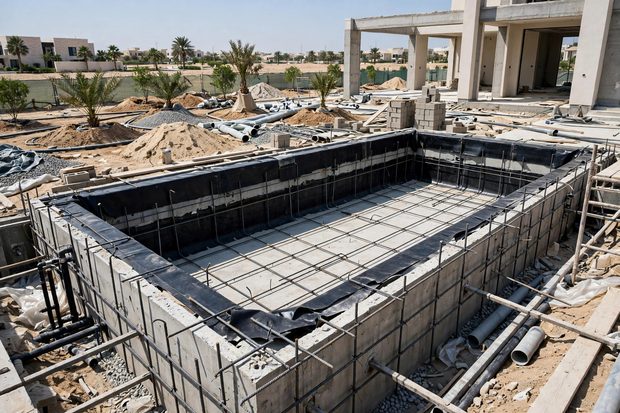
Payment should follow progress, never precede it
Your payment schedule is one of your strongest tools for keeping a project on track, so treat it as part of the buying decision, not an afterthought. Professional practice in the UAE is a modest mobilisation payment on signing, with the balance tied strictly to verified completion milestones — design approval, excavation, shell completion, tiling and finishes, plant installation, commissioning and handover. Each payment should follow work you can see and verify, ideally with photos, inspection notes and a contractor sign-off at each stage. Holding back a final portion until the snagging list is complete is standard practice and protects both sides: it gives the contractor a clear incentive to finish properly, and it gives you leverage if the last details drag. A demand for full payment before work begins is a structural red flag, not a negotiating position. It removes your leverage entirely and signals either financial instability or a lack of professional commitment to quality. The same caution applies to large cash payments: always pay by traceable means, keep every receipt, and make sure permits, warranties and guarantees are in your possession before the final payment is released. If a contractor claims it needs substantial capital upfront for materials, a fair counter-offer is a milestone schedule that funds materials as each stage is reached — professional firms respect clients who approach project finance with that kind of commercial maturity. And read the contract clauses around payment together with the variation clause, the delay clause and the warranty wording, including how disputes are settled. A contractor that is happy to put all of this in writing is a contractor that has run this conversation honestly many times before.Timelines, honestly stated
Ask for a written programme before work begins, and judge it by its honesty rather than its optimism. A realistic Dubai villa pool runs in two phases. First, design and approvals: drawings prepared, developer NOC obtained, municipality permit issued — a process that commonly takes several weeks and can take longer when a submission comes back with comments or when the developer’s review track runs separately. Second, the build itself: excavation, steel and shotcrete, curing, waterproofing and water testing, tiling and finishes, plant installation, commissioning and handover — a standard villa pool commonly takes a few months on site once the permit is in hand, with larger or more complex designs, infinity edges with balance tanks, and imported finishes all extending the programme. Two things most often knock that programme off course. The first is incomplete or non-compliant permit submissions, which is why the approvals conversation in this guide comes first, not last. The second is fragmented teams: when design, approvals and execution sit with different companies, each handoff is a delay waiting to happen, and nobody owns the gap between them. A milestone-driven approach, where one team coordinates design, approvals and execution in-house, is what keeps a project predictable. The other common cause of slippage is imported tile and finishes with long lead times — worth asking about explicitly if your design depends on a specific imported product, and worth confirming availability at the quote stage rather than discovering a delay mid-build. And throughout, judge the contractor by its communication: the complaint Dubai homeowners repeat most is not that a project slipped, but that nobody told them it had slipped. A contractor that reports progress against milestones, with a single named contact reachable on WhatsApp and photo updates at each stage, is worth more than a contractor that merely promises the earliest date.Warranties in writing, and a handover worth keeping
Warranties separate confident builders from those hoping you never call back, but only the written warranty counts. Verbal assurance is worth nothing when a defect appears in year three. A serious swimming pool contractor in Dubai stands behind the work in writing, and the document should distinguish clearly between its parts. The structural warranty covers the pool shell and the waterproofing — the parts that are hardest and most expensive to fix — and on a well-built pool it runs for several years. Equipment warranties on pumps, filtration, heating and chlorination are usually the manufacturers’ warranties, passed through by the contractor, and they run for their own periods. Workmanship cover deals with tiling, finishes and plumbing. Each of these should state its length, its exact coverage, and — just as important — what voids it: unauthorised alterations, poor water chemistry left uncorrected, or servicing by unqualified hands are common exclusions, and you should know them before you sign, not after a claim is refused. Two further questions complete the picture. First, who services the warranty — the contractor itself, or a third party you have never met? A warranty serviced by the company that built the pool is worth more than one serviced by whoever answers the phone. Second, what does the handover actually include? A proper handover gives you as-built drawings, warranty documents, equipment manuals, water-chemistry guidance and a schedule for the first months of maintenance — not just a set of keys and a wave. Ask for a sample handover file from a finished job before you commit: it should contain measured test results and the warranty paperwork, and it tells you more about a contractor’s standards than any brochure. If a contractor cannot show you a sample warranty document and a handover checklist before you sign, it has not finished designing its own aftercare, and you will be the one who discovers that.Who is actually on your site, and who comes back afterwards
Many buyers do not realise how important this question is until something goes wrong. Some companies are design-build firms: the same organisation designs the pool, engineers it, builds it and maintains it afterwards, so accountability sits in one place. Others are, in effect, sales operations: they win the job and then hire whatever labour is cheapest that week. The result is inconsistent quality, and when a defect appears, nobody accepts responsibility because the design, the shell and the servicing were three different companies’ problems — and therefore yours. So ask directly: who designs the pool, and is it the same team that builds it? Who holds the structural engineering — in-house or outsourced? Who will actually be on site day to day, and who supervises them? Subcontracting a specialist element to a qualified firm is normal in construction; handing the whole build to the cheapest available labour is not. Prefer a contractor that keeps design, engineering, site teams and aftercare under one roof, or that names its subcontractors and retains supervision and warranty responsibility for their work in writing. And ask who returns after handover when the water needs balancing, the filter needs servicing, or a tile needs attention. A pool’s real cost of ownership starts the day it is filled, and an annual maintenance contract with a named schedule — regular visits, water testing and balancing, filter cleaning, equipment checks — keeps a healthy pool healthy. It also keeps the same technician visiting your pool, which is how small problems get caught early. For ongoing care, see our guides to swimming pool maintenance in Dubai and swimming pool cleaning in Dubai, and if an older pool needs more than maintenance, our swimming pool renovation services cover structural and finish renewal.
Red flags that should make you pause
Most bad pool experiences announce themselves early, if you know what to listen for. Be cautious when a contractor is evasive about its licence or insurance, or about past permits. Be cautious when its portfolio is renders rather than real finished pools, or when it cannot name a single past client willing to speak to you. Be cautious when the scope is vague — no named equipment, no waterproofing system described, no payment stages, no written programme — because vagueness at quotation stage becomes dispute at construction stage. Be cautious when you are pressed to sign quickly; good contractors are busy, and they do not need to lock you into a decision before you have had time to do your research. Be cautious when the price is dramatically lower than every other quote without a clear explanation of what is different, when full payment is demanded before excavation, or when approvals are dismissed as unnecessary or offered as something you should handle yourself. None of these signs alone proves a contractor is bad. Together, they are a pattern worth respecting. If you have read this far, you are already doing the single most useful thing a buyer can do: slowing the decision down long enough to compare properly. Shortlist two or three licensed contractors, put the same questions from this guide to each of them, compare their itemised scopes line by line, visit one finished pool from each, and only then decide. The right contractor will welcome every question in this guide. That reaction, more than any brochure, is the signal to trust.Frequently asked questions
How do I check that a swimming pool contractor is licensed in Dubai?
Ask to see a copy of the trade licence in the same company name as the quotation, and check that it is current and that the listed activities cover swimming pool construction or building contracting. A legitimate contractor produces it without hesitation, along with examples of permits it has secured. Also ask who holds the insurance on site and ask to see the certificate. If a company is vague or evasive about either document, treat that as an early warning rather than a minor detail — an unpermitted or uninsured build can mean fines, forced rework and serious problems when you eventually sell the villa.Do I need Dubai Municipality approval and a developer NOC for a villa pool?
Yes, in most cases you need both. Every private pool in Dubai must be registered with Dubai Municipality through the Building Permits System before any digging starts, with drawings covering the site plan, pool structure, plant room, pipework and electrical layout. If your villa is in a master community, you will also need a No Objection Certificate from the developer, and that review commonly takes longer than the municipality permit, so it should start early. DEWA sign-off covers electrical and plumbing connections, Dubai Civil Defence clearance applies where safety systems are involved, and properties in special development zones such as Palm Jumeirah are approved by Trakhees instead of Dubai Municipality. Your contractor should file, chase and close all of these as part of the build.Should I choose a design-build company or separate designer and builder?
For most villa owners, a design-build company is the safer choice, because accountability sits in one place: the same organisation designs the pool, engineers it, builds it and maintains it afterwards. When design, approvals and execution sit with different companies, each handoff is a delay waiting to happen, and a defect can become everyone’s problem and therefore nobody’s. If you do use separate firms, make sure the contract names who supervises the work day to day and who retains warranty responsibility. Either way, ask who exactly will be on your site, who employs them, and who returns after handover.Why do quotes for the same pool differ so much?
Because quotes usually describe different pools underneath the same headline. The differences hide in the shell method, the waterproofing system, the equipment by brand and model, the finishes, and what is excluded — authority fees, decking, the safety barrier, excavation and disposal. The lowest number typically achieves its saving in the two places you cannot see: waterproofing and plant. Compare itemised scopes line by line — structure, waterproofing, equipment, finishes and plant separately — rather than comparing final numbers, and treat any quote that is dramatically lower than the others as a question, not a bargain: ask precisely what has been left out.How much should I pay a pool contractor upfront?
Never the full amount before work begins. Professional practice is a modest mobilisation payment on signing, with the balance tied strictly to verified completion milestones — design approval, excavation, shell completion, tiling and finishes, plant installation, commissioning and handover — and a final portion held back until the snagging list is complete. Each payment should follow work you can see and verify, ideally with photos and a contractor sign-off at each stage. Always pay by traceable means, keep every receipt, and make sure permits, warranties and guarantees are in your possession before the final payment is released. For an exact quotation for your own villa, message us on WhatsApp and we will arrange a site visit.How long does it take to build a swimming pool in Dubai?
Think in two phases. Approvals — drawings, developer NOC and municipality permit — commonly take several weeks, and longer when a submission returns with comments or when the developer’s review runs separately. The build itself, from excavation through steel and shotcrete, curing, waterproofing and water testing, tiling and finishes, plant installation and commissioning, commonly runs into a few months for a standard villa pool once the permit is in hand. Larger or more complex designs, infinity edges with balance tanks, and imported finishes all extend the programme. Be wary of any timeline that skips the curing and water-testing stages to sound faster — those stages are what make the pool last.What warranty should I expect from a pool contractor?
Expect it in writing, with its parts distinguished. The structural warranty covers the pool shell and waterproofing and, on a well-built pool, runs for several years. Equipment warranties on pumps, filtration, heating and chlorination are usually the manufacturers’ warranties passed through by the contractor, each with its own period. Workmanship cover deals with tiling, finishes and plumbing. Read the exclusions as carefully as the coverage: unauthorised alterations, poor water chemistry left uncorrected, or servicing by unqualified hands commonly void a warranty, and you should know that before you sign. Also confirm who services the warranty — the company that built the pool, or a third party — and ask to see a sample warranty document before committing.Concrete or fiberglass — which pool shell is better?
Neither is universally better; the right choice depends on your plot, your design and your priorities. A reinforced concrete shell, built by shotcrete or gunite, is the standard for custom villa pools in Dubai because it can be shaped freely, engineered for local soil and groundwater conditions, and finished in any tile or interior. A fiberglass shell is factory-made, which makes installation faster and the surface smooth, but it limits shape and size and still needs correct ground preparation and backfill to avoid movement over time. What matters most is not the shell material alone but the system around it: correct engineering for your soil, a proper waterproofing membrane, a witnessed water test before tiling, and hydraulics sized for the pool.What if the contractor subcontracts the work?
Ask who exactly will be on your site, who employs them, and who supervises them day to day. Subcontracting a specialist element to a qualified firm is normal in construction; handing the whole build to the cheapest available labour is not. The risk is accountability: when design, shell and servicing sit with three different companies, a defect becomes everyone’s problem and therefore nobody’s. Prefer a contractor that keeps design, engineering, site teams and aftercare under one roof, or that names its subcontractors and retains supervision and warranty responsibility for their work in writing. If a contractor cannot say who will be on your site, it is asking you to trust a stranger with a structure you will live with for decades.What are the biggest red flags when hiring a pool contractor in Dubai?
Evasiveness about the licence or insurance, a portfolio of renders rather than real finished pools, and no past client willing to speak to you are the first three. Add to those a vague scope with no named equipment, no waterproofing system described and no payment stages; pressure to sign quickly; a price dramatically lower than every other quote without a clear explanation of what is different; a demand for full payment before excavation; and approvals dismissed as unnecessary or left for you to handle. None of these signs alone proves a contractor is bad, but together they are a pattern worth respecting. Shortlist two or three licensed contractors, put the same questions to each, compare itemised scopes line by line, visit one finished pool from each, and only then decide. If you would like a professional opinion on your own plot, Hello Landscaping & Pools LLC offers a free site visit, after which you receive an exact quote for your villa — ask on WhatsApp and we will arrange it.Related reading: our contractor vetting and hiring guide covers interviews and red flags, our companies guide compares the field, and our construction process guide shows what happens after you sign.


