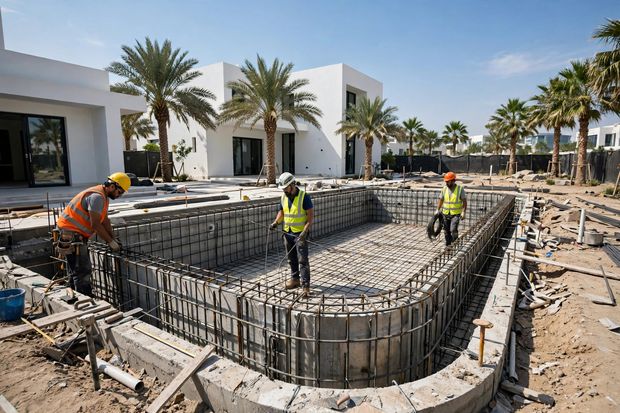


Swimming Pool Maintenance Cost in Dubai: What You Actually Pay For
Every villa owner in Dubai asks the same question sooner or later. What does pool maintenance actually cost each month? For example, one quote covers weekly visits and chemicals. Another covers visits only. A third looks cheap until the first repair bill arrives. The number on its own means almost nothing. It is the work behind the figure that matters. What do they do on each visit? What is included, and what will you still pay for separately?
We look after pools across Dubai every week. In fact, our work covers family villas in Arabian Ranches and waterfront homes on Palm Jumeirah. As a result, owners who understand what drives the figure make better choices. They keep clearer, safer water. This guide explains the seven factors that decide your monthly figure. It also shows what a good contract should include, where the hidden costs sit, and how to compare two quotes like-for-like. For advice on your own pool, call +971 50 866 5595 or message Hello Landscaping & Pools LLC on WhatsApp for a free site visit.
The Short Answer: What Your Monthly Pool Care Really Covers
Think of your monthly pool care as three things bundled together. First, there is labour. A trained technician visits your villa, brushes and vacuums the pool, empties the skimmer baskets, and checks the equipment. The second is water chemistry. On each visit, the technician tests the water and adjusts chlorine and pH, so the pool stays safe to swim in. At the same time, the pump, filter and cleaner are kept running well, and small faults are spotted before they turn into big ones.
Most Dubai villa pools need a weekly visit as a minimum. However, pools that get heavy use need a second visit in the hottest months. Dubai heat, dust and strong sun break chlorine down fast. In fact, a pool can turn cloudy or green within days if it is left alone. Regular care keeps the water balanced and the equipment healthy. Our guide to how to maintain a swimming pool explains the weekly routine in more detail.
The three buckets every pool owner pays for
Every maintenance figure breaks down into the same three buckets, whatever the contract is called. Labour covers the technician’s time on site and the travel to your villa. Chemicals cover chlorine, pH adjusters and the other products that keep the water balanced. Finally, equipment care covers routine checks, filter cleaning and minor adjustments. Some contracts bundle all three into one monthly figure. Others, by contrast, charge a lower figure and bill chemicals and parts separately. But you must know which one you are buying before you compare figures.
Why two neighbours can pay very different amounts
Two villas on the same street can have very different maintenance figures. One pool may be twice the size of the other, with an overflow edge, a heater and a saltwater system. The other may be a small skimmer pool that the family uses twice a week. In addition, one garden may sit under mature trees that drop leaves daily. Add in the age of the equipment and how often the pool is used, and the gap makes sense.
The 7 Factors That Decide Your Monthly Maintenance Figure
No two pools cost the same to maintain, because no two pools are the same. Seven factors decide most of the difference. A good contractor will ask about them at the first site visit, before giving you a figure. If a quote arrives without anyone looking at your pool, treat it with caution. The factors below explain why a fair quote for your pool may look nothing like a figure a neighbour mentioned.
Understanding these factors also helps you control the figure over time. Some of them you cannot change, like the size of your pool. On the other hand, you can influence others, like how much shade the pool gets or how often the filter runs.
Pool size and water volume
Size is the biggest single driver of maintenance cost. A larger pool holds more water, so it needs more chemicals to stay balanced. As a result, it takes longer to brush, vacuum and clean. A large pool also needs a bigger pump and filter. These use more power and cost more to service.
Visit frequency — weekly vs twice-weekly
How often the technician visits is the second big driver. A weekly visit is the standard for most Dubai villas. A twice-weekly visit suits pools that are used every day. It also suits pools with heavy bather loads, and pools in dusty or tree-lined gardens. More visits mean more labour, so the monthly figure rises. But more visits also mean the water stays balanced, the pool stays cleaner, and small problems get caught early.
Pool type — skimmer vs overflow, saltwater vs chlorine
The type of pool changes the work involved. An overflow or infinity pool has a balance tank. It needs checking and cleaning, and its edge needs regular attention. By contrast, a skimmer pool is simpler, with fewer parts to service. Saltwater pools use a salt cell that generates chlorine. However, the cell needs regular cleaning and will eventually need replacing. Chlorine pools need regular dosing instead. Our guide to saltwater vs chlorine pools in Dubai explains the running differences in full.
Equipment age and condition
Old equipment costs more to maintain than new equipment. A pump that is ten years old may need more frequent attention. Similarly, an old filter may need more frequent backwashing and media changes. A heater or chiller adds another system to check and service. New equipment, by contrast, usually runs cleanly for years with routine checks. When a contractor visits your pool for the first time, they should look at the plant room before quoting.
Bather load and how the pool is used
A pool used by a family of four a few times a week is easy to keep balanced. A pool that hosts large gatherings every weekend is a different job. More swimmers mean more body oils, sunscreen and debris in the water. As a result, the technician may need to visit more often, test more carefully, and clean more thoroughly. If your pool sees heavy use in summer and light use in winter, a good contract should reflect that seasonal change.
Shade, trees and dust exposure
Dubai’s environment shapes maintenance more than most owners expect. A pool surrounded by trees collects leaves every day. A pool on an open plot catches wind-blown dust and sand. It settles on the floor and clouds the water. A shaded pool stays cooler and loses less chlorine to the sun. On the other hand, a pool in full sun needs more chemical attention. But it all adds work to each visit.
Location and access
Location plays a smaller role, but it still counts. Villas with easy access and parking are quicker for a technician to reach. By contrast, remote plots or homes with difficult access take longer. Some communities also have rules about service hours and vehicle access. But they help explain small differences between quotes for similar pools in different areas, from Dubai Hills Estate to Jumeirah.
What Is Usually Included in a Maintenance Contract
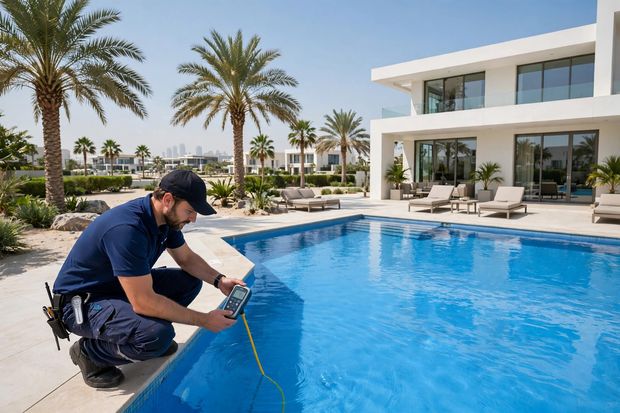
A good maintenance contract should read like a clear list of jobs, not a vague promise. The best way to judge one is to ask a simple question. What exactly happens on each visit? The answer should cover cleaning, water testing, chemical balancing and equipment checks. If a contract only says “weekly maintenance” without listing the tasks, ask for the list in writing. A professional company will be glad to spell it out.
Most professional contracts in Dubai follow a similar pattern. A technician visits on a set day each week, works through a checklist, and leaves the pool clean and balanced. Some companies also send a short report after each visit.
Weekly cleaning visits
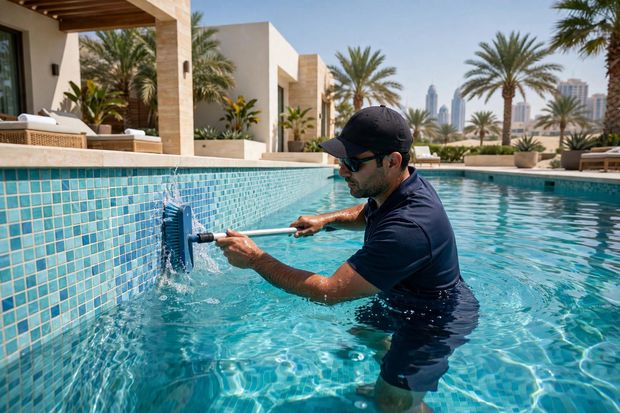
Every visit should include brushing the walls and floor, vacuuming or running the automatic cleaner, and skimming leaves and debris from the surface. Empty the skimmer and pump baskets on every visit. Wipe the waterline tiles to prevent a scum line from building up. The technician should also check the water level and top it up if needed. These jobs sound basic, but they are the foundation of a healthy pool.
Water testing and chemical balancing
Water testing is the most important part of the visit. The technician tests pH and chlorine, and adjusts them to the safe range. Dubai Municipality’s holiday-home guidelines set pH at 7.4 to 7.6. Free chlorine should sit at 1 to 2 parts per million. Those are smart targets for a home pool too. The technician should also check alkalinity and, from time to time, calcium hardness. Above all, balanced water protects swimmers’ skin and eyes.
Filter and pump checks
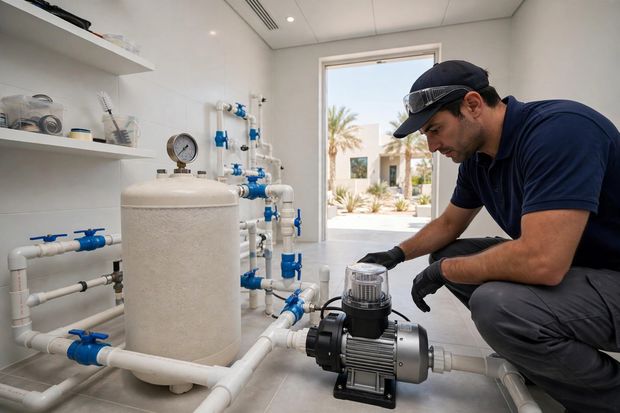
Each visit should include a quick check of the pump and filter. The technician listens for unusual noise, checks the pressure gauge on the filter, and backwashes the filter when the pressure rises. At the same time, they make sure water is circulating properly. They should also check the timer, the cleaner, and any heater or chiller that is installed. These checks take only a few minutes. Our swimming pool maintenance team includes these checks on every visit.
What a visit report should show you
A short visit report is a sign of a professional company. It should show the date, the water readings, the chemicals added, and any observations. Some companies send this by WhatsApp with a photo of the clean pool. The report protects you as well as the company. In other words, it creates a record of the pool’s condition over time.
What Is Often Excluded — the Hidden-Cost Trap
The most common surprise in pool maintenance is not the monthly figure. It is the extras that arrive later, billed separately, that nobody mentioned at the start. This is where the cheapest quote often stops being cheap. Over a year, it can cost far more than a slightly higher all-inclusive figure.
Exclusions are not dishonest on their own. Some owners prefer a lower monthly figure. They want to pay for extras only when they arise. However, the problem comes when the exclusions are hidden in small print or never explained. The four areas below are the ones that catch owners out most often.
Chemicals and supplies
Chemicals are the most common exclusion. Others bill every tablet and bottle separately. In summer, chlorine burns off fast in the heat, so chemical use rises sharply. A contract that excludes chemicals can vary a lot from month to month. Finally, ask whether chemicals are included, and what happens if use goes above any cap.
Spare parts and repairs
Almost no standard contract includes spare parts. Pump seals, filter media, cleaner parts, light bulbs and salt cells are normally billed separately. That is fair, because they wear out at different rates in different pools. The trap is a contract that also excludes the labour to fit the part, or charges a call-out fee for every repair visit.
Green-pool recovery
A green pool needs a recovery treatment, and that is almost always an extra charge. Recovery involves shock dosing, algaecide, extra brushing and vacuuming. It often takes several visits over a few days. In fact, it takes far more time and chemicals than a normal visit. If your pool has turned green, our guide to why pool water turns green and how to fix it explains what recovery involves.
Call-outs and emergency visits
An emergency visit is usually billed separately from the contract. Some companies include a number of call-outs in an annual contract. Others charge for every extra visit. Ask what counts as a call-out, what the response time is, and whether contract customers get priority.
AMC vs Pay-Per-Visit: Which Works Out Better
Most Dubai owners choose between two ways of paying for maintenance. An annual maintenance contract, known as an AMC, covers scheduled visits for a year at a fixed monthly figure. Pay-per-visit means you book each visit when you need it, and pay for that visit only. Both models work, but they suit different owners.
A good company will help you choose rather than push one model. The sections below explain how each model works, when each one makes sense, and the one question that settles the choice for most owners.
How an annual maintenance contract works
Under an AMC, the company visits on a set schedule, usually weekly, for twelve months. The figure is normally fixed for the year, so you know what you will pay each month. Chemicals may be included or billed separately, so check that point carefully. The contract usually covers routine cleaning, testing and equipment checks. It may include priority call-outs or a discount on repairs.
When pay-per-visit makes sense
Pay-per-visit suits owners who use the pool rarely, or who are happy to manage the schedule themselves. If your villa is empty for months at a time, booking visits as needed can work well. However, the risk is gaps. A pool left for three weeks in summer can turn green, and recovery then costs more than the visits you skipped.
The break-even question to ask
The simplest way to compare the two models is to ask one question. How many visits will my pool actually need over a year? Next, multiply the pay-per-visit figure by that number of visits. Then compare that total with the annual cost of the AMC, including its chemicals. For most pools that are used regularly, the AMC works out better.
The Costs Beyond the Contract: DEWA, Chemicals and Equipment
Your maintenance contract is only part of what a pool costs to run. Three other costs sit outside it. The first is electricity and water. Your pump runs for hours every day, and the pool needs regular top-ups. The second is chemicals in peak summer, when use climbs. The third is the slow wear of equipment, which needs a small fund set aside each year. They are simply part of honest budgeting.
Thinking about these costs together gives you the true picture of pool ownership. A pool that looks cheap to maintain can run an old pump that wastes power for long hours. As a result, it can cost more overall than a pool with a slightly higher contract and efficient equipment.
Pump electricity and water top-ups
The pump is the biggest running cost of a pool after the contract itself. It needs to run long enough each day to circulate and filter the whole volume of water. An old single-speed pump uses far more power than a modern variable-speed pump running at low speed for longer. Water top-ups are the other regular cost. Evaporation, splash-out and backwashing all lower the water level.
Chemical use in peak summer
Chemical use is not steady through the year. In winter, a pool may need only light dosing. In peak summer, strong sun and high temperatures break chlorine down quickly, and heavy use adds more demand. This is the season when a contract that excludes chemicals can surprise you. The monthly chemical bill climbs just when the pool is used most. In addition, keeping the pump running properly helps the chemicals last longer.
The annual equipment fund
Pool equipment wears out slowly, and the smart approach is to expect it. Pumps, filters, cleaners, heaters and salt cells all have a working life. Each will need repair or replacement one day. Setting aside a modest amount each year for equipment means a failed pump is a hassle, not a crisis. Regular servicing extends the life of every part.
How Often Should Your Pool Be Serviced in Dubai?
Weekly servicing is the standard for most Dubai pools, and for good reason. Heat, sun, dust and use can push a pool out of balance within days. A weekly visit keeps the chemistry steady and the pool clean. It also gives the technician a chance to spot equipment problems early. But weekly is the safe starting point for any pool that is used regularly.
It should follow the season, the use of the pool, and the weather. The sections below explain how the rhythm changes through the year.
The summer vs winter rhythm
Summer is the demanding season. High temperatures, strong sun and daily use mean chlorine burns off fast. Debris builds up quickly, and the filter works harder. As a result, many owners move to twice-weekly visits from May to September. Winter is gentler. The water is cooler, use is lighter, and chemical loss is slower.
After dust storms and parties
Some visits should be booked outside the normal schedule. A dust storm can leave a fine layer of sand on the pool floor and cloud the water within hours. A large party adds sunscreen, oils and debris that the filter and chlorine must clear. After either event, an extra visit keeps the pool safe and clear. If you know a party is coming, book the extra visit in advance.
Holiday homes and empty villas
An empty villa still needs pool care. In fact, it needs it more, because nobody is there to notice a problem. A pool left without circulation and chemicals for weeks will turn green. If your villa in Emirates Hills or elsewhere stands empty for part of the year, keep the maintenance contract running and ask for a photo report after each visit.
Water Chemistry: The Numbers That Keep Your Pool Safe
Clear water is not always safe water, and safe water is not always clear. The chemistry behind the sparkle is what protects swimmers. It is the part of maintenance that owners understand least. You do not need a chemistry degree to own a pool. But you should know the key numbers and what they mean. A good technician will explain them to you.
Water balance is a system, not a single reading. pH, chlorine, alkalinity and calcium hardness all work together. If you change one, the others shift. That is why regular testing matters more than a one-off shock dose.
pH and chlorine targets
pH measures how acidic or alkaline the water is. It decides how well chlorine works. Dubai Municipality’s holiday-home guidelines set pH at 7.4 to 7.6. Free chlorine should sit at 1 to 2 parts per million. If pH drifts high, chlorine becomes weak and the water can turn cloudy. If pH drops low, the water can irritate eyes and skin, and wear down equipment.
Alkalinity and calcium hardness
Total alkalinity acts as a buffer that keeps pH steady, so it should be checked regularly. If alkalinity is low, pH swings wildly from day to day. If it is high, pH creeps up and scale forms more easily. Calcium hardness measures dissolved calcium in the water. Low hardness can damage plaster and tiles. On the other hand, high hardness leads to scale on the pool surface and inside the equipment.
Why Dubai’s hard water causes scale
Dubai’s water carries a high mineral load. That is the root of the scale problem many owners see. White crust on tiles, cloudy water, and rough patches on the pool surface are all signs of scale. Scale forms faster when pH and alkalinity run high, and in hot water. Regular testing and balancing keep it under control. If scale has already built up, it needs proper treatment. Scrubbing it off dry can damage the tiles.
DIY vs Professional Maintenance: An Honest Comparison
Many owners wonder whether they can maintain the pool themselves and save the contract figure. The honest answer is that some can, and some cannot. The difference is time, not know-how. But it is regular, physical work that cannot be skipped. If you enjoy the routine and you are at home every week, DIY can work. If you travel or work long hours, a professional is the safer choice.
The other question is what DIY really costs. The contract figure is not the only number. DIY needs chemicals, test kits, brushes, a vacuum and your own time. Mistakes can be expensive. For example, a wrong dose of chemicals can stain the surface or damage equipment.
What DIY really takes each week
DIY maintenance takes a real block of time every week. You need to test the water, adjust pH and chlorine, brush the walls and floor, vacuum, empty the baskets, and check the pump and filter. In summer that routine can take an hour or more. It must happen even when you are busy or away. You also need somewhere to store chemicals safely, away from children and heat.
The mistakes that cost more than a contract
The most expensive DIY mistakes are the quiet ones. Over-dosing chlorine can bleach tiles and damage the pool surface. Similarly, letting pH run high for months builds scale that is hard to remove. Ignoring a pump that sounds different can end with a burned-out motor. Running the filter too little leaves the water cloudy and invites algae. None of these mistakes comes from not caring.
The middle path — DIY between professional visits
There is a smart middle path that suits many owners. Keep the professional contract, and handle the light jobs between visits yourself. Skim leaves from the surface, empty the skimmer basket, and check the water level. That keeps the pool looking good and reduces the work on each visit. Meanwhile, the technician handles testing, chemicals and equipment.
How to Compare Two Maintenance Quotes Like-for-Like
Comparing maintenance quotes is harder than it looks, because two quotes rarely cover the same things. The other may cover a visit every two weeks, with chemicals extra. The monthly figures will look very different. But the comparison means nothing until the inclusions match. The only fair way to compare is to make the quotes match first, then look at the figures.
Start by asking both companies for the same details, in writing. Any company that answers clearly is a company you can trust. On the other hand, any company that avoids the questions is telling you something too. If you compare a quote for a pool in Palm Jumeirah with one for a pool in Dubai Hills Estate, remember that location, size and equipment still differ.
The same-schedule, same-inclusions test
Write down the schedule and the inclusions side by side. How many visits per month does each quote include? Are chemicals included, and is there a cap? What about filter cleans, backwashing and equipment checks — are they included too? How many call-outs come with the contract? Is there a visit report? Once both quotes answer the same questions, the comparison becomes honest. Our guide to swimming pool cost in Dubai explains the same like-for-like thinking for construction.
Five questions to ask before you sign
Ask these five questions of any company before you sign. First, what exactly happens on each visit? Second, are chemicals included, and what is the limit? Third, how are repairs and spare parts charged? Fourth, what happens if the pool turns green — is recovery included? Fifth, can I cancel or pause the contract, and what notice is needed? If you would like a second opinion on a quote, call +971 50 866 5595 and we will talk it through with you.
Red flags — the too-cheap quote
A quote far below every other quote is a warning, not a bargain. It usually means fewer visits, no chemicals, untrained staff, or corners cut on testing. As a result, the pool often looks fine for a month and then turns cloudy, green or damaged.
When Maintenance Stops Being Enough: Repairs and Renovation
Maintenance keeps a healthy pool healthy. It cannot fix a pool whose equipment is worn out, or a surface that has reached the end of its life. Every pool reaches a point where repairs become frequent and parts become hard to find. Keeping old equipment running then costs more than replacing it. Knowing when you have reached that point saves money and frustration.
The signs are usually clear once you know what to look for. The sections below describe them, and explain when a renovation is the smarter choice. If your pool is at this stage, a site visit can confirm it in one look at the plant room and the pool surface.
Signs the equipment needs replacing
Look out for a pump that is noisy, leaking, or struggling to prime. A filter that needs backwashing all the time is another warning sign. Water that stays cloudy even after the chemistry is balanced points the same way. So does a heater or chiller that trips, a cleaner that no longer moves properly, and lights that keep failing. Repeated repairs to the same part, or repairs every few weeks, are a sign the equipment is finished.
When a renovation saves money
Renovation makes sense when the pool surface is stained or rough, the tiles are falling off, the coping is cracked, or the plumbing leaks. If you are already paying for frequent repairs, a renovation often works out better than patching the old pool again and again. Our swimming pool renovation team can assess your pool and explain the options. For a new pool, our swimming pool construction team can advise. For cooling, see our guide to pool chillers in Dubai.
Which Maintenance Plan Suits Your Pool? A Simple Decision Guide
By now you have the full picture, so here is a simple way to use it. The right plan depends on your pool, your household and how you use the pool. There is no single best plan for everyone. Use the guide below to find the shape that fits, then confirm it with a site visit.
Whatever plan you choose, the rule stays the same. Regular care, balanced water, and a company that reports what it does. That mix keeps the pool safe, clear and ready to swim in.
Match the plan to your household
For a family that swims daily in summer and hosts guests often, choose a weekly contract with twice-weekly visits in the hottest months. A small household that uses the pool a fair amount is usually fine with a standard weekly contract that includes chemicals. And if the villa stands empty for months, keep a weekly contract running with photo reports.
Your next step — a free site visit
Book a free site visit and let a technician look at your pool. They will check the pump and filter, test the water, and talk through the plan that fits. You will get a clear figure for your pool, a written list of what is included, and an honest answer about what your pool needs. Call +971 50 866 5595, message Hello Landscaping & Pools LLC on WhatsApp, or visit hellolandscapingllc.com to book your visit.
Frequently asked questions
Visits, contracts and water balance
How often should a swimming pool be serviced in Dubai?
Most villa pools need a weekly visit as a minimum. In the hottest months, pools that are used every day often need a second visit each week. Heat, sun and dust in Dubai break chlorine down fast. As a result, a pool left for two or three weeks can turn cloudy or green.
What does a swimming pool maintenance contract usually include?
A standard contract covers weekly cleaning visits, water testing and chemical balancing, and pump and filter checks. The technician brushes and vacuums the pool, empties the baskets, tests pH and chlorine, and checks the equipment. Chemicals may be included or billed separately, so always ask.
Is an annual maintenance contract better than pay-per-visit?
For pools that are used regularly, an annual maintenance contract usually works out better. You get a fixed schedule, the same technician, and often priority call-outs. On the other hand, pay-per-visit suits pools that are rarely used, or owners who are happy to manage bookings themselves.
Why does my pool maintenance figure change in summer?
Chemical use climbs in summer. Strong sun and high temperatures break chlorine down faster, and heavy use adds more demand. Some owners also add an extra visit each week in the hottest months. If your contract excludes chemicals, the monthly figure will rise in summer.
What is the ideal pH and chlorine level for a home pool in Dubai?
Dubai Municipality’s holiday-home guidelines set pH at 7.4 to 7.6. Free chlorine should sit at 1 to 2 parts per million. Those are smart targets for a home pool too. Your technician should test both on every visit.
DIY, problems and choosing a company
Can I maintain my own pool in Dubai?
Yes, if you have the time and you are at home every week. DIY takes a real block of time each week for testing, brushing, vacuuming and equipment checks. It must happen even when you are busy or away. Many owners keep a professional contract and handle light jobs between visits, like skimming leaves and emptying the basket.
Why does my pool turn green even with regular maintenance?
A green pool usually means the chlorine ran out or the circulation stopped. This often happens during a hot spell, a dust storm, or a period without visits. Algae grows fast in warm, still water. As a result, recovery needs shock dosing, extra brushing and several visits over a few days.
Does pool maintenance include chemicals and spare parts?
It depends on the contract. Some contracts include chemicals, some include them up to a cap, and some bill them separately. Spare parts and repairs are almost always billed separately, and that is normal. Finally, ask for the inclusions in writing, and ask how repairs are quoted and approved.
What should I do if my villa is empty for months?
Keep the maintenance contract running. An empty pool still needs weekly circulation, testing and cleaning. Without them it will turn green, and it may damage the surface and equipment. Ask your company for a photo report after each visit. Then you know the pool is safe and ready when you return.
How do I choose a pool maintenance company in Dubai?
Look for a company that visits your pool before quoting. It should give you a written list of what each visit includes. It should also answer clearly about chemicals, repairs and call-outs. Check that they test the water on every visit and can show you the readings.