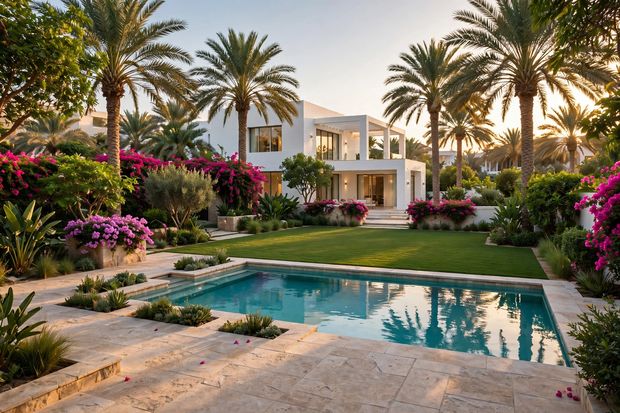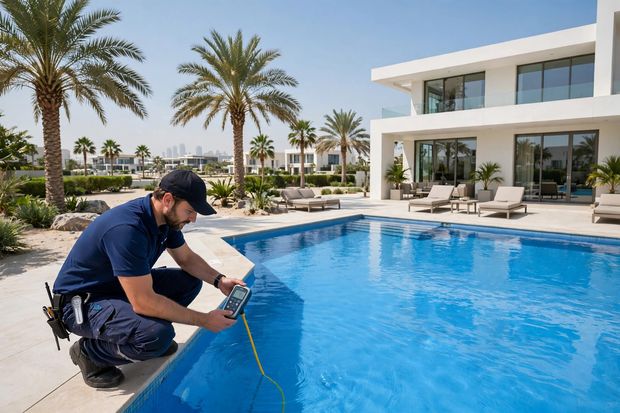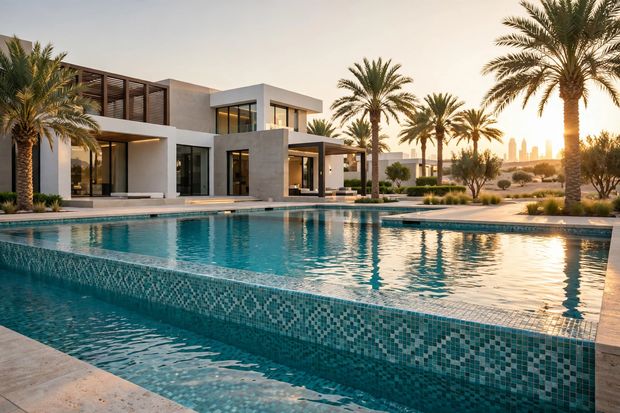

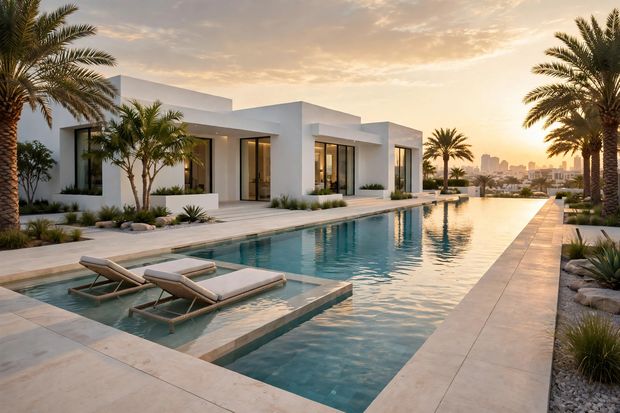

A swimming pool is the centrepiece of a Dubai villa garden. It shapes how the garden looks. It shapes how the family uses it. And it shapes how much work it needs for years to come. Yet many owners choose a design from a photograph. Only later do they discover the shape fights the plot. Or the finish fights the heat. Or the equipment has nowhere sensible to live. Good pool design starts earlier than the tile sample. It starts with the plot, the sun, and the way your family actually swims. It also starts with the rules of your community.
This guide explores the swimming pool design decisions that matter most in Dubai, from skimmer and overflow systems to infinity edges, modern pool shapes, and compact townhouse solutions. It also covers family-friendly features, durable finishes, climate control, shade planning, and the community approvals to consider before construction begins. Every idea here reflects the design and construction considerations we work with on villa projects across Dubai. Our work runs from Palm Jumeirah to Arabian Ranches. For advice on your own plot, call +971 50 866 5595. Or message Hello Landscaping & Pools LLC on WhatsApp for a free site visit.
Start With the Plot, Not the Picture
The best pool designs in Dubai start with a tape measure. They do not start with a mood board. Your garden decides more about the final pool than any photograph can. Its length, width, levels, and soil all set hard limits. The position of the villa matters too. A design that respects the plot produces a better pool than one that fights it. It also costs less to build. And it costs less to run, because nothing is forced into a space that never suited it.
Before you fix on a style, walk the garden at different times of day. Note where the sun falls in the morning. Note where the shade lands in the afternoon. Feel where the wind comes from. Check which windows look onto the garden. These small observations shape the real design choices. They decide where the pool sits, which way it faces, and where the equipment room goes.
How garden shape decides the pool shape
A long, narrow rear garden suits a lap-style rectangle. Many Arabian Ranches and Dubai Hills villas have this shape. Run the pool along the length of the plot. Add a sun shelf at one end. Tuck a compact equipment room to one side. A wide, shallow garden suits a broader rectangle or an L-shape. Place it closer to the villa. Leave a generous lawn or seating zone beyond it. Corner plots sometimes allow an L-shaped pool to wrap the building line. That creates a much larger feeling of water without the full excavation of a very large shell.
Sun, shade and wind — the three forces that shape comfort
Sun decides when the pool is pleasant and when it is too warm. A pool with full southern exposure and no shade needs more cooling in summer. A pool with a well-placed pergola or sail on its western side needs less. Wind strips heat from the surface. It pushes dust and leaves into the water. It can make an evening swim chilly even in warm months. Planting, a feature wall, or a pergola can break the wind without blocking the view. But only if the design places them on the right side.
The west-facing garden problem
West-facing gardens take the hardest afternoon sun in Dubai. The water heats fast. The deck gets too hot for bare feet. And the evening swim arrives with the sun still glaring across the water. Yet evening is when most families actually use the pool. A shade sail or pergola on the west side solves more here than any equipment upgrade. Plan it into the design from the start. Adding shade after the pool is built usually means posts in the wrong place. Or a structure that fights the garden.
Skimmer vs Overflow: The First Big Design Decision
Every pool design in Dubai starts with one structural choice: skimmer or overflow. It is not a cosmetic detail. This choice decides how the water looks, how the pool is built, and how much plant-room space you need. It also decides how the pool behaves on a windy day. Get this choice right for your plot and your budget. Then every decision after it becomes easier.
A skimmer pool is the simpler system. For many villa gardens, it is the right one. An overflow pool is the premium finish. On the right plot, it is worth every bit of extra engineering. The honest answer depends on your garden, your view, and how you use the pool. It does not depend on which one looks better in a brochure.
How a skimmer pool works
A skimmer pool collects surface water through fixed inlets. These sit in the pool wall, just below the waterline. The engineering is straightforward. The build is simpler. Maintenance is easier because there are fewer moving parts. The water level sits visibly below the coping. That suits a rear garden framed by landscaping. For a compact garden or a family pool used daily, a well-detailed skimmer pool will look sharp. It will serve well for decades.
How an overflow pool works
An overflow pool is also called a wet-edge or knife-edge pool. It brings the water level flush with the surrounding deck. Water spills continuously into a perimeter channel. It recirculates through a balance tank buried below ground. The result is a seamless mirror of sky and water. It photographs beautifully. It looks genuinely premium from the villa interior. The trade-off is real. The civil and hydraulic scope is far greater. The balance tank needs dedicated space. And the pump runs longer.
When overflow is worth it — and when it is not
Overflow earns its place where the pool terrace is the centrepiece of the outdoor living space. Think of a Palm Jumeirah or Emirates Hills villa where the garden is designed around the water. For a smaller garden, a skimmer design usually delivers the better result for the budget. The same applies when the pool sits behind the villa, where nobody sees the waterline from the house. Ask your designer to show you both options against your actual plot. Then decide.
| Feature | Skimmer pool | Overflow pool |
|---|---|---|
| Appearance | Waterline below coping | Water flush with deck |
| Construction | Simpler | More complex |
| Balance tank | Usually not required | Required |
| Space requirement | Lower | Higher |
| Engineering cost | Generally lower | Generally higher |
| Best suited for | Everyday villa pools | Premium terraces and views |
Infinity Edge Pools: When the View Earns the Premium
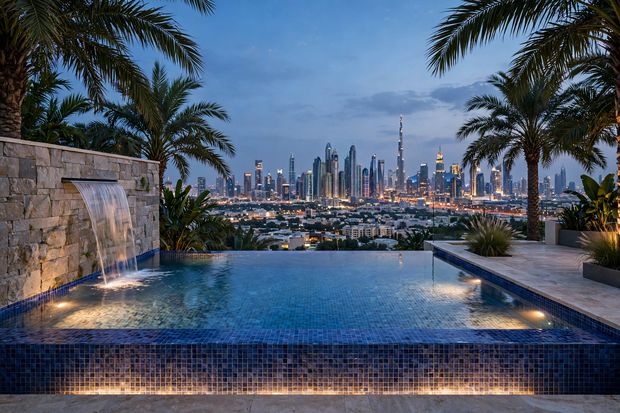
An infinity pool is a specific type of overflow pool. One or more edges drop to a catch trough below the visible horizon line. The water appears to continue past the edge into the view beyond. In Dubai, the effect is at its best where there is a real view to borrow. An elevated villa looking toward the skyline works well. So does a Palm Jumeirah property with an open sea aspect. A golf-course villa with a long green outlook works well too.
On a flat plot surrounded by boundary walls, the infinity illusion is much weaker. You can still build one. Many owners do, for the clean look of the edge itself. But the hydraulic complexity should be weighed against what the finished result will actually deliver. A raised-edge standard pool often achieves a cleaner look on such a plot. And it needs far simpler engineering behind it.
What makes the illusion work
The illusion depends on the view, not on the pool. The edge must sit at the right height against the horizon. The waterline must read as one continuous surface. That means the edge, the deck, and the view must be designed together. The pool position matters. The villa floor level matters. The boundary treatment matters too. A designer who only draws the pool will fail here. If the sightline is ignored, the result looks like an ordinary pool with a missing wall.
The hidden engineering behind an infinity edge
Behind the edge sits a catch basin. It collects the water spilling over. A high-capacity return pump sends it back continuously. The overflow channel must be levelled with extreme precision. Even a small error makes the waterline look uneven rather than seamless. The balance tank, the second pump, and the extra pipework all need plant-room space. Plan that space at the design stage. If you compare an infinity design with a standard pool, ask for the full picture. Include the plant room before you choose. Our guide to types of swimming pools explains how infinity pools sit alongside the other main pool types.
Geometric vs Freeform: Matching the Pool to Your Villa
Most contemporary villas in Dubai follow clean architectural lines. A geometric pool tends to read as the stronger design choice. Think of a rectangle, an L-shape, or a rectangle with a simple step or notch. A rectangle aligned with the villa facade creates a clear visual axis. It runs from the living room to the garden boundary. It is also the most efficient shape to engineer, tile, and maintain. Every edge is straight. Every measurement is simple.
Shape is not only about looks. It decides how easy the pool is to clean. It decides how the water circulates. And it decides how the family actually uses it. A rectangle swims well, cleans well, and takes a cover well. A curve looks softer. But every curve adds formwork, tile cutting, and cleaning time. Choose the shape that fits the villa and the garden. Do not choose the shape that looks best in isolation.
Rectangular and L-shaped pools
Rectangular pools suit almost every Dubai villa garden. They work in a compact townhouse plot. They work in a wide Emirates Hills garden. An L-shape adds flexibility. It can wrap a corner. It can separate a shallow family zone from a deeper swimming zone. It can fit a pool around an existing tree or structure. Both shapes work with overflow or skimmer finishes. Both take heating, cooling, and automation cleanly.
Freeform and lagoon-style pools
Freeform and organic shapes suit a specific kind of villa. The villa needs a mature landscape, a naturalistic garden style, or a plot where straight lines would feel awkward. Curves need more complex formwork. They need bespoke pipe routing. They need extra tile cutting. So the added build effort should match a real design reason. A garden that genuinely calls for curves is that reason. Difference for its own sake is not. In the right setting, a freeform pool with rock features and planting can look extraordinary.
Which shape suits which villa style
Modern villas with glass, stone, and straight lines call for geometric pools. Arabic-influenced villas with courtyards and arches suit a pool that echoes those lines. Often that means a rectangle softened by a raised spa or a feature wall. Villas with established, lush gardens can carry a freeform design. When in doubt, match the pool to the architecture you already have. The pool should look like it belongs to the villa. It should not look like it arrived from a different house.
| Feature | Geometric pool | Freeform pool |
|---|---|---|
| Appearance | Clean straight lines, clear visual axis | Soft curves, naturalistic look |
| Build complexity | Efficient to engineer, tile and maintain | More formwork, bespoke pipe routing, extra tile cutting |
| Maintenance | Cleans well, takes a cover well | More cleaning time |
| Best for | Modern villas, most Dubai gardens | Mature landscaped gardens where curves fit |
Small Gardens, Big Ideas: Plunge Pools and Compact Designs
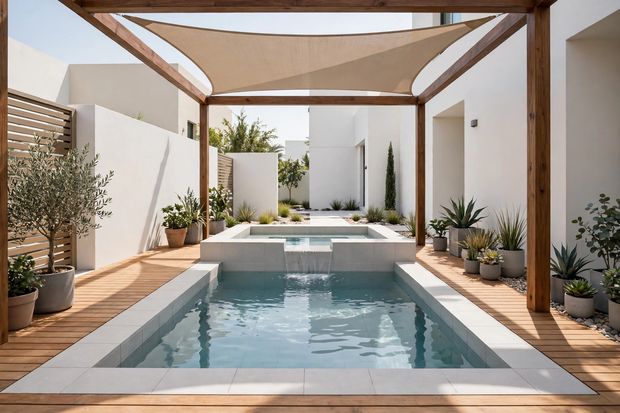
For townhouse gardens, the compact plunge pool is often the practical answer. The reason is simple. Townhouse communities like JVC, The Springs, Mudon, and Jumeirah Village Triangle have gardens that are beautiful but not large enough for a standard pool. A plunge pool fits comfortably in these gardens. It cools the family down on a summer afternoon. And it turns a small outdoor space into the most-used part of the home.
Small does not mean compromised. That is why choosing the right small swimming pool design matters to townhouse owners. Even a compact garden needs a pool with proper filtration, circulation, and temperature control. A small pool heats up faster than a large one. Its surface area is large compared with its volume. So plan a chiller from the start. Without one, the pool will spend the summer too warm to enjoy.
Plunge pools for townhouses
A plunge pool is built for cooling and relaxing rather than lap swimming. It suits a family that wants to cool off. It lets children splash safely. And it lets the family enjoy the garden without giving the whole plot to water. Keep the design simple. Use clean lines, a comfortable depth, and a shaded edge. Keep easy access from the house. A small spa spillover at one end adds a second use. It gives warm water on a cool winter evening without needing a separate structure.
Lap pools and counter-current jets
If you swim for fitness, length matters more than width. A lap pool needs enough length for continuous swimming. Many Dubai gardens cannot fit it. The practical answer is a counter-current swim jet. Powerful underwater jets create a current you swim against. It works like a treadmill for swimmers. Fitted to a compact pool, a counter-current system gives you a real workout. It fits a garden that could never hold a full lap pool. Plan the jets at the design stage. They need their own pump and pipework.
Rooftop pools — what to check first
Rooftop pools are a defining feature of Dubai’s luxury townhouse and penthouse market. They need one check before any design work begins: structural capacity. Water is heavy. A rooftop pool adds a serious load to the building. A structural engineer must confirm the roof can carry it. Or the engineer must say what reinforcement it needs. Do this before the design is finalised. Waterproofing is also more demanding than at ground level. A rooftop leak becomes a building leak. That engineering-first approach is what any luxury rooftop pool project in Dubai should expect. Get the engineering right first. Then design the pool around it.
| Feature | Plunge pool | Lap pool |
|---|---|---|
| Purpose | Cooling and relaxing | Fitness swimming |
| Space needed | Fits a small townhouse garden | Needs length, or counter-current jets in a compact pool |
| Fitness use | Light use, children splashing | Lap swimming or swim-against-current training |
| Cooling need | Heats up fast — plan a chiller from the start | Same — plan heating and cooling at the design stage |
| Best for | Small gardens, family cooling | Swimmers with limited garden length |
Family-Friendly Design: Beach Entries, Sun Shelves and Safe Depths
A family pool is designed around the youngest swimmer first. Children use the shallow end, the steps, and the shelf far more than the deep end. So those zones deserve the most design attention. A pool that is safe and fun for a five-year-old is also more relaxing for the adults. Nobody spends the swim watching the deep end.
Family design is also about sightlines. Place the shallow zone where it is visible from the seating area. Keep it visible from the villa windows too, so children are always in view. Keep the deep end clearly separate. Make the change in depth obvious. A shelf edge, a step, or a change in tile colour all work. Nobody should walk into deep water by surprise.
Beach entries and sun shelves
A beach entry is a gradual slope from deck level into shallow water. It feels like walking into the sea. The shallow shelf at the entry end gives very young children a safe wading area. Adults use the deeper section at the same time. A sun shelf is also called a tanning ledge. It is a wide, shallow platform built into one end of the pool. It is deep enough to sit in with a lounger partly submerged. Both are among the most appreciated design choices families make. Both add very little to the shell when they are planned from the start.
Depth zones and child safety
Clear depth zones make a pool safer without making it look fenced-off. Use a shallow play zone, a mid-depth social zone, and a deeper swimming zone. Mark each one with steps or a shelf. That tells every swimmer where they stand. Non-slip finishes on steps and the shelf matter more than most owners realise. Wet stone and wet tile are slippery. The entry is where most slips happen. Ask your designer to specify the step and shelf finishes explicitly. Do not leave them as an afterthought.
Fencing and safety barriers
Many Dubai communities require a safety barrier around a pool. Even where they do not, a barrier is the single most effective safety feature a family pool can have. Design it in, not on. A glass panel works. So does a low wall with planting. Or a fence that matches the villa architecture. Any of these keeps children safe without turning the garden into a compound. Your designer should confirm the community rules for your plot. Do this before the design is finalised. The rules vary by developer, and they affect the layout.
Spas, Waterfalls and Water Features Worth Adding
Water features are where a functional pool becomes a lifestyle pool. They are best scoped at the design stage. Retrofitting one after the main build costs far more. Every feature needs its own pump, pipework, and electrical connection. So the cost of a full feature package adds up quickly. Agree the full list before construction starts. Do not add features halfway through, when the pipe runs are already buried.
The rule is simple: choose fewer features, and choose them well. One well-placed waterfall will be used and loved for years. One good spa will be too. Five small features scattered around the pool will be switched off within a year. Each one still needs maintenance. So spend the design time on placement and sizing.
Integrated spa spillovers
A spa spillover attaches an elevated spa to one end of the pool. Water cascades from the spa level down into the main pool. The visual effect is strong. The practical use is genuine too. The spa works as a separate heated zone. It is useful on cool winter evenings even when the main pool is not heated. It needs independent heating. It needs separate plumbing. And it needs its own equipment set. So plan it into the design and the plant room from the start.
Blade waterfalls, deck jets and scuppers
A single blade waterfall from a feature wall is often more effective than several smaller features. It adds movement and sound. It gives the pool a focal point from the villa interior. Deck jets arc water into the pool in a clean curve. Scuppers pour from a wall or a raised edge. Each one needs its own pump and pipework. So agree the feature list early. And let your designer show you each feature in the 3D design before you approve it.
One feature done well beats five done cheaply
A water feature that is undersized, badly placed, or poorly lit will be switched off and forgotten. A feature that is sized properly will not. Place it where it is seen from the house. Light it well after dark. Then it becomes the part of the pool everyone remembers. Spend the design time on placement and sizing. Let your designer show you the feature in the 3D design before you approve it.
Finishes That Survive Dubai: Tiles, Coping and Decking
Dubai is hard on pool finishes. The sun is strong. The water is hard. And the temperature swings between seasons. A finish that looks perfect in a showroom can scale, fade, or crack within a couple of years. That happens when it was chosen for looks alone. The finishes that last are the ones chosen for the climate first. Colour comes second.
Ask your designer to show you finishes on pools that have lived through two or three Dubai summers. Do not judge from samples in a box. A finish that has survived hard water and full sun on a real villa pool is a safer choice. It beats a new product with no local track record. The same applies to the deck. It must stay cool underfoot. It must resist slipping when wet. And it must hold its colour in full sun.
Glass mosaic, porcelain and plaster
Glass mosaic is the premium choice for Dubai pools. It holds its colour. It resists chemicals. And it gives the water a deep, rich tone. Porcelain tiles are the practical middle ground. They are durable and easy to clean. They come in a wide range of colours and textures. Plaster is the simplest finish and the easiest to repair. But it needs more care with water chemistry. And it will show its age sooner. For a full comparison of pool types and their finishes, see our guide to types of swimming pools. Whichever finish you choose, the waterproofing underneath matters more than the tile on top. A beautiful finish over poor waterproofing is a leak waiting to happen.
Coping and deck materials that stay cool
Coping is the edge you sit on, step on, and touch every time you use the pool. So it deserves real attention. Natural stone and light-coloured porcelain stay cooler underfoot than dark stone. That matters on a Dubai afternoon. The deck around the pool should be non-slip when wet. It should be comfortable for bare feet. Large-format light stone works well. So do textured porcelain and quality composite decking. But only when they are specified for outdoor pool use. Avoid any deck material that has not been tested in full sun. Some composites and dark stones become too hot to walk on by midday.
Hard water and scale — choose finishes that forgive
Dubai’s water is hard. Scale builds up on tiles, fittings, and water features over time. Smooth, light-coloured finishes show scale less than dark, textured ones. They are also easier to clean when scale appears. This is also a maintenance question. A pool with a regular maintenance routine and balanced water chemistry will scale far less. A pool that is cleaned only when it looks dirty will scale fast. Choose the finish with your maintenance plan in mind. Do not choose it apart from the plan. If you are weighing saltwater against chlorine, our saltwater vs chlorine guide explains how each system affects finishes and maintenance.
Designing for Dubai’s Climate: Heating, Cooling and Shade
Year-round pool use in Dubai needs temperature management in both directions. From May to October, an unconditioned outdoor pool can become too warm for comfortable swimming, especially on a still afternoon. From November to February, the same pool can drop below comfortable temperature overnight. A design that ignores this reality produces a pool that is only pleasant for half the year.
The fix is to design heating, cooling, and shade into the pool from the start. Equipment that is planned at the design stage fits the plant room. It connects to the plumbing cleanly. And it works efficiently. Equipment added later usually means compromise. It may be squeezed into a plant room that was never sized for it. Or its pipework may run on the surface because the ground is already finished.
Plan heating and cooling at the design stage
A reversible heat-cool pump is the most flexible single unit for a Dubai villa pool. It cools the water through summer. It heats the water through winter. It needs to be sized for the pool volume, the sun exposure, and the shade. Its position and plumbing affect the whole plant-room layout. Read our guides to pool chillers in Dubai and pool heating before you finalise the design. Make the equipment choice and the design choice together. Do not make them months apart.
Shade sails, pergolas and planting
Shade is the cheapest temperature control a pool can have. It is also the most beautiful. A pergola with a sail cuts the cooling load. A well-placed tree does the same. A feature wall that blocks the afternoon sun does it too. Shade also slows evaporation. And it makes the deck usable at midday. Design the shade with the pool, not after it. The posts, the fixings, and the planting all need to be in the plan before construction starts. Otherwise they will fight the pool for space.
Smart automation and lighting
Smart automation is now a standard part of a premium Dubai pool design. It is not an upgrade. Temperature, filtration, lighting scenes, and chemical dosing can all be managed from a phone. That matters for owners who travel. It also matters for anyone who wants the pool ready before they land home. LED lighting is equally essential. Dubai pools are used in the evening for much of the year. Well-designed underwater and perimeter lighting transforms the garden after dark. Plan the lighting with the design. Then the fittings sit in the right places. And the scenes match the way you use the garden.
From Design to Build: Permits, 3D Design and the Build Sequence
A good pool design is only half the job. The other half is turning it into a pool that is approved, built correctly, and handed over without surprises. In Dubai, that usually means permits, community approvals, and a build sequence that follows the design. It does not mean a design that is redrawn halfway through construction because an approval was missed.
The most common design failure we see is a beautiful drawing that was never checked against the rules. Setbacks, community conditions, safety fencing, and equipment placement are all fixed by approvals. Your developer fixes them too. A design that ignores them will be redesigned, at your cost, after the permit application comes back. Check the rules before you fall in love with the drawing.
The design process step by step
A proper design process starts with a site visit. The designer measures the garden. The designer checks levels and access. And the designer talks through how the family will use the pool. Then comes the concept: shape, position, and features. After that comes a 3D design that shows the pool in your actual garden. Only after the design is approved does the detailed engineering begin. That covers structure, plumbing, electrics, and finishes. Our swimming pool construction service follows this sequence. Our guide to the pool construction process in Dubai explains each stage in detail.
Permits and developer NOC
Swimming pool construction in Dubai may require approvals from the relevant authority and your community developer. Requirements depend on the property’s location and project scope. Some plots need further clearances. All of this takes time. A contractor who handles approvals properly will manage the drawings, the submissions, and the inspections for you. Read our full guide to swimming pool permits in Dubai before you sign with any contractor. Then you will know exactly which approvals your pool needs. You will also know what a realistic timeline looks like.
What a good 3D design should show you
A good 3D design shows your pool in your garden. It does not show a generic render. It should show the pool from the villa windows. It should show it from the seating area. And it should show it at dusk with the lighting on. It should show the shade at different times of day. It should show the equipment room position too. If the 3D design cannot show you these things, it is a picture, not a design. Ask for the views that matter before you approve it.
Which Pool Design Suits Your Villa? A Simple Decision Guide
There is no single best pool design in Dubai. The best swimming pool design for a Dubai villa is the one that fits the available space, the household’s needs, and the owner’s budget. The right answer comes from matching the design to the way you live. It does not come from copying a photograph of a villa that is nothing like yours.
Use this guide as a starting point. A family with young children in a wide garden will choose differently from a couple in a townhouse with a small courtyard. Both will choose differently from a villa owner with a view worth framing. The design that fits your life is the one you will use every day. That is the only measure that matters.
Match the design to your household
Family with young children: a rectangular pool with a beach entry or sun shelf, clear depth zones, and a safety barrier designed into the garden. Keep the shallow zone visible from the house.
Small townhouse garden: a plunge pool with a shade sail, a counter-current jet if you swim for fitness, and a chiller planned from the start. Keep the lines clean and the equipment compact.
View property (Palm Jumeirah, Emirates Hills, Dubai Hills): an overflow or infinity edge that frames the view, with lighting designed for evening use and a plant room sized for the extra pumps.
Fitness swimmer: a lap-style rectangle or a compact pool with counter-current jets, plus a cover to hold the temperature and cut evaporation.
Older pool, new look: a redesign can transform an existing pool. New finishes, a new edge, or added features can do it — without a full rebuild. See our pool renovation service and our guide to swimming pool renovation in Dubai for what a renovation can change.
Your next step — a free site visit
The fastest way to a design that fits is a site visit. We measure the garden. We check sun and shade. We look at access and levels. And we talk through how your family will use the pool. Then we design against your actual plot, not a generic template. We design pools for villas across Dubai. That includes Palm Jumeirah, Arabian Ranches, Dubai Hills Estate, Emirates Hills, and Jumeirah.
In these communities, garden orientation and community rules change everything. Call +971 50 866 5595 or message us on WhatsApp to book your free visit.
Four Dubai Villa Gardens, Four Design Answers
The four examples below are illustrative design scenarios, not completed projects. Each one shows how the same design principles apply to a different kind of Dubai villa garden — a narrow plot, a view property, a compact townhouse garden, and a west-facing garden. The plot, not the picture, decides the answer in every case.
A narrow garden in Arabian Ranches
A long, narrow rear garden suits a lap-style rectangle run along the length of the plot, with a sun shelf at one end and a compact equipment room tucked to one side. The rectangle swims well, cleans well, and takes a cover well, and the straight lines suit the villa’s architecture. Many Arabian Ranches villas have this garden shape, so the design starts with the tape measure rather than a photograph.
An overflow pool in Palm Jumeirah
A Palm Jumeirah property with an open sea aspect is where an overflow pool earns its place. The waterline sits flush with the deck, so the surface reads as a seamless mirror of sky and water from the villa interior. The balance tank and the extra pump need dedicated plant-room space, and the overflow channel must be levelled with extreme precision, so both are planned into the design from the start rather than added later.
A compact plunge pool in JVC
A JVC townhouse garden is beautiful but not large enough for a standard pool, so a compact plunge pool is often the practical answer. It is built for cooling and relaxing rather than lap swimming, and a shade sail keeps the water and the deck usable through the afternoon. A small pool heats up fast, so a chiller is planned from the start, and the clean lines keep the equipment compact and the garden easy to live in.
A west-facing garden in Dubai Hills
A west-facing garden in Dubai Hills takes the hardest afternoon sun, so the water heats fast and the deck gets too hot for bare feet. A pergola or shade sail on the west side is planned into the design from the start, because adding shade after the pool is built usually means posts in the wrong place. Cooling is planned at the design stage too, so the pool stays comfortable through the summer rather than becoming too warm to enjoy.
Swimming Pool Design Cost in Dubai
This section explains what decides the cost of a swimming pool design. It does not list prices. The cost of a swimming pool design in Dubai depends on the size and shape of the pool, the structure it needs, and the finishes and features you choose. A skimmer pool and an overflow pool are built differently, and the plant room, access, and approvals all shape the cost too. Every garden is different, so a pool that looks simple in a photograph can be a very different project once the plot is measured.
Quoting starts with a free site visit. We measure the garden, check sun and shade, look at access and levels, and talk through how your family will use the pool. Then we quote for the design that fits your plot. We give no fixed figures over the phone, because every garden designs differently — message us on WhatsApp or call +971 50 866 5595 to book your visit.
Frequently Asked Questions
What is the most popular pool design in Dubai?
The rectangular concrete pool is the most common design across Dubai villa communities. It suits the widest range of gardens. It works with every villa style. And it accepts the widest range of added features. Beach entries, overflow edges, integrated spas, and automation can all be added to a rectangular base. For most villas, it is the safest starting point. The design work goes into the details rather than the shape.
Skimmer or overflow — which should I choose?
Choose a skimmer pool if your garden is compact. Pick it if your budget is a real constraint. It also fits when the pool sits behind the villa, where the waterline is rarely seen from the house. Choose overflow if the pool terrace is the centrepiece of your outdoor living space. Then you get the mirror-like water surface it creates. The decision should follow your plot and your view, not a photograph. Ask your designer to show you both options against your actual garden before you decide.
Can I build an infinity pool on a flat plot?
Technically yes. But the visual effect depends entirely on what the infinity edge looks toward. The design is most dramatic when the water appears to merge with a view. A golf course, a garden below, or the city skyline all work. On a flat plot without a meaningful view, a raised-edge standard pool often gives a cleaner result. It also needs far simpler engineering. Always assess the plot and the view angles before recommending an infinity design.
What pool design works best for a small townhouse garden?
A plunge pool is the most practical option for townhouse gardens in communities like JVC, The Springs, and Mudon. It fits a small garden. It cools the family down in summer. And it turns a compact outdoor space into the most-used part of the home. For gardens with a little more depth, a compact rectangular pool with a counter-current swim jet gives you both leisure and fitness use. It does this without needing the length of a full lap pool. Plan a chiller from the start. A small pool heats up fast in Dubai summer.
Do I need a permit for a new pool design in Dubai?
Swimming pool construction in Dubai may require approvals from the relevant authority and your community developer. Requirements depend on the property’s location and project scope. Some plots need further clearances. The permit process should be planned into the design timeline from the start. It takes time. And it can change the design. Setbacks, fencing, and equipment placement are all fixed by the approvals. Our guide to swimming pool permits in Dubai explains the full approval stack. It also covers the documents you need and what happens if you build without one.
How long does pool design and construction take in Dubai?
A straightforward villa pool usually takes a few months from final design to handover. That includes the approval stage. The design and 3D work come first. Then come permits and the developer NOC. Then comes construction itself. The exact timeline depends on the complexity of the design. It also depends on the community approval process and the season. A contractor who gives you a realistic timeline is more trustworthy. That includes approvals. Be wary of one who promises a fast build and mentions permits later.
What finishes last longest in Dubai’s heat and hard water?
Glass mosaic holds its colour and resists chemicals best. It is the premium choice for that reason. Porcelain tiles are the practical middle ground. They are durable, easy to clean, and widely available. Plaster is simplest and easiest to repair. But it shows its age sooner. Whichever finish you choose, the waterproofing underneath matters more than the tile on top. Balanced water chemistry with regular maintenance will protect any finish far longer than neglect will allow.
Should I add a heater or chiller at the design stage?
Yes, if you want year-round use. A reversible heat-cool pump handles both summer cooling and winter heating. It needs to be sized and positioned at the design stage. That is because it affects the plant-room layout and the plumbing. Adding heating or cooling after the pool is built usually means compromise. Our guides to pool chillers and pool heating explain how each system works. They also explain what to plan for.
Can an old pool be redesigned instead of rebuilt?
Often, yes. A renovation can change the finishes. It can reshape the edge. It can add a sun shelf or spa. It can upgrade the equipment. And it can fix waterproofing — all without demolishing the shell. Whether a redesign is possible depends on the condition of the existing structure. A site inspection will confirm it. If the shell is sound, a renovation is usually the smarter route to a pool that looks and feels new.
How much does swimming pool design cost in Dubai?
The cost depends on the size and shape of the pool, the structure it needs, and the finishes, features, and access involved. Every villa is different, so we give no fixed figures over the phone. Book a free site visit first: we measure the garden and talk through how your family will use the pool, then we quote for the design that fits your plot. Message us on WhatsApp or call +971 50 866 5595.
Related reading: If you are planning a new pool, start with our guide to swimming pool costs in Dubai and the pool construction process. Then read our permit and approvals guide so you know what your design must satisfy. For ideas on how the finished pool will look and feel, see our guide to indoor swimming pool design.
Your pool will be the centrepiece of your garden for decades. So the design deserves more than a photograph and a guess. Start with the plot. Choose the structure honestly. Plan the climate control and the shade. And let a designer who knows Dubai’s rules and heat turn the idea into a pool that fits your villa. Hello Landscaping & Pools LLC designs and builds swimming pools for Dubai villa owners, creating solutions that suit each property’s layout, family needs, and budget. Contact Hello Landscaping & Pools LLC via hellolandscapingllc.com. Call +971 50 866 5595. Or message us on WhatsApp to book your free site visit.