

You have the villa, the garden, and the idea of a pool you will actually use. Then someone mentions permits, and the excitement stalls. Do you really need a permit to build a swimming pool in Dubai? The short answer is yes. A private villa pool needs Dubai Municipality approval before work starts. In most master-planned communities, a developer NOC comes first. Building without them risks fines, a stop-work order, or being told to change finished work. This guide walks you through every approval in plain language. It covers who issues each approval, what documents you need, and how long each stage usually takes. You will also learn what happens if you skip a step. For advice on your villa, call +971 50 866 5595. Or message Hello Landscaping & Pools LLC on WhatsApp for a free site visit.
Most of the confusion comes from one fact: there is no single “pool permit”. Instead, there is a small stack of approvals. Which ones apply depends on your plot. A villa on open land in Jumeirah follows a different path from a villa in an Emaar community. A rooftop or commercial pool follows yet another. Once you see the stack clearly, the process is straightforward. A good contractor handles most of it for you. That is exactly what this guide does. It lays out the whole stack, stage by stage, so you know what to expect before you sign anything.
The Short Answer: Yes, You Need a Permit
Every new swimming pool in Dubai needs prior approval from Dubai Municipality. That rule covers private villa pools as well as hotel, school and community pools. Work should not start before the approval is in hand. If a contractor tells you a permit is unnecessary, treat that as a warning sign, not good news. The approval protects you, your neighbours and the future value of your home. In practice, most villa pools need two layers of approval. Dubai Municipality issues the building permit. Your community developer issues a No Objection Certificate, known as an NOC, before the municipality submission can proceed. Some plots need more: a free-zone approval, a utility clearance or an environment NOC. The sections below explain each layer, so you can check exactly which ones your plot needs.
What counts as a pool that needs approval
A new in-ground pool always needs approval, whatever its size. The same applies to an above-ground pool built as a permanent structure, an infinity or overflow pool, and a pool added to a rooftop or terrace. Even a plunge pool counts: excavation, drainage and structure all affect the plot. Portable or inflatable pools that sit on the ground without excavation are a different matter. They rarely need a building permit. Check your community rules first, because some communities restrict them anyway.
Who checks — and when
Dubai Municipality checks the drawings before work starts. It then inspects the finished pool before issuing a completion certificate. Your community developer checks that the pool fits community rules. That means setbacks, appearance, fencing and equipment. Utility providers check water and power connections. Each check happens at a different stage. That is why the timeline here is split by stage, not given as one number.
The Full Approval Stack: Every Permission Your Pool Needs
Think of approvals as a stack, not a single form. Each layer has its own issuer, its own documents and its own timeline. A typical villa pool in a master community needs three to five layers. A villa on open land may need fewer. Your contractor should be able to name every layer your plot needs at the first meeting. If they cannot, ask them to confirm it in writing before you pay a deposit. A missing approval is the most common reason a submission is sent back.
Dubai Municipality building permit
The core approval is the Dubai Municipality building permit. A registered consultant submits structural, architectural and mechanical drawings through the Building Permit System portal. Dubai Municipality reviews the plans for structural safety, drainage, water handling and compliance with its pool technical guidelines, published as DM-HSD-GU34. No excavation should begin until this permit is issued.
DM Environment Department NOC
Pools also need a Dubai Municipality Environment NOC, in every area of Dubai. It is separate from the building permit, and many first-time owners miss it. It covers drainage and water discharge. Your consultant applies for it with the main submission, so it adds paperwork, not a whole extra timeline.
Developer NOC
In master-planned communities the developer must agree first. Emaar, Nakheel and Dubai Properties each run their own NOC process.
Trakhees and free-zone approvals
Some free zones fall under Trakhees or the Dubai Development Authority instead, so Nakheel villas often need that approval as well.
DEWA and utility clearances
The consultant usually handles utility clearances and the underground check.
Which approvals apply to your plot
As a rule of thumb, an Emaar villa needs all three, a villa on open land in Jumeirah or Al Barsha goes straight to Dubai Municipality, and a Nakheel villa may need Trakhees too. Your plot decides the stack, so confirm it before design work begins.
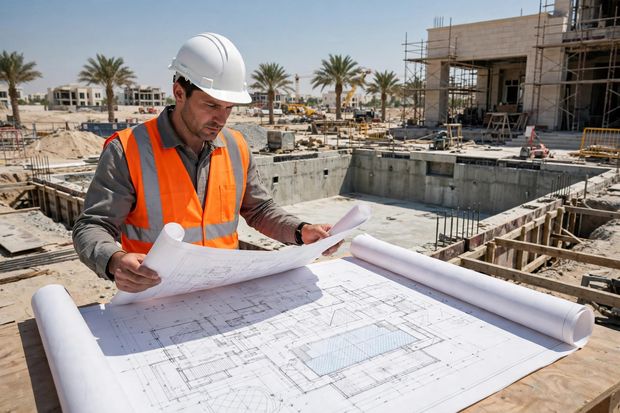
Dubai Municipality Approval, Step by Step
Approval follows a clear sequence, and knowing the steps helps you spot delays early and keeps your contractor accountable. Most of the work belongs to your consultant and contractor, not to you. Your role is to provide documents, approve the design and sign forms. A good contractor will still keep you updated at each step, because you are the one waiting on the timeline.
Step 1 — Consultant drawings
Step one is the drawing package, prepared by a licensed consultant. It covers the architectural layout and structural drawings, stamped by a licensed structural engineer. It also covers mechanical and electrical plans for filtration, lighting and heating. Finally, it lists material specifications for tiles, coping and deck finishes. The drawings must show setbacks from plot boundaries, drainage routes, safety fencing and the plant-room layout. Weak drawings are the main cause of review comments, so this step deserves time.
Step 2 — Submission through the DM BPS portal
Step two: submission through the Building Permit System portal. Only an approved consultant can submit. Your contractor’s consultant matters as much as the builder. It includes the developer NOC where required, the title deed and the drawing set. The file then enters the review queue.
Step 3 — Review, comments and resubmission
Step three is review: Dubai Municipality approves the plans or returns comments. A clean submission is commonly reviewed in five to ten working days. If comments come back, the consultant revises and resubmits, which can extend the stage to two to four weeks. Missing documents cause most delays here, so a complete first submission is worth the effort.
Step 4 — Inspection and completion certificate
Step four comes after construction. Dubai Municipality inspects the finished pool and issues a completion certificate. The inspection checks the drawings, safety provisions, drainage and equipment. Keep this certificate safe. It matters at resale, and it proves the pool was built legally.
Developer NOC: The Step Homeowners Miss Most
The developer NOC is the approval most villa owners have never heard of, and it causes the most delays. In a master-planned community, you cannot just dig a pool. The developer must agree before Dubai Municipality will process your permit. That is why the NOC comes first, not last. Each developer runs its own process. Emaar uses its community portal. Its Design Review Committee reviews any change to the villa’s appearance or structure. Nakheel and Dubai Properties have their own portals and committees. Your contractor should know your developer’s process.
What a developer NOC actually covers
The NOC confirms your pool fits the community’s rules. The review covers position and size, drainage, fencing, equipment and visual impact. It is a community check, not a building safety check. That is Dubai Municipality’s job. A community can refuse a safe pool that breaks its rules.
Setback rules and community conditions
Most communities require a setback. Emaar guides cite 1.5 metres in The Springs and The Meadows, and 2.0 metres in Dubai Hills Estate. Other communities set their own distances. Corner or elevated plots may face extra conditions. Infinity pools on elevated plots often need extra structural review for the retaining wall. Check your community’s rule before finalising the design.
Safety fencing and equipment enclosures
Safety fencing is mandatory, and the developer and Dubai Municipality both review it. Many guides cite at least 1.2 metres with a self-closing, self-latching gate. Pool equipment must sit in an approved enclosure. Visible equipment is a violation in many areas.
Emaar, Nakheel and Dubai Properties — what differs
Timelines differ too. An Emaar NOC commonly takes ten to fifteen working days. Nakheel communities often add a Trakhees step. Dubai Properties runs its own process. The documents are similar. The portals and committees differ. That is why a contractor who has worked in your community is worth more.
What Documents Do You Need?
The document list looks long, but most of it is standard. Your consultant prepares the technical drawings, and you provide the ownership and identity documents. Gathering everything before submission is the single best way to avoid the back-and-forth that stretches timelines. If any document is missing, the submission is usually returned rather than paused. That is why experienced contractors ask for the full list at the first site visit.
Drawings your consultant must prepare
The drawing set covers the pool layout, structural sections, reinforcement details, mechanical and electrical plans, drainage design and the plant-room layout. Drawings must be stamped by a licensed structural engineer, and they must show setbacks, levels, fencing and equipment positions. For infinity or overflow pools, the balance tank and extra plumbing must appear in the drawings too. Our swimming pool design team prepares this package as part of the build, so owners are not left chasing consultants themselves.
Title deed, passport and community forms
On your side, you need a copy of the title deed and passport copies for the owner. You also need the developer’s own application form where a community NOC applies. Some developers also ask for the villa’s original approved drawings, to check the pool against the existing structure. Keep copies of everything you submit, and keep the approval letters together. You will need them again at inspection and at resale.
The document checklist
Before your consultant submits, use this checklist. First, the developer NOC, where your community requires one. Second, the title deed and owner identification. Third, the full stamped drawing set, including structure, mechanical, electrical and drainage plans. Fourth, the DM Environment Department NOC application. Fifth, utility clearance requests where excavation or new connections are involved. Sixth, the developer’s community form and any community-specific drawings. Tick each one off, and ask your consultant to confirm the list in writing.
How Long Does Approval Take in Dubai?
Approval time is the question every villa owner asks first, and the honest answer is that it varies. A clean submission in a straightforward community moves fast. A submission with missing documents, or a pool in a community with a busy committee, takes longer.
Realistic timeline by stage
Design and drawings usually take two to three weeks, depending on how fast you approve the concept. The developer NOC commonly takes five to fifteen working days, with Emaar reviews often landing at ten to fifteen working days. Dubai Municipality review of a clean submission takes five to ten working days, extending to two to four weeks if comments come back. Added together, approvals commonly take four to six weeks from a complete submission to a permit in hand. Construction itself then takes roughly eight to sixteen weeks for a typical villa pool, as covered in our guide to swimming pool construction in Dubai.
Plan your project around these ranges, not around a single promised date. If a contractor guarantees approval in a fixed number of days, ask what happens if the review returns comments. Comments are normal, and a good contractor plans for them.
What causes delays — and how to avoid them
The most common delay is a missing document, so the checklist in the previous section matters. The second most common delay is a drawing that does not meet the reviewer’s standard. That is usually a setback, a drainage detail or a fencing gap. The third is a developer committee that meets on a fixed schedule, so a submission that misses one meeting waits for the next. You can avoid most delays by submitting a complete package. Check setbacks before design. Also let your contractor manage the submission, rather than splitting it across several parties.
What Happens If You Build Without a Permit?
Some owners are tempted to skip approvals to save time. It is a false saving. Dubai Municipality can issue fines and stop-work orders, and it can require changes to finished work that does not match approved drawings. A pool built without approval may need to be altered or even removed, which costs far more than the approval ever would.
Fines, stop-work orders and forced changes
If work starts without a permit, Dubai Municipality can stop it immediately. The owner then faces fines, a formal submission after the fact, and possible changes to work already done. Retrospective approval is slower and harder than approval before work starts, because the reviewer cannot check excavation or reinforcement that is already buried. In practice, the “quick” route without a permit is usually the slowest route of all.
The risk does not end when construction finishes. An unapproved pool creates problems that surface years later, often at the worst possible moment.
Resale and insurance problems later
It complicates a future sale, because buyers and their banks check approvals. It can also affect insurance, since an insurer may refuse a claim linked to unapproved work. Even a neighbour complaint can trigger an inspection that uncovers the missing permit. The completion certificate from Dubai Municipality is the document that closes all of this down. Keep it with your title deed. That is why the permit is worth treating as part of the build, not as optional paperwork.
Do Renovations and Pool Changes Need Approval Too?
Not every pool job needs a permit. A simple repair does not. But many renovations do, and the line between the two is worth knowing before work starts. The rule of thumb: if the work changes the structure, shape, drainage or safety provisions, it probably needs approval. If it only restores what is there, it usually does not.
When a renovation needs a fresh permit
A renovation needs approval when it changes the pool shell. Approval is also needed when it alters the depth or shape, moves the plant room or changes drainage. The same applies to an infinity edge, a raised wall or a new spa. A full remodel is treated like a new build, and it follows the same submission route. When in doubt, ask your contractor to confirm in writing. A five-minute check beats a stop-work order. Our swimming pool renovation guide covers the signs a pool needs renovation. This section covers approvals.
When a simple repair does not
Routine repairs do not need a fresh permit. Replacing a pump, servicing a filter, fixing a leak, or rebalancing water chemistry are maintenance, not construction. These jobs are covered by your regular pool maintenance routine, and they need no submission at all. The same applies to cleaning, chemical dosing and minor tile repairs that do not touch the shell.
Retiling, resurfacing and equipment upgrades
Retiling and resurfacing sit in the middle. A like-for-like retile with no structural change usually needs no new permit, but it may need a community notification where your developer requires one. An equipment upgrade normally needs no building permit. That covers a new pump, a salt chlorinator, a heater or a pool chiller. Electrical work must still meet safety standards, though. If the upgrade changes the plant room layout or adds a new structure, check first. Our pool renovation team confirms the approval position for every job before work starts.
Commercial and Shared Pools: Extra Rules
Private villa pools follow the path described above. Commercial and shared pools — hotels, gyms, schools, clubs, compounds — face extra rules on top of it. If you manage one of these, budget extra time and extra documents. The core difference is use. A private pool serves one family. A shared pool serves many people, so the authorities apply stricter hygiene, safety and supervision rules. Your contractor should confirm the full list for your facility type before quoting. Requirements differ between a hotel pool and a school pool.
Hygiene permits and lifeguard rules
Public and semi-public pools generally need hygiene permits as well as construction approval, plus water treatment systems, lifeguard or safety supervision, and clear signage. The Health and Safety Department’s technical guidelines set the standard, and the pool must meet it before opening. Plan for this from the design stage, because retrofitting hygiene systems after construction is costly.
Signage, depth markings and access
Commercial pools need depth markings, safety signage, controlled access and rescue equipment, all shown in the approved drawings. The fencing and gate rules are stricter than for a villa pool, and access for people with limited mobility must be considered. These details belong in the drawing package, not added after handover. A reviewer will check them. The same discipline applies to the whole approval route: confirm every requirement for your facility type at the design stage, keep the documents together, and let one contractor manage the submission from drawings to inspection. That is how a commercial pool opens on time, with every certificate in place.
How to Choose a Contractor Who Handles Approvals Properly
Approvals separate good contractors from risky ones. A good contractor treats permits as part of the job, with a named consultant, a clear document list and a realistic timeline. A risky one treats permits as your problem, or as a step to skip. Ask these five questions before you sign or pay a deposit. The answers matter more than the brochure. Bad approvals handling costs months. Good handling makes the whole build feel simple.
Five questions to ask before you sign
First, are you licensed for pool work in Dubai, and can you show it? Second, who handles the drawings and the submission — you, or me? Third, which approvals does my plot need? Have you worked in my community before? Fourth, what is in the quote — brands, tile allowance, approval work? Fifth, who maintains the pool after handover, and at what cost? A contractor who answers all five clearly has done this before.
Red flags — “no permit needed”
Walk away from any contractor who says no permit is needed and offers to start immediately. Walk away too from a quote far below everyone else’s, because the missing money usually shows up later in waterproofing, steel or equipment. And be wary of anyone who asks for a large deposit before showing you the approval plan. A proper contractor explains the approval route at the first meeting, names the consultant, and puts the timeline in writing. Our guide to swimming pool costs in Dubai explains what a proper quote should include alongside the approval work. Choose the contractor who is open about permits, and the build itself will run far more smoothly.
Who Needs Help With Permits — and Your Next Step
Permits sound complicated, but they break down into a short list of steps and a short list of documents. The hard part is knowing which steps apply to your plot, and that is exactly what a site visit settles. Whether you are building new or fixing an existing pool, the next step is the same. Get the approval position confirmed for your villa before you commit to anything. Hello Landscaping & Pools LLC handles the full approval route for villa pools across Dubai. That covers drawings, developer NOC, municipality submission and inspection. It is part of our swimming pool construction service. We work across Palm Jumeirah, Arabian Ranches, Dubai Hills Estate, Emirates Hills and Jumeirah. We also cover the wider villa communities. There, garden orientation, plot shape and community rules change everything about a pool.
New villa pools
Building a new pool? Book a site visit before finalising the design. We measure the plot, check setbacks and community rules, confirm your approval stack, and give you a realistic timeline. The visit costs nothing, and it stops the most expensive mistake: a design your community or Dubai Municipality will not approve.
Existing pools and renovations
For an existing pool, a site visit confirms whether changes need a fresh permit or can go ahead as maintenance. Retiling, resurfacing, upgrades and remodels each sit differently. The answer depends on your pool. The same visit checks the plant room, drainage and safety fencing.
Book a free site visit
Call +971 50 866 5595 or message Hello Landscaping & Pools LLC on WhatsApp to book your free site visit. We confirm your approvals, the documents, and how long it should take. Then we quote for the work. We give no fixed figures over the phone: every pool and plot is different.
Frequently Asked Questions
Do I need a permit to build a swimming pool in Dubai?
Yes. A new swimming pool needs Dubai Municipality approval before work starts, and in most master-planned communities a developer NOC comes first. Pools also need a No Objection Certificate from the Dubai Municipality Environment Department. Building without these approvals risks fines, a stop-work order, or being told to change finished work.
What is a developer NOC, and do I need one for a pool?
A developer NOC is a No Objection Certificate from the developer that manages your community — Emaar, Nakheel, Dubai Properties or another master developer. You need one if your villa sits in a master-planned community, because Dubai Municipality will not accept the submission without it. Villas on open land outside master communities usually go straight to Dubai Municipality with no developer NOC.
How long does pool permit approval take in Dubai?
For a complete submission, approvals commonly take four to six weeks in total. Design and drawings usually take two to three weeks. The developer NOC commonly takes five to fifteen working days. Dubai Municipality review commonly takes five to ten working days for a clean submission. It extends to two to four weeks if comments come back. Missing documents are the most common cause of delay.
What documents do I need for a pool permit in Dubai?
You normally need the developer NOC where your community requires one. You also need a copy of the title deed and owner identification. Finally, you need a full stamped drawing set. It covers layout, structure, mechanical and electrical plans and drainage. Your licensed consultant prepares the drawings, and the submission goes through the Dubai Municipality Building Permit System portal. The DM Environment Department NOC is applied for alongside the main submission.
Can I build a pool without Dubai Municipality approval?
No, and you should not try. Dubai Municipality can fine the owner, stop the work, and require changes to anything built without approval. Retrospective approval is slower and harder than approval before work starts, because buried work such as excavation and reinforcement cannot be inspected afterwards. An unapproved pool also creates problems at resale and with insurance.
Do I need a permit to renovate my existing pool?
It depends on the work. A full remodel, a change to the pool shell, depth or shape, or new drainage or safety structures usually needs a fresh permit. Routine repairs — pump replacement, filter servicing, leak fixes and chemical balancing — do not. Like-for-like retiling and equipment upgrades usually need no new building permit, though your developer may ask for a community notification. Ask your contractor to confirm in writing before work starts.
What are the setback rules for pools in Dubai communities?
Setback rules vary by community. In Emaar communities, guides commonly cite a minimum setback of 1.5 metres from all plot boundaries in The Springs and The Meadows, and 2.0 metres in Dubai Hills Estate. Other communities set their own distances, and corner or elevated plots may face extra conditions. Check your community’s rule before finalising the design.
Does a pool need safety fencing in Dubai?
Yes. Safety fencing is mandatory and is reviewed by both the developer and Dubai Municipality. Many community guides cite a fence of at least 1.2 metres around the pool, with a self-closing, self-latching gate. Pool equipment must also sit in an approved enclosure, because visible equipment counts as a community violation in many areas.
What is Trakhees approval, and when is it needed?
Trakhees is the planning and development authority for certain free zones and Nakheel-managed areas in Dubai. If your villa sits in one of those areas, you may need a Trakhees approval in addition to the developer NOC and the Dubai Municipality permit. Your contractor should confirm this at the design stage, because the submission route changes.
Who handles pool permits in Dubai — me or the contractor?
A good contractor handles the whole route: consultant drawings, developer NOC, municipality submission and inspection. Your role is to provide the title deed, identification and community forms, and to approve the design. Before you sign, ask the contractor to name the consultant, list the approvals your plot needs, and put the timeline in writing. If a contractor says no permit is needed, treat that as a warning sign.